
DPR Suddenly Accelerates Oil and Gas Bill Deliberation, Here Is the Explanation from Lawmakers
Jakarta, CNBC Indonesia - The House of Representatives (DPR) has taken the initiative to accelerate deliberation of the bill replacing Law No. 22 of 2001 on Oil and Gas with a new law. Discussion of the Oil and Gas Law revision has been ongoing for a long time, even for more than 10 years. But why has the DPR now suddenly accelerated the revision of the Oil and Gas Law?
Deputy Speaker of the People’s Consultative Assembly (MPR) and member of House Commission XII Eddy Soeparno explained that the Oil and Gas Law revision is a follow-up to the Constitutional Court (MK) mandate, which has annulled several articles in the previous regulation since 2012. According to him, now is the right momentum to accelerate the development of the oil and gas sector so that it is not hampered by administrative problems.
“It has long been our concern because this Oil and Gas Law revision has long been a mandate from the Constitutional Court to revise several articles because they have been annulled by the MK. Therefore, we feel that it is very important now to revise the Oil and Gas Law, especially amid the current conditions we face,” Eddy explained to CNBC Indonesia, quoted on Friday (21/8/2026).
One important point in the bill draft is the plan to establish a Special Business Entity (BUK) as an entity replacing the Special Task Force for Upstream Oil and Gas Business Activities (SKK Migas). As is known, one of the Constitutional Court rulings in 2012 dissolved the Upstream Oil and Gas Business Activities Implementing Agency (BP Migas), after which a temporary task force, SKK Migas, was formed until a permanent legal entity is determined in the Oil and Gas Law revision.
Eddy emphasised that the new institution will have a business function and be directly responsible to the President to cut bureaucratic stages. “The highlight that is the focus of many parties’ attention is the Special Business Entity BUK replacing SKK Migas. Its form, structure, and how its institutional functions and roles work are, I think, one of the focuses of attention. That is because BUK ultimately has the important task of, first, increasing our oil and gas lifting and, second, strengthening our energy security,” he said.
Another point discussed is the existence of an oil and gas development fund or Petroleum Fund to support research activities in the energy sector. Eddy is targeting the regulation to be enacted into law before the current sitting period ends in mid-October.
“We are targeting it to be completed as soon as possible, hopefully before the current sitting period ends. The current sitting period ends in mid-October, so before mid-October it should be completed. The draft has already been harmonised between the DPR Legislation Body and Commission XII,” he stressed.
Meanwhile, Deputy Chairman of House Commission XII Bambang Haryadi asserted that discussion of this regulation has actually been carried out in stages since 2015. He also views the Oil and Gas Bill as a solution to fill the legal vacuum following the dissolution of BP Migas by the Constitutional Court in late 2012.
“The Oil and Gas Bill has indeed been discussed since 2015. Following the Constitutional Court ruling at the end of 2012 which dissolved BP Migas because it was deemed contrary to the 1945 Constitution, Presidential Regulation No. 9 of 2013 was issued to fill the temporary legal vacuum by establishing SKK Migas,” he said.
Bambang explained that the fundamental difference between the new regulation and Law No. 22 of 2001 lies in the unification of the state’s control and business functions. This is considered an improvement in governance in accordance with the constitutional mandate to provide the greatest possible benefit to the people.
“The goal is clearly to implement the Constitutional Court ruling. The important point is that control and business operations must be controlled by the state. Law 22 of 2001 separated control and business operations. In this Oil and Gas Bill, they are unified in accordance with the Constitutional Court ruling,” he added.
He is optimistic that the investment climate in the upstream oil and gas sector will become more attractive to business actors. According to him, clarity of regulations regarding the management of working areas will have a direct impact on efforts to pursue national oil production targets.
“That is indeed the goal,” Bambang concluded when asked about the purpose of the law revision with the target of increasing national oil lifting.
Oil and Gas Bill Becomes DPR Initiative
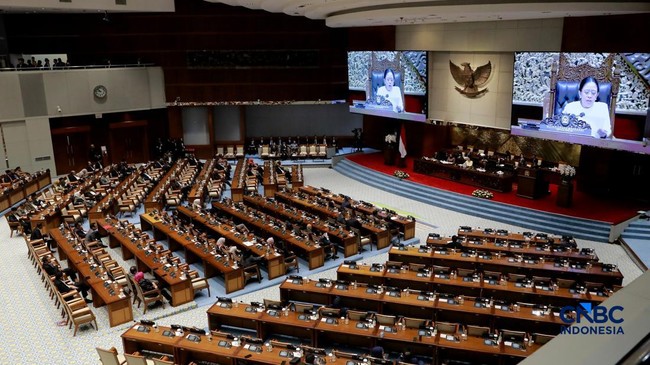
For information, the decision to revise Law No. 22 of 2001 on Oil and Gas as a new bill was taken at a DPR Plenary Meeting held at the Nusantara Building, Parliamentary Complex, Senayan, Central Jakarta, on Tuesday (18/8/2026). Present at the plenary meeting were DPR leaders, namely Speaker Puan Maharani and four deputy speakers, Sufmi Dasco Ahmad, Sari Yuliati, Saan Mustopa, and Cucun Ahmad Syamsurizal.
Initially, Saan asked for the opinions of the factions on the Oil and Gas Bill proposed as an initiative of House Commission XII. The factions’ opinions were submitted in writing. Then, Saan asked for the approval of the members present regarding the bill becoming a DPR initiative. The House members approved it.
“We ask the honourable House, can the bill proposed as an initiative of House Commission XII on Oil and Gas be approved as a DPR initiative bill?” Saan asked. “Agreed,” the House members replied.
Previously, the DPR Legislation Body approved the harmonisation of the Oil and Gas Bill. All factions approved the bill at the decision-making meeting on the results of the Oil and Gas Bill harmonisation held at the Nusantara Building, Parliamentary Complex, Senayan, Jakarta, on Saturday (15/8/2026).
Working Committee Chairman Sturman Panjaitan said the Oil and Gas Bill was agreed to become a replacement bill. The working committee also made a number of technical improvements and refinements to the bill draft.