
DPR Raid Leads to Demolition at Cibinong Prison
DPR Raid Leads to Demolition at Cibinong Prison
September 30, 2026 | 08:16 pm
TEMPO.CO, Jakarta - Members of Commission XIII of the House of Representatives (DPR) conducted a surprise inspection at the Class IIA Cibinong Correctional Facility. The brief visit resulted in the demolition of housing structures erected without being registered as state-owned assets, even as the issue surrounding these unauthorized buildings, allegedly occupied by inmates, remained under investigation.
Sugiat Santoso, Deputy Chair of Commission XIII, stated that the structures had to be torn down because their construction was illegal. “And most critically, they were built on a riverbank, which violates regulations,” Sugiat said at Cibinong Prison on Wednesday, September 30, 2026.
Another Commission XIII member, Rieke Diah Pitaloka, questioned the hasty demolition process. She argued that the teardown should have taken the ongoing investigation into account. “A premature demolition without proper documentation could be categorized as the destruction of evidence, particularly regarding the inquiry by the Ombudsman,” Rieke said at the venue.
Sugiat subsequently explained that the buildings and their contents had already been inventoried during an inspection by the Inspectorate General of the Ministry of Immigration and Corrections. The politician of the ruling party Gerindra noted that if left standing, the illegal structures would remain difficult to monitor.
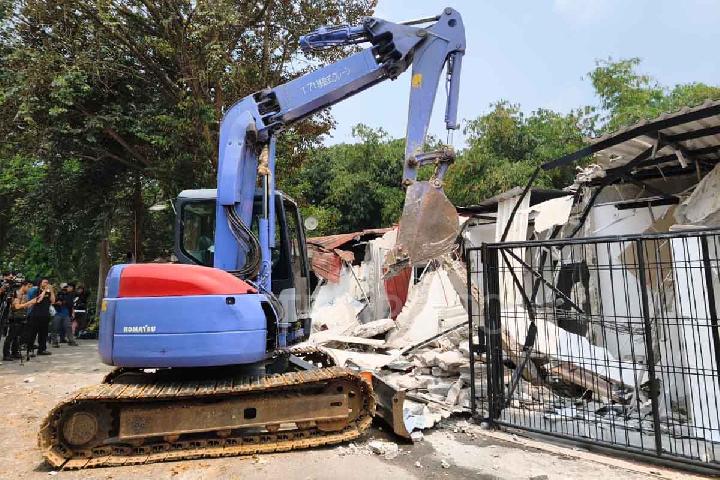
House commission leaders then instructed Director General of Corrections Mashudi to immediately dismantle the structures. During a parliamentary hearing on Monday, September 28, 2026, Mashudi acknowledged that 13 buildings at Cibinong Prison were not registered as state assets. Mashudi subsequently ordered his subordinates to tear down the buildings without delay. Officers began the operation by cutting off the electricity supply to the homes and removing furniture from inside.
Shortly thereafter, an excavator previously stationed within the prison complex moved toward the unauthorized structures. The buildings were then flattened one by one.
Brief Inspection Process
Before deciding to dismantle the unauthorized structures, lawmakers inspected the interior of the houses. Unlike during the Ombudsman’s earlier visit, the doors now bore “official residence” labels with sequential numbers.
House members discovered several items that had appeared in the Ombudsman’s inspection video, including alcoholic beverages in one house. They also spotted family photographs, which prison staff claimed belonged to officials occupying the residences.
Along with furniture and air conditioning units, children’s toys were visible in several homes. However, a photograph of Jimmy Masrin, a convict in the LPEI credit fraud case, was no longer present; Mashudi had previously claimed officers seized the photo during a raid.
Commission XIII member Yanuar Arif also pointed out an anomaly: the remnants of a CCTV camera that had been removed from one house. “What is the story here? Was this CCTV active or not? If it wasn’t active, who deactivated it? Everything must be brought to light,” Yanuar said.
Conclusion of Abuse of Power
Rudi Setiawan, Inspector General of the Ministry of Immigration and Corrections, stated that an internal investigation had reached a preliminary conclusion. He explained that the probe focused on discrepancies between the findings of the Ombudsman and those of the Directorate General of Corrections.
Rudi stated that initial findings showed construction of the unregistered buildings was not funded by the state budget. Furthermore, none of the structures had building permits.
The former West Java Police Chief claimed investigators had identified the individuals occupying the facility. However, he declined to elaborate, stating that full investigation results would be presented to the House on Monday, October 5, 2026.
“The preliminary conclusion indicates an abuse of authority under Article 5, with penalties stipulated in Article 8 of the Government Regulation,” Rudi said at Cibinong Prison on Wednesday.
According to Rudi, potential penalties for the violation range from demotion and suspension to dishonorable discharge. However, these are administrative sanctions rather than criminal charges.
Read: Ombudsman Finds Alleged Illegal Levies at Cibinong Prison
Click here to get the latest news updates from Tempo on Google News