
DPR Promises to Pass Asset Forfeiture Bill by 15 December at the Latest
The Indonesian House of Representatives (DPR) has pledged to pass the Asset Forfeiture Bill into law by 15 December 2026 at the latest.
The promise was made to coincide with a demonstration by the Pati United Community Alliance (AMPB) and others demanding the enactment of the regulation, in front of the DPR building in Jakarta on Thursday (27/8).
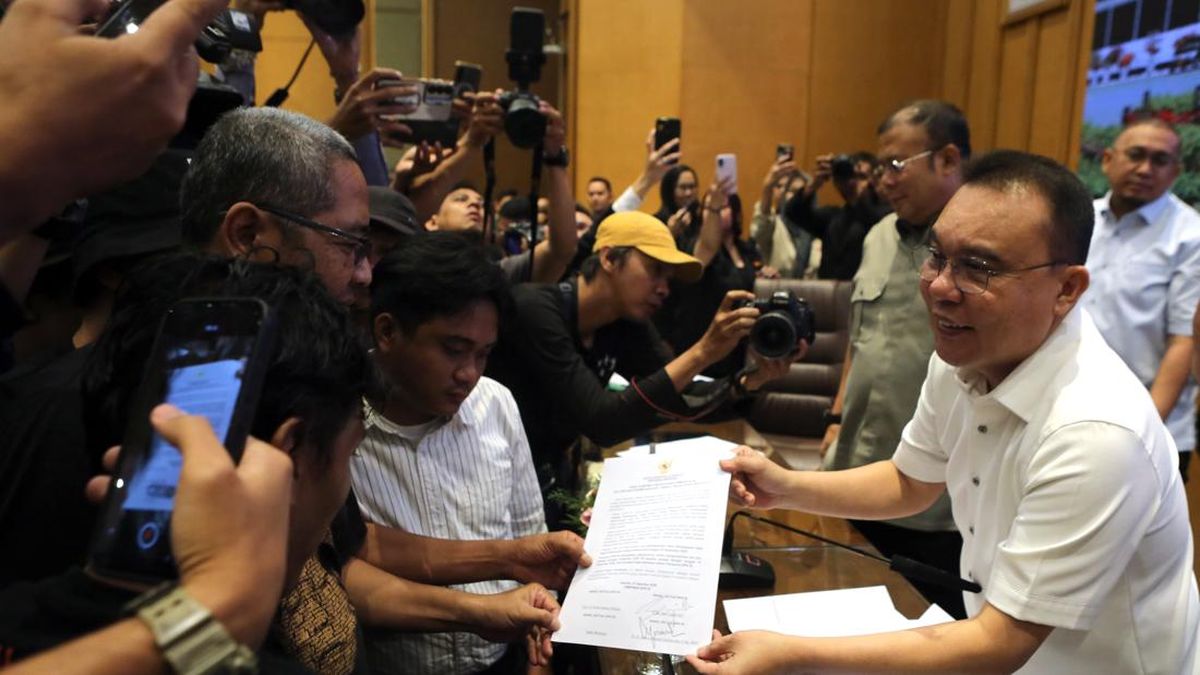
DPR leaders held an audience with AMPB representatives inside the parliament building during a break in the plenary session.
The three DPR leaders present on that occasion were Sufmi Dasco Ahmad, Cucu Ahmad Syamsurizal, and Saan Mustopa.
“The plenary session earlier conveyed, agreed and approved that the latest deadline for the signing of the Asset Forfeiture Law will be passed at the plenary session on 15 December 2026,” said Dasco during the meeting.
As a form of commitment to the enactment, the DPR leaders signed a letter of agreement stating their readiness to resign if the agreement is not realised.
The letter states that the DPR leaders are not only prepared to resign from their positions, but also as members of the council. The three leaders signed the letter together with AMPB Coordinator Supriyoni, also known as Botok Pati.
“Alhamdulillah, the result of the audience with the DPR RI leadership is that the DPR RI leadership has stated that the Corruptor Asset Forfeiture Bill will be passed by 15 December at the latest. If it is not passed by 15 December 2026, the DPR leadership and their ranks are ready to resign from their positions as leaders or members of the DPR,” said Botok.
Civil society coalition notes
The Civil Society Coalition has asked the DPR and the government to open the draft and the Problem Inventory List (DIM) of the Asset Forfeiture Bill.
This civil coalition consists of a number of organisations such as Indonesia Corruption Watch, Auriga, Kaoem Telapak, the Centre for Law and Policy Studies (PSHK), the Anti-Corruption Study Centre (SAKSI) of the Faculty of Law at Mulawarman University, and Transparency International Indonesia.
The civil coalition has identified at least three substantive points that are important issues in the circulating DPR version draft dated 10 July 2026 compared to the government’s draft.
First, the coalition suspects that the DPR has removed the norm relating to illicit enrichment. Article 5 paragraph (2) of the government’s 2023 draft contains provisions for the forfeiture of assets that are disproportionate to income and whose origins cannot be legally proven.
This provision is suspected to have been removed from the DPR version of the draft.
In fact, this instrument is a part that can target the wealth of public officials that is not commensurate with their official income.
In a number of corruption cases, there are indications that suspects arrested by law enforcement have unreasonable wealth based on the State Officials’ Wealth Report (LHKPN).
Second, the coalition suspects that the DPR has narrowed the scope of non-conviction based (NCB) forfeiture.
The DPR draft regulates NCB in Article 3 letter b, with the conditions detailed in Article 6: the perpetrator has died, fled, is permanently ill, or the case cannot be brought to trial.
The problem, according to the coalition, is that all asset objects in Article 5 are always linked to the perpetrator of a criminal act. As a result, NCB in the DPR draft in practice can only be used when the perpetrator is already known but cannot be prosecuted, and it becomes unclear whether it can be used to seize assets that have failed to be executed or unclaimed assets.
This differs from the government’s version of the draft.
Article 5 paragraph (1) letter d explicitly targets the proceeds of crime whose perpetrator or owner is unknown, with examples of illegal logging timber and online gambling proceeds in the explanatory section.
The clarity of this scope is considered important so that NCB does not stop at the concept, but can truly reach assets that have so far escaped the criminal process.
Third, the coalition suspects that the DPR has left the institutional management of assets hanging without a clear responsible party.
The government’s 2023 draft has established a single responsible party, namely the Attorney General as the asset manager in accordance with Article 50. Meanwhile, the details of duties (Article 51), a transparent asset information system (Article 60), and periodic reporting (Article 61) are also included in the government’s draft.
The DPR draft actually dismantles this clarity.
Source: jawawa.id (https://jawawa.id/newsitem/dpr-promises-to-pass-asset-forfeiture-bill-by-15-december-at-the-latest-1787889109)
Originally published by CNN Indonesia (https://www.cnnindonesia.com/nasional/20260828060548-32-1397185/janji-dpr-sahkan-ruu-perampasan-aset-maksimal-15-desember), translated from Indonesian