
DPR Passes Satu Data Indonesia Bill into Law
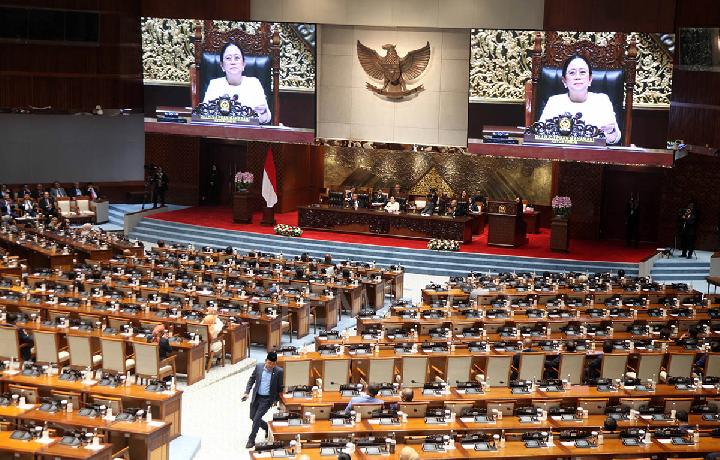
TEMPO.CO, Jakarta - The House of Representatives (DPR) officially passed the Satu Data Indonesia (One Data Indonesia) bill into law during a plenary session. The passage followed unanimous agreement from all eight parliamentary factions on the first-level discussion report compiled by the DPR Legislative Body (Baleg) and the government.
DPR Speaker Puan Maharani presided over the decision-making process. Upon hearing the report from Baleg, Puan sought final approval from all lawmakers present.
“Thank you to the leadership of the Legislative Body of the DPR for presenting the report on the discussion results of this bill. Now we ask each faction whether the Satu Data Indonesia Bill can be approved to be enacted into law. Agreed?” said Puan in the 9th plenary meeting of the first session of the 2026-2027 legislative year at the Nusantara II Building of the DPR, Jakarta, on Tuesday, October 6, 2026.
Lawmakers in attendance unanimously answered with a resounding “agreed.”
Prior to the decision, Sturman Panjaitan, Chair of the Working Committee (Panja) for the bill, presented a report on the intensive deliberations held from September 23 to October 5, 2026. The discussions covered 1,338 problem inventory lists (DIM) from the legislative body and 829 explanatory DIMs submitted by the government.
The Indonesian Democratic Party of Struggle (PDI-P) politician stated that the bill aims to bolster national data governance so that it becomes integrated, up-to-date, accurate, and sovereign. He underscored how flawed data can severely undermine public policy and distort the distribution of social assistance.
“When data is incorrect, it’s not just the numbers that are wrong, but justice is harmed, and assistance is misdirected,” said Sturman.
He clarified that the law does not aim to centralize all physical databases under a single institution, but rather to standardize data governance from central ministries down to village administrations.
“Satu Data reflects the spirit of unity in diversity within data governance across various agencies, from ministries to village governments. However, the standards are singular, the metadata is singular, the reference codes are singular, the master data is singular so that data can communicate with each other from different sources but hold one truth,” Sturman stated.
Sturman noted that extending data governance to the village level is critical, as villages serve as the primary source of initial data generation. “Indonesia will not shine because of a large torch in Jakarta. But Indonesia will only shine because of the candles in the villages. One data Indonesia will not be meaningful if it only shines in the center; it must ignite in every village,” he said.
Concluding his report, Sturman emphasized that the philosophy driving the law is the protection and prosperity of the public. “Data is for the people, not the people for the data,” Sturman said.
The Satu Data Indonesia Law comprises 20 chapters and 141 articles. Key provisions cover the establishment of National Basic Data (DDN), the creation of a One Data operating body reporting directly to the President, the implementation of a national data catalog system, and data interoperability principles that retain physical database ownership with original entities.
In addition to governance, the law lays out stringent penalties for data manipulation and cybercrime under Articles 129 through 135. DPR Baleg Deputy Chair Martin Manurung explained that acts of cyberattack, sabotage, manipulation, and unauthorized control over national data centers or technical infrastructure carry heavy criminal sanctions. “Offenders face up to 15 years in prison or a maximum fine under Category 8,” Martin said.
He added that under Article 134, penalties are increased by one-third if the offense is committed by state officials or public administrators. Meanwhile, corporate liabilities and sanctions are outlined under a separate clause. “Article 135 specifically addresses criminal liabilities for corporations and corporate executives,” Martin stated at the DPR Complex on October 5, 2026.
Read: Indonesia Pilots Buffet-Style Free Nutritious Meal Program in Schools
Click here to get the latest news updates from Tempo on Google News