
DPR Opens Possibility of Revising the State of Danger Law at Constitutional Court Hearing
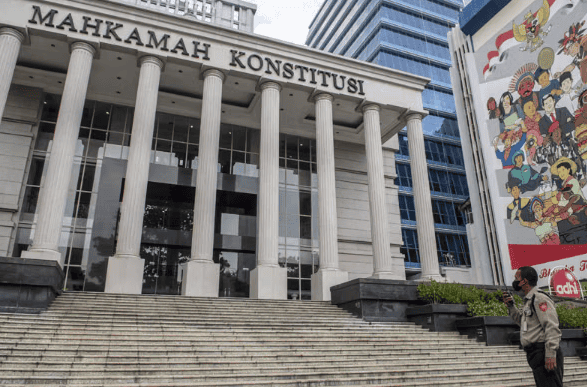
The House of Representatives (DPR) has opened the possibility of amending Law Number 23/Prp/1959 regarding the Declaration of a State of Emergency, in response to developments in Indonesia’s legal and constitutional systems. This stance was conveyed by the DPR during a judicial review hearing at the Constitutional Court on Thursday.
In the hearing for case Number 151/PUUD-XXIV/2026, the DPR emphasised that regulations regarding a state of emergency are still necessary to serve as a guideline for the government when facing extraordinary conditions that threaten national safety. However, the DPR also acknowledged the need to consider various inputs emerging from the public.
Member of Commission III of the DPR, Sarifudin Sudding, stated that the House will closely examine various legal developments, including those arising from the judicial review process at the Constitutional Court.
“The existence of the law in question is still necessary to serve as a guideline and to set boundaries for the authority of government officials in making state policies. However, the DPR RI is certainly paying attention to legal developments, constitutional dynamics, and public input through this judicial review. These factors will be considered by the DPR RI in improving the provisions of the law in the future,” said Sarifudin.
According to the DPR, changes in the names or forms of state institutions following the Reformation era do not automatically render the provisions of the law irrelevant. The critical factor is that the governmental functions regulated by these norms are still being carried out within the current constitutional system.
The DPR also emphasised that the decision to declare a state of emergency cannot be made arbitrarily. Such a decision must have a legal basis, clear requirements, and be held accountable.
“The decision regarding a state of emergency is not an action that falls entirely within the realm of free discretion, but rather a constitutional decision that possesses a basis, requirements, and legal consequences that can be assessed based on applicable legal instruments,” said Sarifudin.
Furthermore, he noted that the DPR retains several legal instruments to demand accountability from the government should emergency powers be misused.
“The DPR RI maintains other legislative instruments to hold the government accountable. This is to ensure that every use of authority is conducted in accordance with the law and does not exceed the purposes authorised by the Constitution,” he added.
Meanwhile, the government has requested the Court to maintain the provisions regulating the duration of a state of emergency. Expert Staff to the Minister for Economic and Social Affairs at the Ministry of Law, Wisnu Nugroho Dewanto, explained that the duration of an emergency is not rigidly determined because the nature of emergencies is difficult to predict from the outset. According to Wisnu, the principle applied is that an emergency must be terminated immediately once the conditions necessitating its declaration have ceased.
“The constitutional implementation of a state of emergency can only be carried out if there are conditions that meet the requirements specified in the legislation, and its continuity must always be based on the actual need to address the circumstances that prompted its declaration,” said Wisnu.
He also emphasised that all government actions during an emergency must remain subject to the principles of the rule of law. “All actions taken based on Article 33 of the law in question must remain grounded in the principles of the rule of law, the principle of legality, the principle of proportionality, and the very purpose of the emergency administration itself, which is to protect the safety of the nation, the state, and the community,” he stated.
Previously, this lawsuit was filed by six petitioners who argued that several provisions in the Law on the Declaration of a State of Emergency are no longer compatible with the constitutional system following the amendments to the 1945 Constitution. One of their primary objections is the lack of oversight functions by the DPR when a state of emergency status is in effect.
The petitioners argued that parliamentary oversight is essential to prevent the abuse of power by the government during the implementation of emergency status. They cited examples of other countries that involve legislative bodies in supervising the execution of emergency measures.
Through their petition, the applicants are requesting the Constitutional Court to order the DPR to amend the Law on the Declaration of a State of Emergency within six months of the ruling. If no amendments are made, they request that the law be declared permanently in conflict with the 1945 Constitution.
Source: jawawa.id (https://jawawa.id/newsitem/dpr-opens-possibility-of-revising-the-state-of-danger-law-at-constitutional-court-hearing-1782384665)
Originally published by Media Indonesia (https://mediaindonesia.com/politik-dan-hukum/904286/di-sidang-mk-dpr-buka-peluang-revisi-uu-keadaan-bahaya), translated from Indonesian