
DPR Legislative Body Agrees to Bring Indonesia One Data Bill to Plenary Session
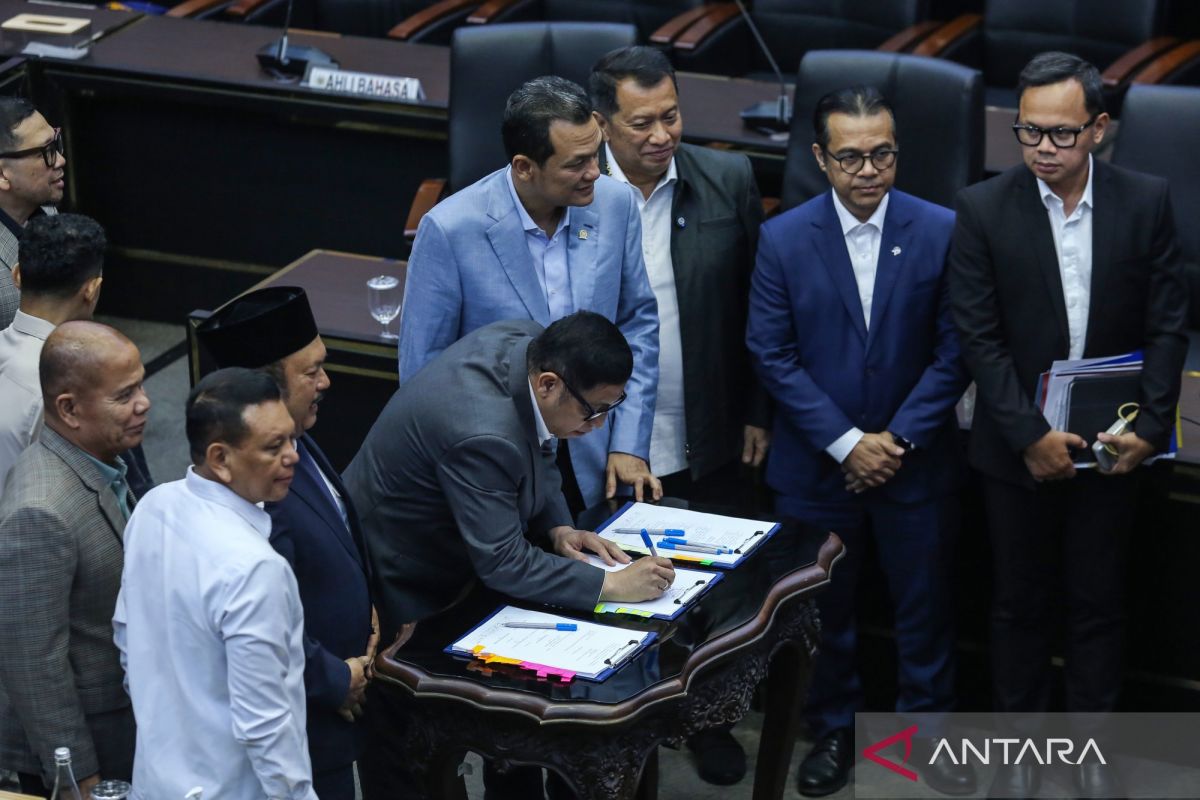
Jakarta (ANTARA) - The Legislative Body (Balag) of the Indonesian House of Representatives (DPR RI) has agreed to bring the results of the discussions on the Indonesia One Data Bill (RUU SDI) to the DPR RI plenary session on Tuesday (6/10) for a final decision.
“Can the results of the SDI Bill discussions be processed further in accordance with laws and regulations?” asked the Chairman of the DPR RI Legislative Body, Bob Hasan, during a meeting at the DPR RI Building, Jakarta, on Monday, which was subsequently approved by legislators and government representatives.
The Deputy Chairman of the Legislative Body and Chairman of the SDI Bill Working Committee (Panja), Sturman Panjaitan, explained that the discussion of the List of Problem Inventories (DIM) for the Bill was conducted intensively, prioritising the principles of transparency and public participation.
He stated that the discussions resulted in several important and strategic materials, such as the regulation of National Basic Data (DDN) controlled by the state, which serves as the primary reference for development planning, fiscal policy and budgeting, the distribution of social assistance, and other strategic national needs.
In terms of institutional aspects, the SDI Bill regulates the formation of SDI administration responsible to the President, replacing the Indonesia One Data Agency.
This administrative body will have a coordinative, normative, and facilitative nature in coordinating data supervisors, data producers, and data guardians.
The SDI Bill also regulates the division of authority between the central government, regional governments, and villages or sub-districts in producing and managing data.
Furthermore, regulations regarding data standards, metadata, reference codes, and/or master data, as well as a national data catalogue system, must be implemented by all data producers and data guardians without centralising data control within a single institution.
Regarding the use and control of data access, the Bill regulates the imposition of fees for limited data access as non-tax state revenue (PNBP). Additionally, the access and transfer of data outside Indonesian jurisdiction must obtain approval from the DPR in the case of closed data.
Public participation is also strengthened through the provision of input, reporting of alleged data misuse, participatory oversight, and voluntary data contributions.
Meanwhile, for dispute resolution, the SDI Bill prioritises non-litigation mechanisms, with a mediation period of a maximum of 14 working days, which can be extended for an additional 14 working days.
On the other hand, the Bill also contains administrative sanctions, criminal provisions, and transitional provisions to ensure compliance and the sustainability of SDI administration.
“After all the DIMs were discussed intensively, the SDI Bill was agreed upon in the working committee meeting, consisting of 20 chapters and containing 141 articles,” said Sturman.