
DPR Hajj Oversight Committee: Mina Issues Must Not Be Allowed to Recur Without Solutions
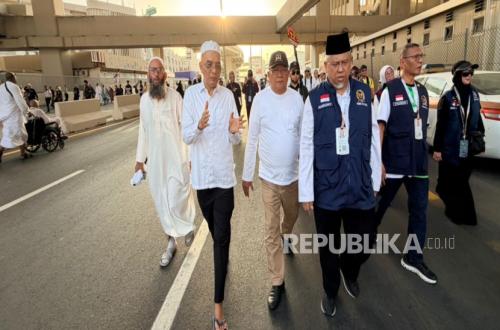
Overcrowding of pilgrims in Mina has once again drawn attention during the 1447 Hijriyah/2026 Hajj pilgrimage. While the overall execution of this year’s Hajj was deemed successful, limited space and facilities in the Mina area remain a challenge directly experienced by Indonesian pilgrims.
Marwan Dasopang, Chairman of the House of Representatives’ Commission VIII and member of the DPR Hajj Oversight Committee, stated that the issue cannot be left unresolved without long-term solutions.
According to Marwan, the overall stages of this year’s Hajj were conducted according to schedule and deserve appreciation. He noted that services for pilgrims were good from arrival to the peak of the pilgrimage.
“The overall Hajj management was successful. The initial stages through to the peak of the pilgrimage proceeded as scheduled. We should appreciate all parties who worked hard to serve the pilgrims. However, conditions in Mina remain the main challenge,” said the PKB faction politician in a statement cited on Saturday, 30 May 2026.
Marwan explained that the limited capacity of the Mina area makes overcrowding unavoidable, particularly when millions of pilgrims from various countries gather simultaneously for mabit and the stoning of the jamarat.
As a result, pilgrims’ movement is restricted and comfort levels decline. In addition to space issues, the DPR Hajj Oversight Committee received reports about suboptimal basic facilities. Some pilgrims complained about air conditioning (AC) not functioning properly and inadequate water supply at certain points.
“We have received various inputs regarding facilities in Mina. Issues include AC not working optimally, insufficient water supply, and other challenges arising from high pilgrim density in a very limited area,” he said.
According to Marwan, the Mina issue requires a more progressive approach. If expanding the Mina area is no longer possible due to land constraints, the government should consider alternatives such as tiered tents.
“We must start thinking of new formulas. If the Mina area cannot be expanded, options like tiered tents or other schemes that allow more space for pilgrims must be considered,” he said.
Alongside physical infrastructure, the DPR Hajj Oversight Committee is pushing to optimise the tanazul scheme as a solution to reduce overcrowding. Under this scheme, some pilgrims would not stay in Mina tents but return to designated hotels with special arrangements.
Marwan estimated around 60,000 Indonesian pilgrims could participate in the scheme as their hotels are suitable for mobilisation to the pilgrimage sites.
“Of the approximately 201,000 Indonesian pilgrims, around 60,000 could potentially stay in hotels with proper arrangements while still meeting regulations. If implemented, this would free up more space in Mina for those remaining in tents,” he explained.
However, he noted that implementing the tanazul scheme or new facilities requires thorough studies, meticulous organisation, and intense communication with the Saudi Arabian government.
Therefore, he hopes the Indonesian Ministry of Hajj and Umrah will strengthen negotiation and coordination efforts to find a permanent solution for the Mina issue. He acknowledged it is not an easy task, requiring strong coordination, regulatory support, and intense communication with the Saudi government.
“However, the Mina issue must not be allowed to recur without solutions. We must be bold in seeking breakthroughs to enhance the comfort and safety of Indonesian pilgrims,” he stressed.