
DPR, Government, and BI Agree on Policy Package to Safeguard Economy Amid Global Uncertainty
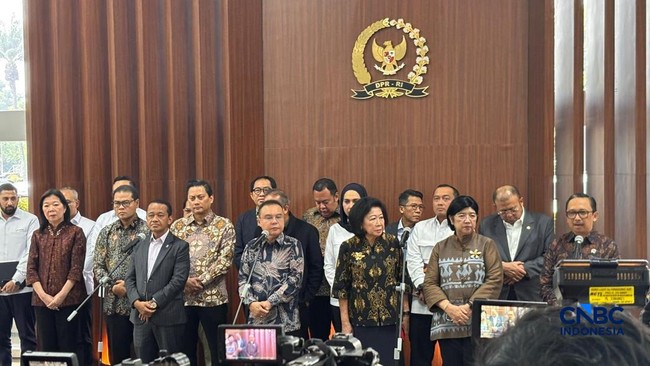
Jakarta, CNBC Indonesia - Leaders of the Indonesian House of Representatives (DPR) held a special meeting on Monday (29/6/2026) with key officials responsible for maintaining the nation’s economic stability and growth. Attendees included Deputy Speaker of the DPR Sufmi Dasco, Chairman of Commission XI Mukhamad Misbakhun, and Chairman of the Budget Committee Said Abdullah. Representing the government were Deputy Minister of Finance Juda Agung, Bank Indonesia (BI) Senior Deputy Governor Destry Damayanti, and Deputy Chair of the National Economic Council (DEN) Mari Elka Pangestu. Following the meeting, Dasco stated that the gathering was a coordination session between the government and the DPR to sustain Indonesia’s economic growth trend amidst ongoing global economic uncertainty. “Today we held a coordination meeting for economic growth as well as a meeting to mitigate several issues that have arisen recently,” Dasco said during a press briefing. The government, represented by the Ministry of Finance and the National Economic Council, together with Bank Indonesia, has established a commitment to implement a series of policy solutions to face economic uncertainty.
Wakil Ketua DEN Mari Elka Pangestu said that all parties agreed the government needs a policy response focused on maintaining public purchasing power in the short term. She noted that the current global economic uncertainty is primarily triggered by volatility in strategic commodity prices, such as crude oil due to conflicts in the Middle East. This issue, she stressed, could trigger inflationary pressures that ultimately erode public purchasing power. “I believe an agreement was reached that the priority is maintaining short-term macroeconomic stability because we are already seeing the impact of global uncertainty, for example, rising oil prices and their impact on inflation and public purchasing power. So this is the priority for maintaining macro stability,” Mari stated. She added that achieving macroeconomic stability requires both fiscal and monetary measures, including coordination between the two. This is where the central bank and the Ministry of Finance play a role in formulating policies to protect public purchasing power. Mari also noted that the government and monetary authorities need to address the issue of strengthening investor confidence, particularly as its impact is clearly visible on the rupiah exchange rate against the US dollar. “The rupiah’s depreciation is greater than that of our peers, meaning we must be vigilant about maintaining confidence and trust, which is inseparable from the policies adopted by each responsible institution,” Mari said.
BI Senior Deputy Governor Destry Damayanti stated that to accommodate macro stability issues, BI has focused on maintaining sufficient liquidity in the economic system. “If we look at the end of May, our expansion was around Rp 600 trillion, and by the end of June, we have expanded to Rp 1,000 trillion, specifically to maintain liquidity so that there are no price shocks in our money and foreign exchange markets,” Destry explained. To specifically maintain exchange rate stability, BI has adjusted its monetary policy by raising the BI rate by 100 basis points to its current level of 5.75%. Additionally, BI has made efforts to adjust the pricing of monetary operation instruments to absorb incoming foreign capital flows, aiming to maintain investor confidence in the domestic financial market. “In one month, during June, there has been a significant inflow, so that year-to-date from January to 26 June, the inflow into our government bond and SRBI portfolios has reached approximately USD 9 billion,” she detailed.
From the Ministry of Finance, the focus is on keeping fiscal stability under control within the safe limits stipulated by the State Finance Law, such as maintaining the budget deficit at around 3% of GDP. “The fiscal condition is still very well maintained. The deficit until May was 0.7% and is estimated to remain below 3% by year-end, so it is still very safe,” said Deputy Minister of Finance Juda Agung. A healthy state budget is crucial for maintaining public economic stability amidst high global uncertainty. With fiscal stability maintained, the government can also contribute to ensuring liquidity in the economic system so that Indonesia can sustain its growth trend. One effort to maintain liquidity is the placement of Rp 281 trillion in funds with the Association of State-Owned Banks (Himbara). An additional Rp 100 trillion has also been prepared in case banks suddenly require it. “After evaluation, it was concluded that the government funds in banks will be returned, the previous Rp 281 trillion will be returned and extended until the end of 2026, December 2026,” Juda explained. “In addition, there is an extra Rp 100 trillion on standby in case it is needed and banks still require liquidity to channel credit,” he stressed. Juda said the Ministry of Finance’s contribution to maintaining liquidity is necessary because banks have indicated that credit growth needs to be sustained to support economic activity. “Because information from banks indicates that credit demand is still quite high, but liquidity needs to be maintained so banks can channel credit growth,” Juda said. “It is estimated that in May, credit grew by 11.5%. We hope credit growth will remain in double digits in the coming months.”
Source: jawawa.id (https://jawawa.id/newsitem/dpr-government-and-bi-agree-on-policy-package-to-safeguard-economy-amid-global-uncertainty-1782719462)
Originally published by CNBC Indonesia (https://www.cnbcindonesia.com/news/20260629123026-4-746488/dipimpin-dasco-ini-hasil-lengkap-rapat-dpr-den-kemenkeu-bi), translated from Indonesian