
DPR Explains Arguments Regarding Detention Provisions in New Criminal Procedure Code at Constitutional Court Hearing
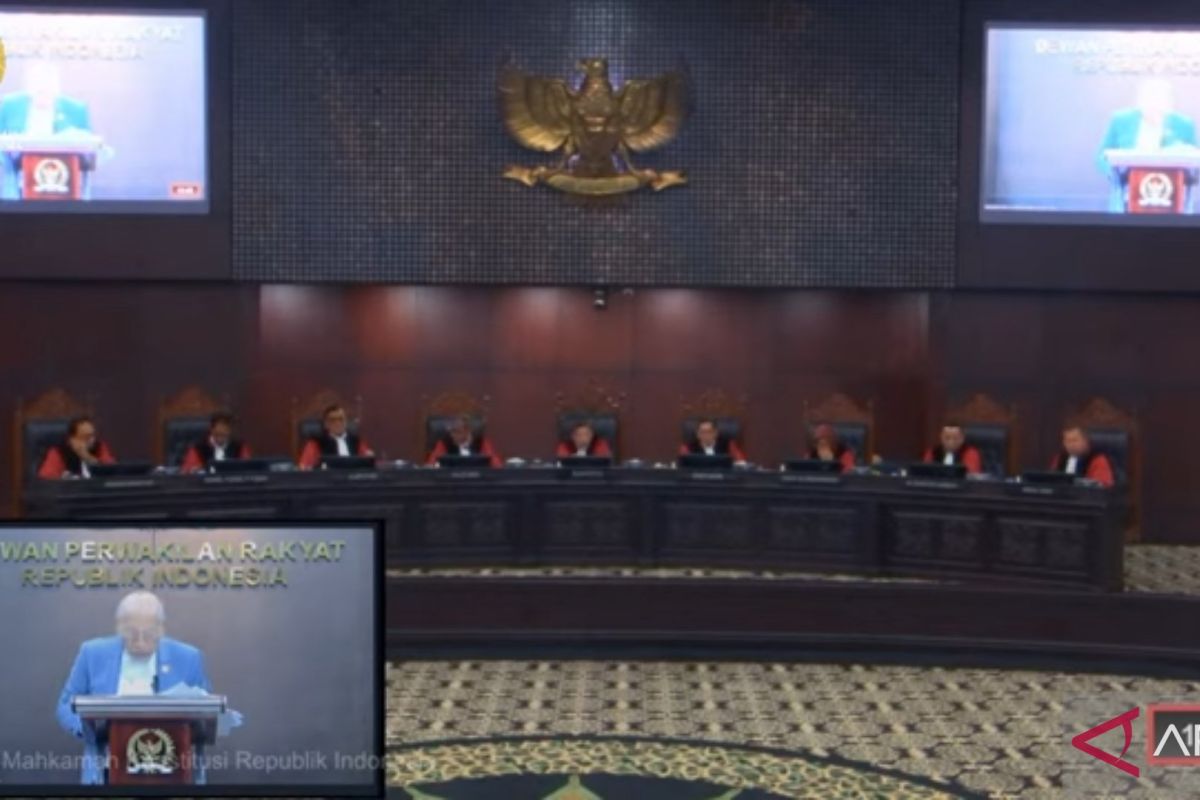
Jakarta (ANTARA) - Legal counsel for the Indonesian House of Representatives (DPR RI), I Wayan Sudirta, has explained the arguments regarding detention as regulated in Article 100, paragraph (5) of the new Criminal Procedure Code (KUHAP), which is currently undergoing judicial review at the Constitutional Court (MK).
According to the trial minutes of petition number 285/PUU-XXIV/2026 on the official MK website, Wayan stated that the regulation in Article 100, paragraph (5) of the new KUHAP (KUHAP 2025) requires detention to be implemented if there is evidence of acts, active measures, or bad faith by a suspect and/or defendant that could potentially disrupt or obstruct the legal process, such as intentionally ignoring summons, providing misleading information, or illegally obstructing the examination process.
“Theoretically, detention is not intended as a procedural action to prevent the emergence of risks that could frustrate investigations, prosecutions, court examinations, or the execution of judgements,” said Wayan.
He explained that detention under the new KUHAP is preventive in nature, meaning it is expected to prevent risks to the judicial process.
He stated that detention is not carried out to retaliate against a suspect’s actions or to declare someone guilty prematurely, but rather to prevent suspects or defendants from performing actions that could frustrate the examination of a case, such as providing information that does not align with the facts or hindering the examination process.
According to Wayan, this provision is consistent with the United Nations Human Rights commitment in General Comment No. 35 regarding Article 9 of the International Covenant on Civil and Political Rights (ICCPR). Essentially, he noted, pre-trial detention must be based on an individualised, reasonable, and truly necessary determination, including to prevent interference with the integrity of the evidence, thereby remaining within the scope of legitimate detention purposes according to those standards.
Furthermore, in principle, the norm in question does not infringe upon the petitioner’s right to security or protection from threats of fear. The norm is directed at suspects or defendants and not at the petitioner in their capacity as an advocate or legal aid provider accompanying them; therefore, there is no expansion of the subject of the norm regarding the performance of the petitioner’s profession.
“On the contrary, KUHAP 2025 actually strengthens the position of advocates, including through the guarantee of the suspect’s or defendant’s right to choose, contact, and obtain legal assistance from an advocate at every stage of the examination,” said Wayan.
During the hearing held on Thursday (10/9), the Constitutional Court heard testimony from the DPR’s legal counsel regarding the judicial review of Law Number 20 of 2025 concerning the KUHAP, as requested by Rio Andre Winter Siahaan.
The petitioner, who practices as an advocate, is testing the constitutionality of Article 100, paragraph (5) letters b and c of the KUHAP against Article 28D, paragraph (1) and Article 28G, paragraph (1) of the 1945 Constitution.
In the preliminary hearing at the MK on Tuesday (4/8), the petitioner argued that the construction of Article 100, paragraph (5) letters b and c of the new KUHAP creates room for interpretation by law enforcement to declare that suspects/defendants who attempt to defend themselves, deny allegations, or present non-incriminating information are providing information that does not align with the facts, thereby fulfilling the grounds for detention.