
DPR: Current Pertamax Fuel Price Not Yet at Full Economic Value
Commission XII of the Indonesian House of Representatives (DPR RI) has scrutinised the pricing policy for non-subsidised fuel, specifically Pertamax, which is considered to still be below its economic value. This indicates government intervention in maintaining energy price stability, even though the product’s status follows market mechanisms by regulation.
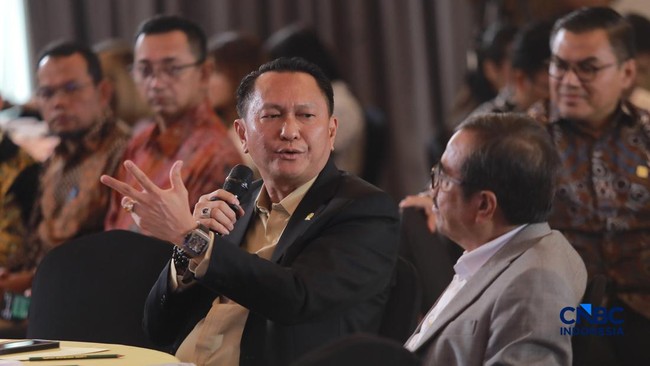
Commission XII Chairman Bambang Patijaya explained that, based on his calculations, the current selling price of Pertamax does not yet fully correspond to the market price. He stated that the government continues to pay attention to the purchasing power of the middle class so that they are not burdened by drastic spikes in global oil prices.
“Actually, this is a market mechanism, but we must be open. I have to ask our friends at Pertamina, for RON 92 on 10 June, what was your capital? It was US$1.1 per litre. If we convert to rupiah, it is around Rp 19,000 to Rp 20,000. However, the government, through the Minister of Energy and Mineral Resources, has stipulated that they may only sell Pertamax for Rp 16,250 in the regions,” he stated during the CNBC Indonesia Energy Forum in Jakarta, cited on Tuesday (30/6/2026).
Bambang assessed that the disparity between the capital cost and the selling price at petrol stations proves that Pertamina is not allowed to freely release prices following global dynamics. According to him, this intervention is carried out to balance fiscal resilience and economic stability amidst geopolitical uncertainty.
“This means that actually, even for non-subsidised prices, Pertamina is not allowed to sell at the full economic price. The public must know that for non-subsidised goods, the government intervenes. This commodity is not simply left alone,” he added.
He also expressed appreciation for the government’s steps in securing the national energy stock, including the assignment of Lemigas as a Public Service Agency (BLU) to assist in crude oil procurement. This synergy is seen as strengthening Indonesia’s position, which now ranks second as the country with the best energy security according to JP Morgan.
“We see that the overall aggregation of policy measures taken by the government is capable of guaranteeing supply availability. It is certain that the need for subsidised fuel is secure until the end of the year, 31 December,” he continued.
Regarding energy self-sufficiency efforts, his party fully supports the implementation of the mandatory 50% biodiesel programme, or B50, which comes into effect tomorrow, 1 July 2026. This step positions Indonesia as a global pioneer in utilising domestic resources to reduce dependence on fossil fuels.
“Furthermore, the government’s policy has long been reflected in how, in order to support the energy transition, we optimise the resources we have, for example B40 which will become B50. This is extraordinary. No other country in the world is implementing this today,” he concluded.