
DPR Commission III Public Hearing: Universitas Pancasila Professor Outlines Five Objects for Asset Forfeiture Bill
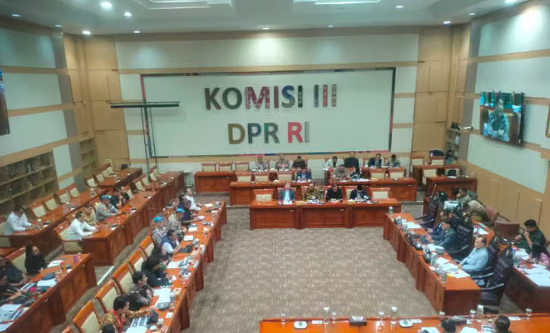
Professor Agus Surono, a Professor of Law at Universitas Pancasila, has asserted that the fundamental framework for drafting the Asset Forfeiture Bill must be based entirely on proof of criminal connection.
Agus highlighted the importance of caution for legislators in selecting which objects can be seized by the state, in order to avoid arbitrary actions against the private property of citizens.
“Asset forfeiture is an instrument for reclaiming assets that must be linked to criminal acts. Assets that were obtained legally must not be seized for any reason,” Agus stated during a Public Hearing (RDPU) with Commission III of the Indonesian House of Representatives (DPR RI) at the Parliament Complex, Senayan, Jakarta, on Monday (14/9).
He emphasised that a crucial boundary in this regulation is the absolute protection of legitimate assets, which should not be seized solely based on the legal status of the owner.
Agus outlined five objects that can be legitimately and proportionally categorised for inclusion in the Asset Forfeability Bill. First, property or economic value obtained directly from criminal activities. Second, assets used as supporting means or instruments for executing criminal acts, as established in the Criminal Code (KUHP), the Criminal Procedure Code (KUHAP), or the Anti-Corruption Law (UU Tipikor).
Third, the results of conversion, transfer, or changes in the form of criminal proceeds that require in-depth asset tracing. Fourth, all added value or financial profits that are legally proven to flow directly from criminal acts.
Fifth, other property belonging to the perpetrator that may be seized if the primary evidence or criminal proceeds have been lost, destroyed, or transferred to another party, provided there are clear legal conditions and criteria.
During the session, Agus touched upon the track record of law enforcement practices in Indonesia, which he believes has previously slipped into disproportionate asset seizures. He cited an example involving a corruption case involving a former Head of the National Police Traffic Corps (Kakorlantas Polri).
In that case, personal goods or wealth were seized by the state despite there being no evidence presented in court linking them to the alleged criminal act.
“There is one case that I believe the honourable members are aware of, the Kakorlantas case. Assets were seized even though there was no connection to a criminal act. This serves as a note that must be addressed; legitimate property must still be granted legal protection,” he continued.
Therefore, Agus requested that Commission III of the DPR RI and the government ensure that the norms in the upcoming draft of the Asset Forfeiture Bill can guarantee the principles of legal certainty and the protection of property rights protected by law.
He warned the DPR not to rush the implementation of the full Asset Forfeiture Bill draft if it ultimately creates new legal loopholes or implementation difficulties on the ground.
[Note: The text also mentions perspectives from other figures, including suggestions to include online gambling in the bill and the proposal of 13 types of crimes, including tax crimes, to be covered under the regulation.]