
DPR Closes Parliamentary Session as Puan Highlights Prison Governance and Fixed-Term Contracts
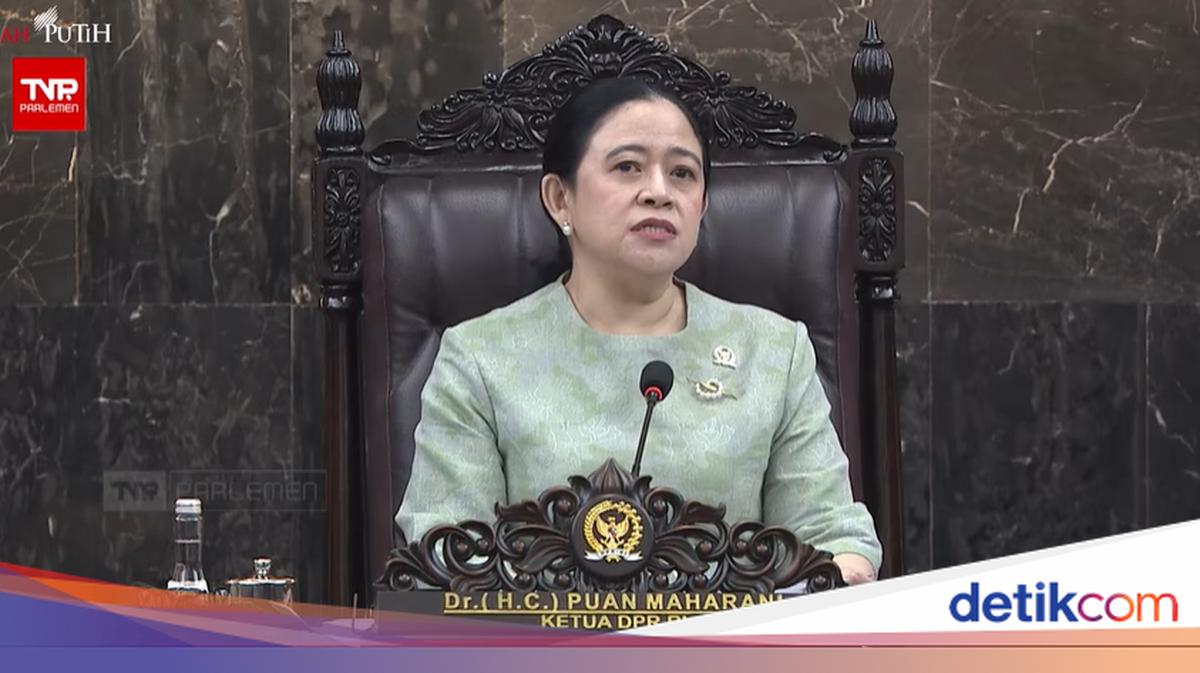
The Indonesian House of Representatives (DPR) held a plenary session to close the First Session of the 2026–2027 Parliamentary Year at the Nusantara II building in the Parliament Complex, Senayan, Jakarta, on Thursday.
In her speech, DPR Speaker Puan Maharani set out several issues of serious concern to the House. The speech was read by Deputy Speaker Sufmi Dasco Ahmad, who chaired the plenary session.
“The DPR is paying serious attention to a range of problems that directly affect people’s lives during this parliamentary session,” Puan said.
“These include social vulnerability, the inaccurate allocation of social assistance, natural disasters, and forest and land fires, which affect public health, education and people’s social and economic lives,” she added.
Puan said the safety of the people was a national priority and that democracy must ensure the state is visibly present to protect them.
“Through its legislative, budgetary and oversight functions, the DPR is ensuring that disaster and forest-fire responses are appropriate and integrated, and that social assistance is increasingly accurate and reaches those who need it,” she said.
She said the state’s success in implementing policy could be measured by whether it was there to protect people when they needed it.
“The DPR is an institution that exercises popular sovereignty and fulfils its constitutional functions to ensure the direction of state administration remains within the bounds of the Constitution and the people’s interests,” Puan said.
She added that state policies must be tested against the country’s objectives: whether they comply with the Constitution and legislation, and whether the state protects, promotes the welfare of and educates the people.
Reaffirming the DPR’s role in realising popular sovereignty
Puan said the DPR must ensure that popular sovereignty goes hand in hand with people’s welfare. Political democracy, she said, should support economic democracy and deliver social justice.
Through its legislative function, the DPR seeks to provide laws that offer both legal certainty and justice. Its budgetary role ensures that the state budget benefits the public as much as possible.
“Through its oversight function, the DPR directs the government’s exercise of authority and the implementation of state programmes so they are effective, transparent and accountable, and do not depart from their constitutional purpose,” Puan said.
She added that the DPR would continue to strengthen its constitutional functions so that state policies became more meaningful in people’s lives.
On legislation, Puan said the DPR had reviewed the National Legislative Programme (Prolegnas) in light of the country’s legal needs during the session. The 2026 priority bill list, as revised for the fourth time, contains 73 bills. The DPR and the Government have completed 20 bills and enacted them as laws, and approved seven bills as DPR-initiated proposals.
Among the laws passed were the Agrarian Reform Regulation Law, the Employment Protection Law and the One Data Indonesia Law. Puan said these strengthened the implementation of the constitutional mandate to deliver social justice, state protection, legal certainty and public welfare.
In the next session, the DPR and the Government will continue deliberations on 13 bills, which remain at Level I discussions.
On the budget, the DPR and the Government have drawn up and approved the 2027 State Budget. Puan said the budget was not merely a fiscal instrument but a policy tool for achieving economic sovereignty and social justice.
“The DPR is directing the state budget towards creating jobs, increasing productivity, strengthening the real sector and national economic self-reliance, and narrowing social and regional inequalities,” she said.
Amid global uncertainty, Indonesia needs strong economic growth alongside sound and credible public finances, Puan said. “Economic growth is not an end in itself; it must be a path to prosperity for the people.”
She stressed that every rupiah of public money in the budget must serve the national interest, strengthen people’s welfare and deliver tangible, equitable benefits. “Higher growth and faster prosperity must not be just a slogan, but a reality that Indonesians directly experience,” she said.
On oversight, Puan said DPR commissions and other bodies had held working meetings and hearings on issues of public concern.
Issues under DPR scrutiny
Puan listed 13 matters receiving serious attention from the House:
Violence by armed criminal groups in Papua, which has caused casualties;
Better management of regional assets;
The effectiveness of law enforcers’ implementation of the new Criminal Code and Criminal Procedure Code;
Faster responses to forest and land fires and water shortages affecting agriculture;
Stronger technology and human resources for disaster mitigation;
Expanding the role of Village Cooperatives/Red-and-White Cooperatives as centres of the village economy;
Developing industrial zones and tourism villages;
Updating the National Single Social and Economic Data;
Protecting workers, particularly those on fixed-term employment contracts (PKWT), outsourced workers, digital platform workers and interns;
Restoring education services after disasters;
Improving budget management and reforming the tax system;
Developing energy infrastructure to support national energy self-sufficiency; and
Reviewing the governance and oversight of prisons.
“The DPR continues to exercise oversight to ensure follow-up on the various state policy recommendations for addressing these problems,” Puan said.
She also said the DPR had given approval, consideration and consultation on the appointment or selection of public and other officials. These included candidates for membership of the Audit Board of Indonesia, National Police Chief, Bank Indonesia Governor, Bank Indonesia Senior Deputy Governor and Bank Indonesia Deputy Governor, as well as Indonesian ambassadors extraordinary and plenipotentiary to other countries and international organisations.
The DPR has designated the North Coast of Java Management Authority as a working partner of Commission IV. It and the Government have also agreed the 2027 costs of organising the Hajj pilgrimage for regular pilgrims.
On parliamentary diplomacy, Puan said the DPR had received parliamentary delegations from Bosnia and Herzegovina, Japan and South Korea, as well as ambassadors from Chile, Sudan, Australia, Russia, Sri Lanka, Azerbaijan and Japan. Bulgaria’s Deputy Prime Minister also visited, coinciding with the 70th anniversary of diplomatic relations between Indonesia and Bulgaria.
Puan said the DPR’s Inter-Parliamentary Cooperation Agency (BKSAP) continued to strengthen the role and contribution of the Indonesian Parliament internationally. Parliamentary diplomacy, she said, was intended to build ties between legislative institutions, create opportunities for cooperation and advance Indonesia’s national interests.
At the end of her speech, Puan praised DPR members for their work in meeting the public’s expectations. She said the recess was an opportunity to meet people, listen to and gather their aspirations, explain the DPR’s constitutional duties and unite communities through the spirit of mutual cooperation.
Following the close of the session, MPs will be in recess from 9 October to 9 November. During the recess, members work outside the DPR building, meeting constituents in their electoral districts to hear their concerns and carry out oversight activities through constituency visits.
“Happy recess, and I hope you will meet the people. May Allah, the Almighty, always grant us His blessings and guidance,” Puan said.
Dasco was accompanied at the session by the other deputy speakers, Saan Mustopa, Sari Yuliati and Cucun Ahmad Syamsurijal.
Before the Speaker’s closing address, the plenary session was scheduled to approve the results of the fit-and-proper process for candidates to the Board of Supervisors of public broadcaster LPP RRI for the 2026–2031 term, and to approve an extension for deliberations on the International Private Law Bill.
Source: jawawa.id (https://jawawa.id/newsitem/dpr-closes-parliamentary-session-as-puan-highlights-prison-governance-and-fixed-term-contracts-1791450130)
Originally published by detikcom (https://news.detik.com/berita/d-8698016/dpr-tutup-masa-sidang-puan-soroti-isu-tata-kelola-lapas-hingga-pkwt), translated from Indonesian