
DPR–Attorney General’s Office Meeting Discusses Proposal for Asset Seizure Without Criminal Conviction
The Indonesian Attorney General’s Office has cautioned that asset confiscation without a criminal conviction must be examined carefully because it restricts property rights.
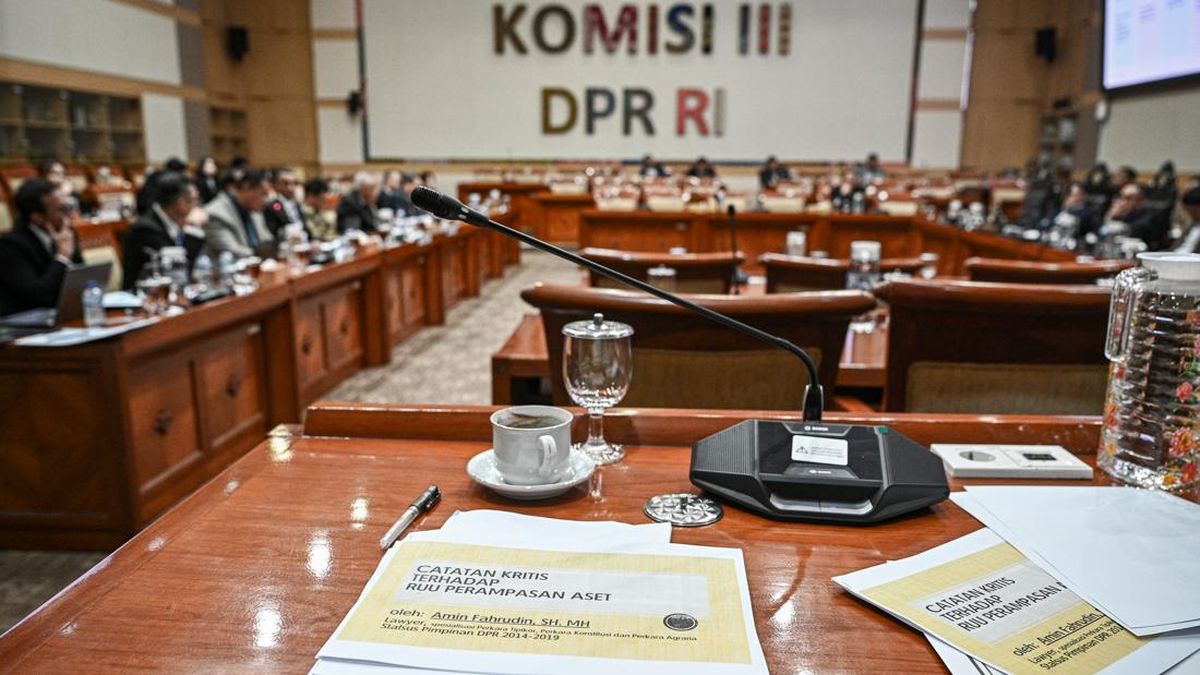
The warning was delivered at a public hearing with Commission III discussing the Asset Confiscation Bill at the parliamentary complex in Jakarta on Tuesday (3 November).
“Confiscation of assets without a criminal judgment is the most severe form of restriction on property rights, because the state takes the property without first proving a criminal offence,” said Narendra Jatna, Deputy Attorney General for Civil and State Administrative Affairs.
The concept of confiscating assets without criminal proceedings is known as Non-Conviction Based (NCB) confiscation. Narendra said it could create opportunities for officials to act arbitrarily.
He went on to describe how NCB has been applied in several countries. Historically, it was used in medieval England in cases of treason against the king, but was later discontinued after being applied arbitrarily.
“It was stopped because it was used very arbitrarily. Under the Forfeiture Act 1870, NCB was abandoned because it was highly abusive,” Narendra said.
The United States also used the NCB concept in dealing with the Medellín Cartel, the drug-smuggling organisation led by Pablo Escobar in the 1990s. Although Escobar had been convicted, his family and associates continued to benefit from the proceeds of narcotics.
Narendra said investigators in Miami abused NCB as a tool for extortion. The case prompted the United States to change its approach.
“NCB is pursued after investigators submit preliminary evidence to a prosecutor to obtain a prima facie finding from the court. In the United States, investigators cannot carry out NCB directly; it must go through a prosecutor, who submits the prima facie case to obtain a court order,” he said.
In Australia, NCB was initially prompted by a case involving a motorbike gang whose assets were disproportionate to its known wealth—so-called unexplained wealth. Over time, however, investigators used NCB for extortion, prompting Australia to change its approach.
“NCB is used as a supplement to criminal cases. If, during a trial, previously untraced assets are discovered, NCB can be applied. In other words, NCB is carried out after a criminal case has been brought—that is the Australian approach,” Narendra said.
The Netherlands, meanwhile, has rejected NCB on the grounds that it could encourage arbitrary action. It maintains that assets should be confiscated through criminal proceedings and has developed financial investigations conducted by prosecutors and their teams.
Financial investigations are conducted in parallel with conventional investigations and can also take place during prosecution and enforcement.
“Technically, the Dutch mechanism is similar to NCB, but financial investigations are conducted within the framework of criminal law instruments,” Narendra said.
He said Indonesia therefore needs to decide which approach is most appropriate for the implementation of NCB.
Several issues have been raised during discussions on the Asset Confiscation Bill. Most recently, the bill’s working committee said it would cover fraudulent investment schemes, illegal rotating savings groups, illegal insurance and fraudulent cooperatives.
The House of Representatives has previously said the bill would cover 13 categories of offences:
Corruption;
Narcotics and psychotropic substances offences;
Terrorism;
Human smuggling;
Smuggling of weapons, ammunition and hazardous materials;
Forestry offences;
Environmental offences;
Tax offences;
Banking offences;
Insurance offences;
Mining offences;
Maritime and fisheries offences; and/or
Human trafficking.
Source: jawawa.id (https://jawawa.id/newsitem/dpr-attorney-generals-office-meeting-discusses-proposal-for-asset-seizure-without-criminal-conviction-1793703300)
Originally published by CNN Indonesia (https://www.cnnindonesia.com/nasional/20261103162616-32-1422837/rapat-dpr-kejagung-bahas-wacana-perampasan-aset-tanpa-pemidanaan), translated from Indonesian