
DPD urges more selective licensing for new madrasah establishments
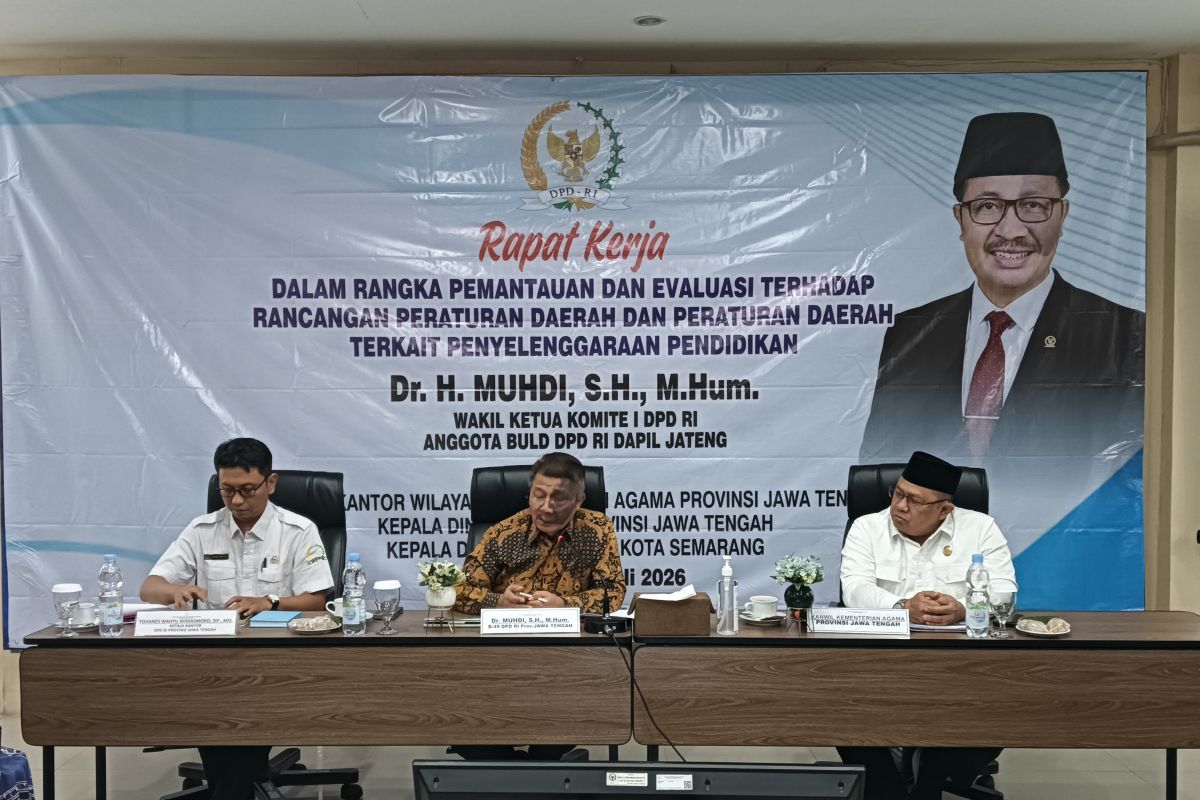
The Regional Representative Council (DPD) RI has urged that permits for new private madrasahs be granted more selectively, given that the number of private madrasahs is disproportionate to the number of students. “The Ministry of Religious Affairs should not be too quick to issue permits for the establishment of new madrasahs. Unless, of course, there is a genuine need in that area,” said Muhdi, Deputy Chairman of DPD Committee I, in Semarang on Monday. He made the statement during a working meeting on the monitoring and evaluation of draft regional regulations and regional regulations related to the implementation of education. According to him, the granting of permits for new madrasahs needs to be more selective by considering local needs, as strengthening existing institutions is far more important than continuously increasing the number of schools. The senator from Central Java encouraged the strengthening of education within the pondok pesantren environment through an equivalency system for graduates. “How to ensure that children in pesantren can have their schooling equalised so that children leaving there automatically receive a diploma equivalent to general schools and can continue to higher levels,” he said. Head of the Central Java Regional Office of the Ministry of Religious Affairs, Saiful Mujab, said the majority of educational institutions under the Ministry of Religious Affairs are indeed privately managed. As many as 97 per cent of madrasahs in Central Java are still private, while state madrasahs account for about three per cent, and there are only 65 state madrasah aliah (MAN) at the senior high school level. “There are only 65 state MANs, whereas there are more than 800 private ones,” he said. In fact, for the RA (Raudhatul Athfal) level, equivalent to kindergarten, none have state status yet. He explained that the biggest challenge for private madrasahs relates to financing. Therefore, he said, the government continues to encourage the transfer of state status for private madrasahs as an effort to expand access to public education. However, he acknowledged that the process is not easy because various requirements must be met, and not all foundations are willing to change their status to state. “Actually, we always encourage them to become state institutions. But sometimes the obstacles are access, then facilities and infrastructure, human resources, and so on. However, we continue to encourage many to be willing to become state institutions,” he said.