
Dozens of IPT Master’s Tourism Students Research Sustainable Development of Wukirsari Tourism Village
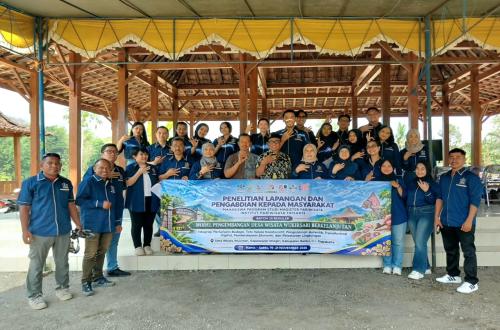
Dr Rina Suprina, head of the Master’s in Tourism programme at Trisakti Tourism Institute, said field research and community service are routine activities for students each semester. In this batch, 26 students selected Wukirsari Tourism Village as their research location.
“Although our campus is in Jakarta, students are free to choose their research location. Wukirsari was selected because the village has received many awards and accolades, both nationally and internationally. We see it as an interesting place to study and compare with other tourism villages,” she said during an interview at the research site on Saturday (21 November 2026).
The students divided their research into five groups, each examining a different area: collaborative governance, cultural tourism experiences, women’s empowerment and small and medium-sized enterprises (SMEs), digital branding strategies, and environmental and batik-waste management.
Rina said the research was intended not only to gather data and fulfil students’ academic requirements. They were also asked to identify ways to support the community through community-service activities.
The findings will be compiled into a comprehensive report. The students will also present their findings and recommendations to relevant parties, including the Tourism Office and the managers of Wukirsari Tourism Village.
“The outputs of this activity will be a scientific article and recommendations that we hope will be useful to the place where the students conducted their research,” she said.
One issue highlighted by the research is that Wukirsari’s various tourism attractions are not yet fully integrated. Activities such as batik-making, wayang puppet crafts, culinary experiences and homestays still need to be combined into a more cohesive visitor experience. This is linked to the relatively short length of visitors’ stays.
Some visitors come to take part in a particular activity and return home on the same day. The students therefore recommended developing a wider range of packages that combine the village’s different attractions. The aim is for visitors not only to make batik, but also to take part in cultural activities, learn about local crafts, sample local food and stay in residents’ homes.
Rina said that the longer visitors stay at a destination, the greater the potential economic benefits for the local community.
“To make tourism more sustainable, perhaps more attractive activities or packages could be developed in the future. Visitors would not just stay for one day, but perhaps for several days with a range of interesting activities. The longer they stay, the greater the benefit for stakeholders and the community here,” she said.
Galuh Wijayanti, a representative of the IPT Master’s programme’s 35th batch, said the students had selected Wukirsari by mutual agreement. They were attracted by the village’s cultural wealth, particularly its batik and wayang traditions. One important recommendation, she said, was to create more appealing tourism packages linking Wukirsari’s different attractions.
“Perhaps there could be two- or three-day activities. In addition to batik-making, the village could work with nearby areas, where there are many wayang artisans and young farmers, as well as Embung Imogiri, a reservoir with a distinctive mountain-like shape. Bringing these into one programme would be very appealing,” she said.
She also said accommodation facilities needed improvement to meet the needs of visitors wishing to stay longer. Amenities such as air conditioning could be considered, particularly to make stays more comfortable for international visitors.
Another student, Arwis Umairi, stressed the importance of combining cultural heritage, community creativity and technology in developing the tourism village. Wukirsari’s potential, he said, should be promoted through digital media using engaging storytelling so it can reach a wider audience.
“We need to understand that a tourism village is a shared responsibility. We can identify our own skills and contributions, and decide where we can help. Once we recognise our potential, we can tell the village’s story digitally in a more engaging way and prepare to welcome the world,” he said.
Findings and recommendations for Wukirsari Tourism Village
The first group examined strengthening collaborative governance and community-based tourism. Its research found that batik, wayang, culinary and homestay attractions had not been integrated into a single tourism package. Economic benefits were also concentrated in certain clusters, while coordination between clusters needed strengthening. The group recommended integrated tourism packages, transparent sharing of economic benefits, stronger coordination forums and a programme to train young people to become the next generation of wayang artisans.
The second group focused on developing authentic cultural tourism, particularly batik and wayang education. Challenges included tour guides’ limited ability to explain cultural stories and philosophies, as well as limited foreign-language skills. Recommendations included storytelling training, cultural narrative guides, improved foreign-language skills, and promotional and educational materials in multiple languages.
The third group studied women’s empowerment and the strengthening of creative SMEs. It found that women were involved in a range of economic activities, including batik-making groups, agriculture, food businesses and homestays. However, this potential needed to be better integrated into the tourism value chain. The group recommended including batik products, traditional snacks from Pasar Sorjadi, agricultural produce and catering in tourism packages, while also strengthening the regeneration of artisans.
The fourth group examined digital branding based on cultural storytelling. Its findings showed that SME social media accounts were not managed consistently, the website did not offer direct booking, and promotional content rarely highlighted Wukirsari’s history and cultural philosophy. Recommendations included a social media content calendar, a digital product catalogue, online booking and payment systems, and standardised guide materials in Indonesian and English.
The fifth group studied the implementation of green tourism and the circular economy. Its research highlighted liquid waste from batik production, particularly from washing, dyeing and wax removal. The group recommended improving wastewater treatment through an industrial wastewater treatment plant (IPAL), applying the 5R principles, using natural dyes, and developing educational tours about batik-waste treatment that take occupational health and safety into account.
“Thank you for the recommendations. At present, we can provide only nine guest-house rooms. Ideally, we would need at least 100 rooms. We are continuing to coordinate with local residents to support improvements that will also benefit the local economy,” a representative said.
Source: jawawa.id (https://jawawa.id/newsitem/dozens-of-ipt-masters-tourism-students-research-sustainable-development-of-wukirsari-tourism-village-1795510402)
Originally published by Republika (https://rejogja.republika.co.id/berita/tozvl9291/puluhan-mahasiswa-magister-pariwisata-ipt-teliti-pengembangan-desa-wisata-wukirsari-berkelanjutan), translated from Indonesian