
Downstreaming’s Share of Investment in Indonesia Rises to 30% in Two Years
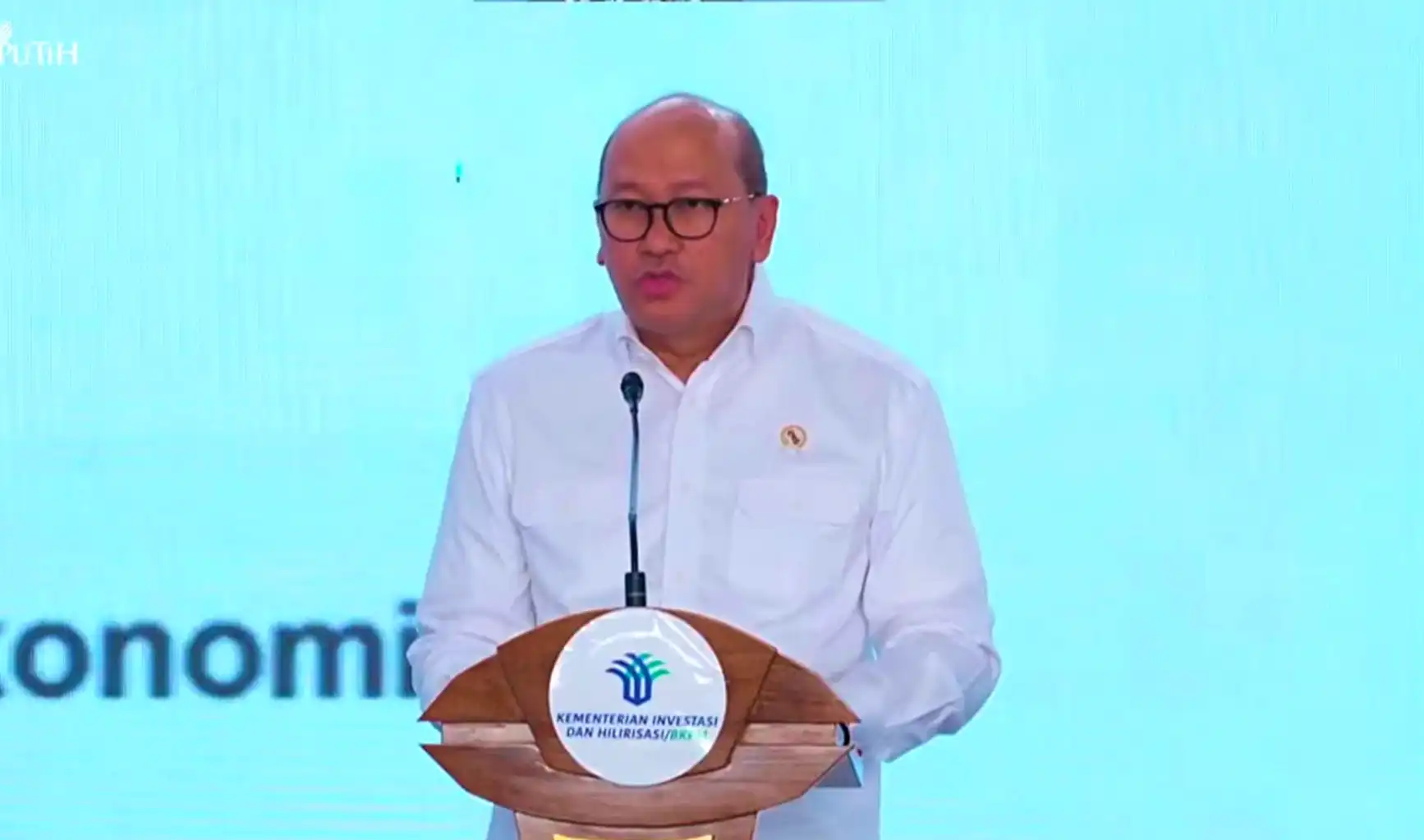
Downstreaming is taking an increasingly large share of investment flows into Indonesia. Investment and Downstreaming Minister and Investment Coordinating Board (BKPM) head Rosan P. Roeslani said downstreaming investment had reached 30% of total investment, up from around 25% over the past two years.
Rosan said the increase came amid growth in national investment realisation. In the first half of 2026, total investment reached Rp1,010.6 trillion, up 7.2% compared with the same period a year earlier.
The result was accompanied by employment for more than 1.4 million people. Data from the Ministry of Investment and Downstreaming/BKPM showed that investment realisation in the first half of 2026 absorbed 1,448,862 workers, an annual increase of 15%.
“Investment in the first half of 2026, thank God, reached Rp1,010.6 trillion, grew by 7.2% and absorbed more than 1.4 million people,” Rosan said while presenting the investment figures to President Prabowo Subianto on Thursday, 8 October 2026.
Of the total realised investment, downstreaming accounted for Rp300.1 trillion, or around 29.7% of national investment. This was up 6.9% on the same period a year earlier.
“Out of total investment, the downstreaming figure has increased. Over the past two years, downstreaming’s contribution, which was previously 25%, has reached 30% of total incoming investment,” Rosan said.
Mineral commodities continued to dominate downstreaming investment. The government recorded Rp206.5 trillion in mineral downstreaming investment, comprising Rp71 trillion in nickel, Rp53.8 trillion in bauxite, Rp37.4 trillion in copper, Rp30.2 trillion in iron and steel, and Rp5.9 trillion in silica sand.
Downstreaming investment also came from plantations and forestry, at Rp54.4 trillion; oil and gas, at Rp35.4 trillion; and fisheries and maritime industries, at Rp3.8 trillion.
This mix shows that downstreaming is beginning to cover a wider range of commodities, although minerals remain the largest contributor. The government is also encouraging expansion into plantations, forestry, oil and gas, and other higher-value-added commodities.
By source of capital, foreign investment continued to underpin downstreaming in the first half of 2026. Foreign direct investment (FDI) amounted to Rp212.8 trillion, or about 70.9% of the total, while domestic investment stood at Rp87.3 trillion, or around 29.1%.
The figures show that foreign investors still play a dominant role in financing downstreaming projects, particularly mineral-based industries and processing zones. At the same time, the government is encouraging greater participation by domestic investors to strengthen industrial supply chains.
Geographically, downstreaming investment was concentrated outside Java. Around 75.7%, or Rp227.3 trillion, of downstreaming investment realised in the first half of 2026 came from projects outside the island.
That share was higher than the distribution of investment nationally. In the first half of 2026, total investment outside Java reached Rp507.8 trillion, or 50.2%, while investment in Java was Rp502.8 trillion, or 49.8%.
“More than 75% of it is realised outside Java. We see downstreaming continuing to grow in the future,” he said.
The scale of downstreaming investment also brings significant energy needs for processing zones. Rosan cited electricity capacity already installed or under development in the Weda Bay and Morowali industrial areas.
“Electricity capacity already installed and under construction there exceeds 7.1 GW. If we add what is in Morowali, that is roughly another 8.8 GW, bringing the total to 15.9 GW. This is far greater than Singapore’s total electricity consumption of 13.1 GW,” Rosan said.
Alongside the expansion of industrial capacity, businesses are beginning to help provide renewable energy in island regions. One example is a grant of a solar power plant (PLTS) in Sumenep regency, East Java.
The Sumenep regency government said PT Torang IWIP Berbakti had donated a 2-megawatt solar power plant for island areas, including Gili Labak Island and Pagerungan Kecil village. The programme also involves state electricity company PLN in using the facility.
“They are ready and have already spoken with Danantara about actively participating in the 100 GW solar panel programme, which we will soon discuss with the Coordinating Minister for Downstreaming,” he said.
Rosan had previously said the programme was part of efforts to widen access to energy while supporting the dieselisation-reduction programme. In his presentation, he said businesses were also ready to participate in the 100 GW solar panel programme, which the government plans to discuss.
The government is also preparing to extend downstreaming to other high-value-added commodities. Sectors identified for future development include semiconductors, bioethanol, coconut-derived products and seaweed.
With its contribution now close to one-third of national investment, downstreaming has become an important component of capital flows into Indonesia.
The government is continuing to promote its expansion so that investment is not concentrated solely in mineral processing, but extends to other commodities and sectors with greater value-added potential.
Source: jawawa.id (https://jawawa.id/newsitem/downstreamings-share-of-investment-in-indonesia-rises-to-30-in-two-years-1791463832)
Originally published by kabarbursa.com (https://www.kabarbursa.com/makro/dua-tahun-naik-kontribusi-hilirisasi-ke-investasi-ri-tembus-30-persen), translated from Indonesian