
Downstreaming Revitalises Construction Sector as Catalyst for Economic Growth
Jakarta – Indonesia, with its abundant natural resources, possesses many unique commodities that are highly sought after globally for processing into semi-finished or finished products. Consequently, the downstreaming programme is a priority for the government, requiring consistent and sustainable implementation. This commitment is evidenced by the establishment of the Ministry of Downstreaming and Investment/BKPM. Downstreaming aims not only to increase the added value of natural resources but also to attract other sectors, including construction and various other industries.
During the Megabuild, Keramika, and Megaproperty 2026 event at NICE PIK-2, Royanto Handaya, President Director of Panorama Media, stated that the 2026 edition is designed to be more than just an exhibition, acting instead as a catalyst for economic growth. By uniting these three sectors, the platform provides a stage for material innovation, architectural technology, and property investment, allowing all stakeholders to accelerate progress within a single platform.
Haryo Yudo Sedewo, Director of Investment Zone Planning Services at the Ministry of Investment and Downstreaming/BKPM, reinforced that investment is expected to serve as the engine of economic growth in support of the Golden Indonesia 2045 Vision. Investment creates jobs, increases income and expenditure, and encourages the growth of new industries. This industrial growth, in turn, creates demand for imports and commodities for export, leading to a trade surplus that drives economic growth and improves Indonesia’s investment credit rating.
Specifically regarding investment, the goal is to significantly boost state revenue, job creation, and technology transfer, while enhancing national capacity in supporting future industries. Downstreaming investment in natural resources is targeted to open pathways for new economic hubs in various regions, creating a multiplier effect towards the Vision of an Advanced Indonesia 2045.
South Sumatra is one of the regions with vast natural resource potential, including oil, gas, coal, palm oil, and rubber. Developing downstreaming processes for these resources to produce higher-value products will revitalise other sectors, including construction, creating a faster orchestration of development. This effort requires a primary driver to leverage Indonesia’s vast commodities for global demand.
The Governor of South Sumatra, H. Herman Deru, has designated Tanjung Carat Port as a National Strategic Project (PSN), intended to serve as a lighthouse for South Sumatra. This US$1.2 billion deep-sea port and international multi-modal logistics centre is designed to overcome logistical constraints and enhance the export competitiveness of the region’s flagship commodities, attracting future downstreaming investments.
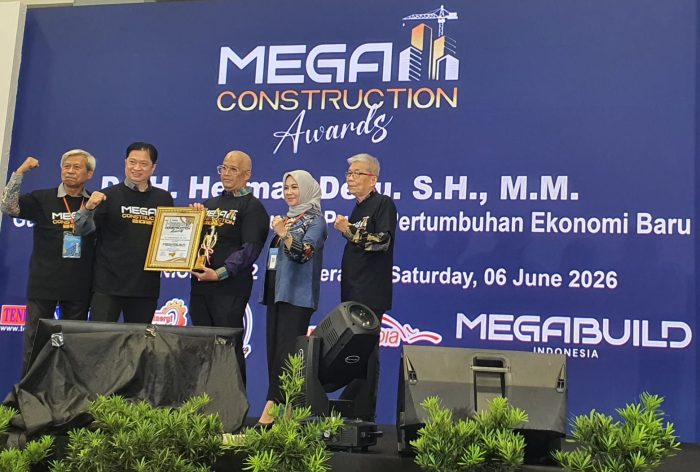
In conjunction with the launch of MEGA CONSTRUCTION, part of the MEGABUILD 2026 series, the FSII (Industry Innovation Synergy Forum) presented an award to the Governor of South Sumatra, H. Herman Deru, as the Visionary Governor for Economic Development. The award was received by Dedi Rachmadi, Head of the South Sumatra Provincial Liaison Agency. The recognition, presented by FSII Chairman Tito Loho, is expected to further inspire economic development in South Sumatra, serving as a successful pilot model for other regional economic developments across Indonesia.