
Downstreaming Key to Boosting Indonesia's Mineral Added Value
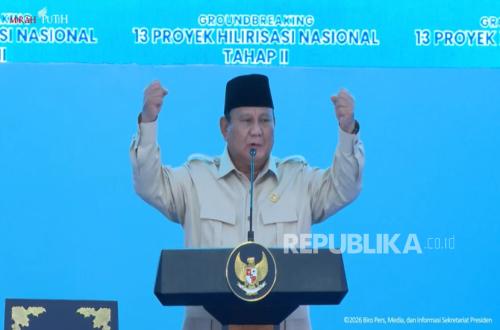
President Prabowo Subianto has stressed that downstreaming is key to increasing the added value of Indonesia’s minerals and coal. The government is pushing for the nation’s natural resources to no longer stop at being raw materials, but to be processed into intermediate and final products domestically.
The President made the remarks in his speech at the Annual Session of the MPR and the Joint Session of the DPR and DPD in commemoration of Indonesia’s 81st Independence Day. He said the government had launched 26 downstreaming projects throughout 2026, comprising 13 projects on 6 February and 13 projects on 29 April.
“On 6 February 2026, we launched 13 downstreaming projects, and another 13 downstreaming projects on 29 April 2026,” Prabowo said.
The President explained that the projects include processing coal into dimethyl ether (DME), downstreaming copper and gold, processing industrial salt, and developing an alumina smelter into aluminium. The downstreaming projects are also said to generate tens of thousands of jobs.
Downstreaming is part of the government’s strategy to build a national industry with added value from upstream to downstream. The government is directing the strength of state-owned enterprises (SOEs) to strengthen industrial development and the value chain of strategic commodities domestically.
“SOE profits are now also being used to drive our downstreaming, along with upstreaming,” President Prabowo said.
The agenda places the Mining Industry Indonesia holding company MIND ID in a strategic position in building the national mineral downstreaming ecosystem. MIND ID integrates the mineral and coal value chain through ANTAM, INALUM, PT Bukit Asam (PTBA), PT Timah, PT Freeport Indonesia, and PT Vale Indonesia.
One downstreaming development is visible in the bauxite-alumina-aluminium chain in Mempawah, West Kalimantan. ANTAM plays a role in managing bauxite resources and mining, while the processing of bauxite into alumina is carried out by PT Borneo Alumina Indonesia (BAI), a joint venture between ANTAM and INALUM.
Furthermore, INALUM serves as the operator for aluminium development and processing, forming an integrated chain from bauxite to alumina to aluminium domestically. The bauxite processing facility into smelter grade alumina in Mempawah has a capacity of approximately one million tonnes of alumina per year.
For copper and gold commodities, MIND ID is also pushing downstreaming into the manufacturing sector. Through PT Freeport Indonesia, copper products are being further developed, including through cooperation with Pindad to process copper cathodes into brass cups with a capacity of 10,000 tonnes per year.
MIND ID is also preparing production facilities for copper rods and wire with a capacity of up to 300,000 tonnes per year, as well as copper pipes with a capacity of 100,000 tonnes per year. For gold, ANTAM is strengthening the downstreaming chain through precious metal processing and refining, including by integrating gold supply from Freeport Indonesia.
Downstreaming is also being developed for nickel commodities through ANTAM, which is involved in the value chain from mining to the development of materials and the electric vehicle battery ecosystem. The move is aimed at ensuring minerals do not only produce primary commodities, but become raw materials for high-value-added industries.
In the coal sector, PTBA is developing downstreaming through processing coal into DME in Tanjung Enim, South Sumatra. The product is projected to become an alternative to reduce dependence on imported LPG, which currently still meets around 80 percent of national LPG demand.
Besides DME, MIND ID together with Pertamina is also developing options for downstreaming coal into synthetic natural gas (SNG) and methanol. The development expands the utilisation of coal into derivative products with higher economic value while strengthening the national industrial chain.
President Prabowo stressed the importance of mastering technology so that Indonesia does not continue to remain in the position of a raw material supplier. The government is encouraging SOEs to acquire technology, intellectual property, management, markets, and experience from the world’s best companies to strengthen national industry.