
Downstreaming and Integrated Landscape as Keys to the Revival of Cocoa and Food
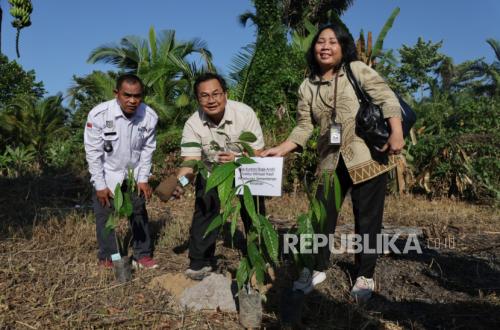
A multi-stakeholder dialogue on Integrated Landscape Management (ILM) was held on Friday (24/4/2026) at the Luwu Regency Office in South Sulawesi. The event, coinciding with Earth Day 2026 under the theme ‘Our Power, Our Planet’, signals a new chapter in efforts to strengthen food security while preserving the environment.
The forum involved central and local policymakers, academics, the private sector, and communities. It spotlighted synergies in Indonesia’s FOLUR (Food Systems, Land Use, and Restoration) programme.
As the world celebrates Earth Day with a spirit of collective action, an integrated food production approach that also considers ecosystems serves as a real example that ‘environmental change depends on the daily actions of communities’.
Luwu Regent H. Patahuddin recalled Luwu’s history as a centre for cocoa and food that once thrived. ‘Luwu has long been a mainstay of the community’s economy with superior cocoa, rice, coffee, and coconut. However, various challenges now hinder it,’ he said.
He emphasised the importance of central support and collaboration to restore that glory through the provision of superior seeds, pest/disease management, and strengthening the downstreaming of commodities.
Integrated Landscape Approach
In the dialogue, speakers highlighted the integrated landscape approach as a solution. Bappenas Deputy Teguh Sambodo affirmed that the integrated landscape approach is key to managing natural resources sustainably.
He underlined the importance of aligning agricultural productivity increases with value addition, forest conservation, and environmental restoration through inter-ministerial and cross-sectoral collaboration.
Deputy of the Coordinating Ministry for Food Nani Hendiarti added that synergy among all stakeholders is a primary condition for superior commodities like cocoa to thrive again. According to her, this multi-stakeholder approach is not just rhetoric.
FOLUR Indonesia, a global initiative supported by the Global Environment Facility (GEF), positions Public-Private-Community Partnerships (PPCP) as a main pillar. The official FOLUR website states that partnerships with major industry players (Unilever, Mondelez, Olam, GIZ) and the government make large-scale investments in sustainable production and conservation more viable. Thus, programmes like FOLUR do not rely solely on grant funds but on financial collaborations that enhance scale and sustainability impact.
Production Accompanied by Forest Conservation
Secretary of the Directorate General of Natural Resources and Ecosystem Conservation of the Ministry of Environment and Forestry (KLHK) Nandang Prihadi reminded that upstream production stability (in erosion- and flood-prone areas) is only guaranteed if accompanied by forest conservation and social forestry management upstream.
By building productivity belts in highland areas (for example, through cocoa-coconut agroforestry) while keeping protected forests intact, Luwu can address erosion issues while increasing residents’ income. This landscape approach reflects the vision of ‘integrating economic, social, and environmental aspects sustainably’ in one policy.
Downstreaming, Traceability, and Value Addition
The national plantation sector is being pushed towards downstreaming, no longer just exporting raw materials but semi-finished or finished products. Director of Plantation Product Downstreaming at the Ministry of Agriculture (Kementan) Kuntoro Boga Andri said that downstreaming and traceability systems are game-changers for commodities like cocoa.
‘We don’t want farmers to just sell raw materials,’ he stated in the dialogue.
Through training and capacity building, Luwu farmers are encouraged to process their harvests themselves, so economic benefits remain in the villages.
In the field, initial positive results are already visible. The FOLUR Luwu demplot for sustainable rice shows productivity increases from 6 tonnes to 7.7 tonnes per hectare thanks to intensive environmentally friendly cultivation practices. Simple innovations like making biochar from cocoa and agricultural waste are also being implemented to improve soil structure while reducing carbon emissions.
Bappenas even mentioned that FOLUR has produced a landscape database, facilitated multi-stakeholder dialogues, and strengthened area governance. This means institutional support is starting to add real value.
Source: jawawa.id (https://jawawa.id/newsitem/downstreaming-and-integrated-landscape-as-keys-to-the-revival-of-cocoa-and-food-1777258281)
Originally published by Republika (https://ekonomi.republika.co.id/berita/te4s62368/hilirisasi-dan-lanskap-terpadu-jadi-kunci-kebangkitan-kakao-dan-pangan), translated from Indonesian