
Downstreaming and Domestic Trade Key to Boosting Regional Economic Growth
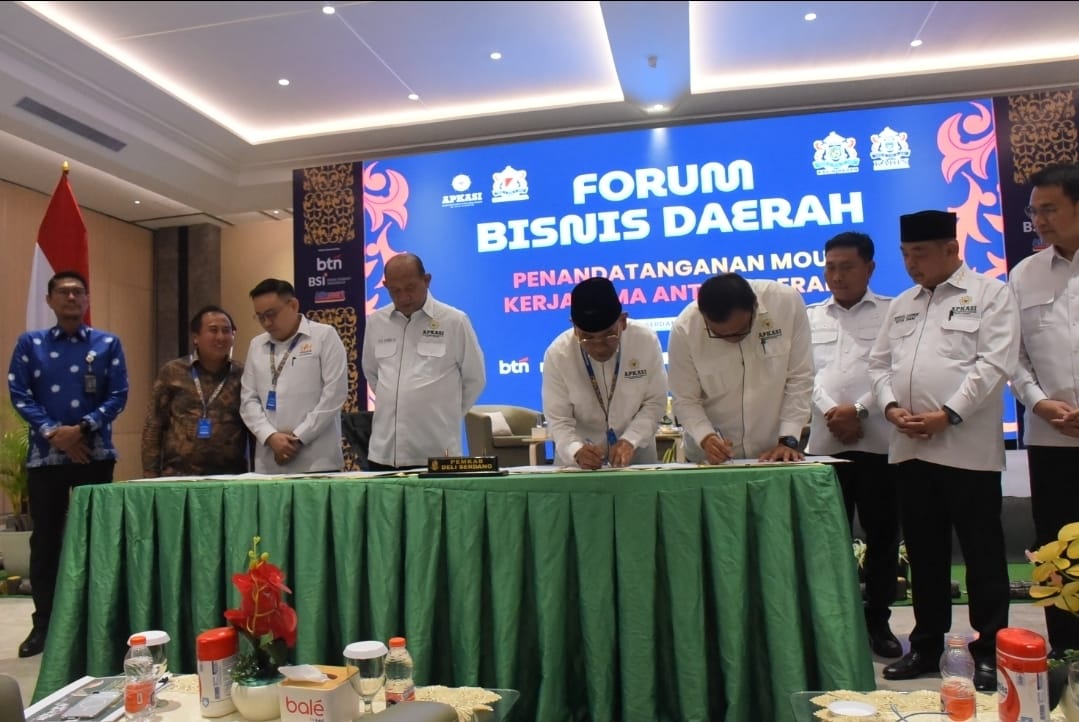
Amid lingering global economic pressures, strengthening domestic trade is a key to maintaining national economic growth. Collaboration between regions, commodity downstreaming, and partnerships with the business world are now being promoted as strategies to strengthen supply chains, curb inflation, and create new centres of economic growth in various regions. This commitment was realised by the Association of Indonesian Regency Governments (Apkasi) through the 2026 Regional Business Forum (Forbisda) in collaboration with the Indonesian Chamber of Commerce and Industry (Kadin) in Deli Serdang Regency, North Sumatra, on Thursday (2/7/2026). The forum, part of Apkasi’s 26th anniversary celebrations, not only served as a discussion space but also produced a number of trade agreements expected to strengthen regional economies. Several memoranda of understanding (MoUs) were signed as a follow-up to the forum. These included a trade cooperation agreement between Deli Serdang Regency and Simalungun Regency focused on controlling regional inflation, as well as cooperation between Simalungun Regency and Langkat Regency to increase regional trade volume. The collaboration also involved the private sector through a shallot horticulture commodity trade agreement between PT Juma Berlian from North Sumatra and CV Sudah Ada from Brebes Regency. This agreement is expected to strengthen food commodity distribution while shortening the national supply chain. Apkasi Chairman Bursah Zarnubi stated that the organisation aims to strengthen the role of regencies as drivers of the national economy through more integrated inter-regional trade. ‘Apkasi has a strategic role as a mediator of inter-regional trade. The cooperation built today will be the starting point for us to prove that Indonesia’s economic strength begins from the periphery, from our regencies,’ said Bursah. Bursah, who also serves as Regent of Lahat, believes it is time for economic development to shift from dependence on the extractive sector towards downstream industry development based on agricultural and plantation commodities. According to him, producing regions must gain greater added value through the development of processing industries in their areas of origin. He cited Lahat Regency’s coffee production, which reaches around 300,000 tonnes per year and has the potential to be developed into a downstream industry. Thus, the economic value of commodities will no longer be concentrated in industrial centres but also enjoyed by communities in producing regions. Apkasi Executive Director Sarman Simanjorang explained that Forbisda is designed to directly match regional production potential with business needs through a supply-meeting-demand concept. Regional heads were given the opportunity to present leading commodities ready for marketing or downstreaming. Banyuasin Regency offered the potential of rice, coconut, and shrimp, while Gorontalo Regency promoted corn as a leading commodity. Deli Serdang Regency introduced its agricultural and plantation sectors as a supporting economic strength for the Medan city area, whereas Brebes Regency showcased shallots, which have been the backbone of its community’s economy. The forum then continued by bringing together regional governments with national business players to discuss domestic investment and trade opportunities. Attendees at the session included Mitra Adiperkasa Director Handaka Santosa, Alfamart Government Relations representative Fatturachman, and representatives from Bank Syariah Indonesia (BSI). Through the presentation of commodity potential from various regions, business players are expected to explore investment opportunities and cooperation through business-to-business (B2B) schemes so that the downstreaming and marketing of regional products can proceed more quickly. Kadin Indonesia Vice Chairman Azis Syamsudin acknowledged that challenges for the business world, particularly in the logistics sector, remain significant. However, the large size of Indonesia’s domestic market is considered important capital to continue strengthening inter-regional trade. According to him, synergy between regional governments and the business world must be continuously expanded so that goods distribution becomes more efficient, investment increases, and the competitiveness of regional products strengthens. Support for this initiative also came from the central government. Director General of Domestic Trade at the Ministry of Trade, Iqbal Shoffan Shofwan, attended to witness the strengthening synergy between regional governments, the business world, and business associations in building a more integrated domestic trade ecosystem. Through Forbisda 2026, Apkasi hopes that inter-regional cooperation will not stop at the signing of agreements but can be realised in actual trade transactions that strengthen commodity downstreaming, maintain food price stability, increase investment, and promote more equitable national economic growth.