
Downstream Processing Drives Rp300.1 Trillion in Investment as Nickel Exports Top US$40 Billion
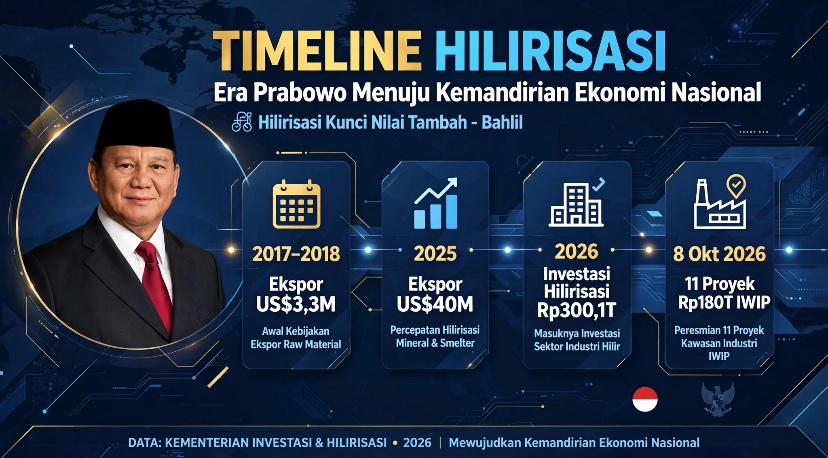
JAKARTA – As President Prabowo Subianto’s government approaches its second anniversary on 20 October 2026, its natural-resource downstreaming agenda has made significant progress. In the first half of 2026, downstream-processing investment reached Rp300.1 trillion, or about 29.7 per cent of total national investment.
The figure reflects the government’s policy direction of shifting the economy away from selling raw materials towards higher-value processing industries.
The Ministry of Investment and Downstreaming/BKPM recorded 6.9 per cent growth in downstream-processing investment in the first half of 2026 compared with the same period a year earlier. This suggests investor interest in Indonesia’s processing industries remains strong amid global economic uncertainty.
Investment and Downstreaming Minister and BKPM head Rosan Perkasa Roeslani said in a press release on 17 July 2026 that downstreaming was no longer focused solely on nickel. Other mineral commodities, including bauxite, copper, iron and steel, and silica sand, were also driving investment.
“Usually, nickel is number one. Now there is a shift: bauxite has become number one,” Rosan said while discussing downstream-processing investment in the second quarter of 2026.
His comments point to a diversification of commodities in the downstreaming drive, which is important for broadening the industrial base and reducing dependence on a single mineral.
Downstream investment strengthens national industrialisation
Downstreaming is the process of turning raw materials into semi-finished or finished products with greater economic value. It can include processing ore into metal, producing battery materials and manufacturing components for the manufacturing industry.
At Rp300.1 trillion, downstreaming has become one of the main pillars of the industrialisation agenda. Its 29.7 per cent share of national investment reflects the scale of capital being committed to building natural-resource-based industrial ecosystems.
The government is not limiting downstreaming to minerals. It is also encouraging the plantations and forestry, oil and gas, fisheries and maritime sectors to join processing chains, including food production, palm-oil derivatives, forest products and seafood processing.
The success of this agenda will ultimately be measured not only by investment value, but also by the ability of industries to produce competitive goods, expand export markets and deliver lasting economic benefits.
Investment outside Java reaches Rp227.3 trillion
The geographical distribution of downstream-processing investment is a significant feature of the data. Of the Rp300.1 trillion total, Rp227.3 trillion, or about 75.7 per cent, was invested outside Java.
This distribution is considered strategically important because many of the raw materials used in downstream processing are located outside Java. Building smelters and industrial estates near raw-material sources could foster new economic centres, create jobs and stimulate supporting sectors such as logistics, transport and maintenance services.
However, a high investment figure does not automatically mean that local communities will immediately benefit. The tangible impact must also be assessed through employment figures, participation by local suppliers and contributions to regional revenues.
Ensuring that benefits are shared more widely — through skills development for local workers, recruitment near industrial estates and partnerships with small and medium-sized enterprises — therefore remains important.
11 nickel projects worth Rp180 trillion and first electric-vehicle battery export
One concrete development has taken place at the Indonesia Weda Bay Industrial Park (IWIP) in Central Halmahera, North Maluku. On 8 October 2026, President Prabowo launched 11 projects forming part of the nickel industrial ecosystem, with investment of about US$10.2 billion, equivalent to Rp180 trillion.
The projects include four entering the commercialisation phase and seven beginning construction. At the same event, the President also sent off the first export of electric-vehicle batteries.
The projects span a broad industrial chain, from nickel-based battery materials and electric-vehicle battery components to aluminium, electric heavy equipment and glass for the solar-energy industry.
“I therefore affirm the Indonesian government’s commitment to respecting and safeguarding all investment made in Indonesia, from wherever it comes,” President Prabowo said in his remarks at IWIP, according to the State Secretariat.
Business certainty is crucial for capital-intensive, high-technology industries that require long construction periods. Their sustainability will depend on production coming on stream, infrastructure and energy readiness, and compliance with regulations.
Nickel exports exceed US$40 billion; 2026 target is US$45 billion
On exports, the Energy and Mineral Resources Ministry said on 14 October 2026 that the value of Indonesia’s nickel exports had exceeded US$40 billion in 2025, a substantial increase from around US$3.3 billion in 2017–18. The government is targeting at least US$45 billion in 2026.
Co-ordinating Minister for Downstreaming and Energy Transition and Energy and Mineral Resources Minister Bahlil Lahadalia said at the opening of the 41st Trade Expo Indonesia in Tangerang on 14 October:
“Downstreaming is key to increasing the added value of Indonesia’s natural resources while strengthening national economic self-reliance.”
The surge in export value illustrates the scale of change in the nickel economy following the development of domestic processing industries. However, export value is not the same as companies’ net profits or government revenue, and should be considered alongside data on domestic value added, employment and the contribution of national industry.
Jobs and sustainability will be decisive
Downstreaming creates job opportunities in areas ranging from construction and production to logistics and supporting industries. Demand for skilled workers is also encouraging the development of expertise in machine operation, quality control and workplace safety.
However, because downstream industries tend to be capital-intensive, their direct employment levels may differ from those of labour-intensive industries. The government therefore needs to strengthen links between industrial estates, vocational education, universities and local businesses to support technology transfer.
Environmental considerations will also be decisive. Waste management, energy efficiency, water-resource protection and environmental restoration must advance alongside industrial expansion.
As the government approaches its second anniversary, Rp300.1 trillion in downstream-processing investment, the launch of 11 nickel projects worth Rp180 trillion and nickel exports exceeding US$40 billion are important indicators that the industrialisation agenda is progressing. The next challenge is to ensure the investment becomes productive capacity, involves domestic businesses and delivers measurable benefits for communities and long-term economic self-reliance.
Source: jawawa.id (https://jawawa.id/newsitem/downstream-processing-drives-rp300-1-trillion-in-investment-as-nickel-exports-top-us-40-billion-1792223423)
Originally published by radar24.co.id (https://radar24.co.id/2026/10/17/hilirisasi-jadi-motor-investasi-rp3001-triliun-dan-ekspor-nikel-tembus-us40-miliar-di-dua-tahun-pemerintahan-prabowo/), translated from Indonesian