
Dormant for 700,000 Years, This Volcano Is Becoming Active Again
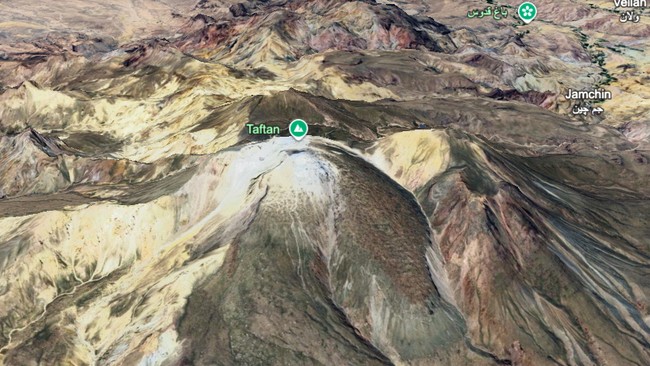
A volcano in southern Iran, thought to have been extinct for about 710,000 years, is now showing signs of life. The discovery has prompted researchers to consider the possibility of increased volcanic activity in the region.
A recent study published on 7 October in the journal Geophysical Research Letters found that the ground near the summit of Taftan volcano rose by about 3.5 inches, or 8.9 centimetres, over ten months, from July 2023 to May 2024.
According to the researchers, the change in the ground surface points to increased gas pressure beneath the volcano.
The finding, reported by Live Science, highlights the need for closer monitoring of Taftan. The volcano had not previously been considered a risk to people.
Study author Pablo González, a volcanologist at the Institute of Natural Products and Agrobiology, part of Spain’s National Research Council (IPNA-CSIC), stressed the importance of paying attention to changes in the area.
Although the ground uplift indicates changes beneath the volcano, the finding alone does not confirm that Taftan will erupt soon. Further monitoring is needed to understand what is causing the change and assess the potential risks.
A volcano is considered extinct if it has not erupted during the Holocene, which began 11,700 years ago. Given its recent activity, González said Taftan might more accurately be described as dormant.
“Somehow, it will erupt in the future, either explosively or more gently,” González told Live Science.
He said there was no reason to worry about an imminent eruption, but the volcano should be monitored more closely.
Taftan is a 12,927-foot (3,940-metre) stratovolcano in south-eastern Iran. It lies among mountains and volcanoes formed by the subduction of the Arabian oceanic crust beneath the Eurasian continent.
The volcano currently has an active hydrothermal system and smelly, sulphur-emitting vents known as fumaroles, but no eruptions have been recorded in human history.
When Mohammadhossein Mohammadnia, a doctoral student working under González at IPNA-CSIC, first examined satellite images of the volcano in 2020, he found no evidence of volcanic activity.
In 2023, however, people began reporting gas emissions from the volcano on social media. The emissions could be smelled in the city of Khash, about 31 miles (50 kilometres) away.
Mohammadnia revisited satellite images from the European Space Agency’s Sentinel-1 mission. Taftan is remote and has no GPS monitoring system of the kind used at volcanoes such as Mount St Helens. The area is also dangerous because of rebel-group activity and border conflict between Iran and Pakistan.
The satellite images showed a slight rise in the ground near the summit, indicating increased pressure beneath the surface.
Mohammadnia calculated that the source of the uplift was 1,608 to 2,067 feet (490 to 630 metres) below the surface. It is impossible to know exactly what is happening, but the researchers ruled out external factors such as nearby earthquakes or rainfall.
The volcano’s magma reservoir lies more than two miles beneath the surface, much deeper than the source of the uplift.
Instead, the uplift may have been caused by changes in the hydrothermal plumbing beneath the volcano that led to a build-up of gas. Alternatively, a small amount of magma may have shifted beneath the volcano, allowing gas to bubble into the overlying rock, raising pressure in its pores and fractures and causing the ground to rise slightly.
The next step in the research, González said, is to collaborate with scientists who monitor gas at the volcano.
“This study is not intended to cause panic among the public. It is a call for the authorities in the region of Iran to allocate some resources to investigate this,” González said.