
Don't Wait to Graduate: Start Preparing Your Career During Your Studies
Amid the rapid and increasingly competitive transformation of the job market, higher education institutions can no longer rest on being mere spaces for transferring knowledge. There is a far greater demand: ensuring graduates are genuinely prepared to face the realities of industry. The question is simple but crucial: are universities today effectively bridging academia and the world of work?
The reality shows that many graduates still feel uncertain when entering the professional world. Not due to a lack of intelligence, but due to a lack of readiness. The gap between theory learned in the classroom and practical work in the field remains a challenge that higher education must address.
This is where the urgency of changing the paradigm of higher education lies. Campuses must move from being merely knowledge providers to becoming career enablers. In other words, the education process should not be oriented solely towards graduation but also towards the comprehensive career readiness of students.
As part of the Digital Business Campus, Universitas Nusa Mandiri (UNM) seeks to answer this challenge through a more integrated approach. The curriculum is no longer designed statically but is crafted to adapt to industry needs.
Learning does not stop at theory but is reinforced by practical work, case studies, and relevant real-world experiences.
However, career readiness is not determined solely by hard skills. The current job market increasingly emphasises soft skills such as communication, leadership, critical thinking, and professional ethics. Unfortunately, these aspects are often neglected if not systematically designed into the education process.
Therefore, strengthening soft skills must be an integral part of the campus ecosystem. Students need to be equipped with the ability to craft a strong CV, to cope with interviews with confidence, and to build a credible personal brand in the digital space. This is not a fringe activity; it is a necessity.
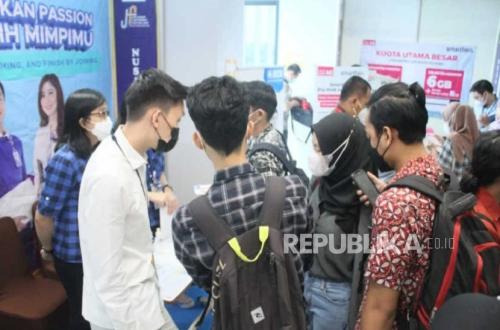
Moreover, campuses must open spaces for direct interaction with the industry. Collaborations with companies, internship programmes, and campus recruitment activities become important bridges so that students not only understand theory but also experience the dynamics of the working world early.
Through the Nusa Mandiri Career Center (NCC), these efforts are integrated into a single career development ecosystem. Students are not left to walk alone but are accompanied to recognise potential, sharpen competencies, and build professional networks.
This approach is important because a career is not built in a single night; it is developed through a deliberate process starting in university years.
We must honestly admit that a degree alone is no longer enough. The job market does not only look for graduates but for talents ready to contribute from day one. Those with experience, portfolios, and networks will have far stronger bargaining power.
Therefore, students can no longer delay career preparation until close to graduation. Rather, from day one of studies, the direction of the future must begin to be shaped. The campus, on the other hand, must exist as an ecosystem that seriously and sustainably facilitates that process.
Ultimately, the success of higher education is not measured solely by how many students graduate but by how well they can endure, develop, and make a real contribution in the world of work. To achieve this, synergy between the curriculum, lecturers, and career development support becomes the key.
It is time to stop viewing university as an end goal. University is a starting point. The question is, are we ready to make the most of it?