
Don't Get Confused! These Are the Differences Between LPG, CNG, and LNG
The government is currently studying the use of 3-kilogram Compressed Natural Gas (CNG) as an alternative to replace subsidised LPG. This step is being taken to reduce Indonesia’s dependence on LPG imports, which continue to drain foreign exchange reserves.
Minister of Energy and Mineral Resources (ESDM) Bahlil Lahadalia revealed that Indonesia imports around 8.6 million tonnes of LPG each year. The foreign exchange spent on purchasing LPG reaches approximately Rp130 trillion to Rp140 trillion per year, while the subsidy budget is in the range of Rp80 trillion to Rp87 trillion.
“This CNG is for the 3-kilogram size; we are still conducting exercises and trials on the cylinder. This CNG is expected to be one of the alternatives for substituting our large imports,” Bahlil said after an inauguration ceremony at the Ministry of ESDM.
Amidst these discussions, the terms LPG, CNG, and LNG are appearing more frequently. In fact, all three are types of gas with different characteristics.
Director General of Oil and Gas at the Ministry of ESDM, Laode Sulaeman, explained that LNG and CNG essentially have almost the same content, which is dominated by methane or C1. Meanwhile, LPG is dominated by propane (C3) and butane (C4).
“So, LNG and CNG have the same content, both are majority C1 and a little C2. But LPG is C3 and C4. Now, our fields produce very little LPG,” Laode said in a podcast.
This difference in composition means their physical forms also differ. LPG naturally transitions more easily into a liquid phase under certain pressures. Because of this, LPG can be stored in moderate-pressure cylinders, such as the 3-kilogram cylinders used by the public.
Meanwhile, CNG is natural gas that has been compressed through high pressure. Its content is dominated by methane and it remains stored in a gaseous phase. Its use is quite broad, ranging from gas-fuelled vehicles and public transport to the industrial sector.
From an environmental perspective, CNG produces lower greenhouse gas emissions compared to petrol and diesel. In the event of a leak, this gas also dissipates into the air more quickly because of its lighter density.
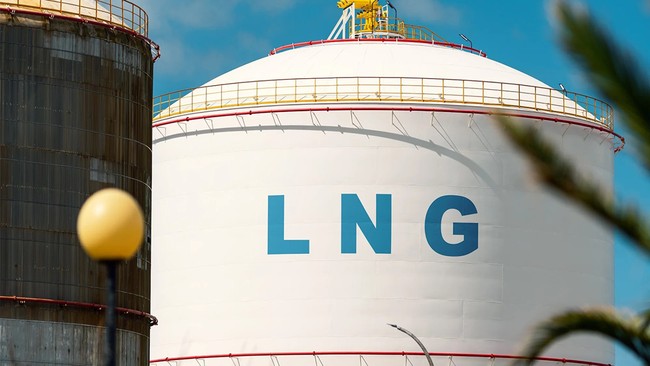
LNG is different again. LNG is natural gas that has been cooled to around minus 162 degrees Celsius, turning it into a liquid. The liquefaction process shrinks its volume by about 600 times compared to its gaseous form. This condition makes LNG more efficient for storage and shipping in large quantities.
Due to its high energy density, LNG is widely used for power plants, large industries, ships, and long-haul trucks. However, LNG distribution requires special facilities in the form of cryogenic tanks capable of maintaining extremely low temperatures.
From an energy security perspective, each gas has a different function. LPG has so far been the backbone of household cooking needs. CNG is more suitable for energy substitution in the transport sector and some household needs in areas close to gas sources. Meanwhile, LNG plays a major role in supporting industrial-scale energy needs and power generation.
These differences mean that the discourse on developing CNG as a replacement for LPG is not as simple as swapping the contents of a cylinder. Distribution infrastructure, cylinder design, and public consumption patterns are all factors that will determine its success.