
Donation Account Case: UMJ Expert Highlights Bank Mandiri Brand Trust
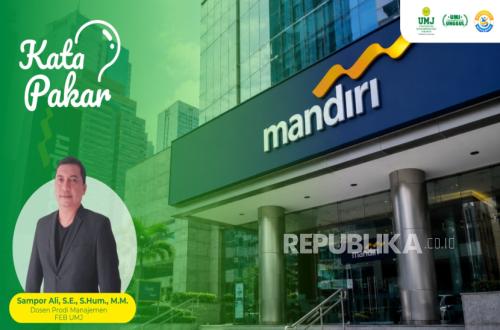
The case of the delayed transaction of a Bank Mandiri account belonging to Supriyono, coordinator of a demonstration in Pati, has drawn public attention. The account, said to contain around Rp 80.9 million, held personal funds and public donations for the protest.
Polda Metro Jaya explained that the request to the bank was for a transaction delay, not an account seizure, referring to Article 26 of Law No. 8 of 2010 on the Prevention and Eradication of Money Laundering (TPPU). Meanwhile, PPATK stated it did not request the account be blocked.
Sampor Ali, a lecturer in the Management Study Programme at the Faculty of Economics and Business, University of Muhammadiyah Jakarta (FEB UMJ), assessed that the issue is not only about legal aspects but also impacts Bank Mandiri’s branding.
According to him, the customer experience of seeing funds in an account become unusable can affect trust in the bank. “Brand trust is built on reliability, predictability, and perceived integrity,” he said in a statement on Friday (28/8/2026).
He added that customers must feel the bank can be trusted to safeguard funds, provide reasonable access, and act based on understandable rules.
Sampor assessed that public perception could develop into concerns about customer control over their funds when an account is requested to be delayed by authorities. This could affect trust more strongly than technical explanations from the bank.
“Public perception could develop into questions about whether customers still have control over their money,” he explained. This is especially so because initial information used the term ‘account blocked’, before it was later clarified that what occurred was a transaction delay.
According to him, one case does not immediately change Bank Mandiri’s image. However, the impact could become more serious if similar cases recur, are not well explained, or are framed as a symbol of political partisanship.
“What needs to be considered is not the amount of funds, but the symbolic meaning of the case. The public could see it not merely as a matter of one account, but question how independent the bank is in facing power,” he said.
Bank Mandiri’s position as a state-owned bank also has the potential to create perceptions of non-neutrality and perceived unfairness. On the other hand, negative narratives on social media, including #boikotmandiri, could develop into negative word of mouth affecting brand preference and customer loyalty.
Sampor assessed that Bank Mandiri has formally fulfilled its obligations based on the request of law enforcement officials. However, the bank still needs to pay attention to public perception of the action.
“Legally and procedurally, Bank Mandiri has done something correct. The challenge is explaining that position so the public does not see Bank Mandiri as a party siding with the government,” he said.
According to him, crisis communication strategy needs to prioritise speed, clarity, empathy, and evidence. Bank Mandiri needs to provide information quickly and consistently so there is no empty space that can be filled with negative narratives.
“Bank Mandiri must explain that the action was a transaction delay based on a request from law enforcement officials. The bank also needs to show evidence and explain the resolution mechanism so the public understands that their funds remain safe,” he said.
He also assessed that communication needs to prioritise empathy towards customer concerns about access to funds. The bank must show a fair and neutral position as a party carrying out requests from law enforcement officials.
Amid these risks, Sampor sees an opportunity for Bank Mandiri to strengthen its positioning as a professional, transparent, law-abiding, and impartial bank.
“That positioning is not enough with just a slogan. Bank Mandiri needs to prove it through strengthening SOPs, internal reviews, customer notification mechanisms, complaint handling, and public communication protocols,” he explained.
He also encouraged training for frontliners so they can explain the differences between blocking, transaction delays, and certain restrictions. This step makes governance and compliance part of the brand trust architecture.
Additionally, Bank Mandiri could provide education on the use of personal accounts to collect large amounts of public funds. Education needs to cover identification of fund sources, purpose of use, record-keeping, accountability, and compliance.
“If managing public funds, use a transparent, legal, and accountable mechanism. That way, Bank Mandiri can be seen as protecting the public, not restricting the public,” Sampor concluded.
Source: jawawa.id (https://jawawa.id/newsitem/donation-account-case-umj-expert-highlights-bank-mandiri-brand-trust-1787889086)
Originally published by Republika (https://news.republika.co.id/berita/tkgl9m472/kasus-rekening-donasi-pakar-umj-soroti-brand-trust-bank-mandiri), translated from Indonesian