
Domestic Workers Law and Care Economy Roadmap: A Transformation Towards Golden Indonesia 2045
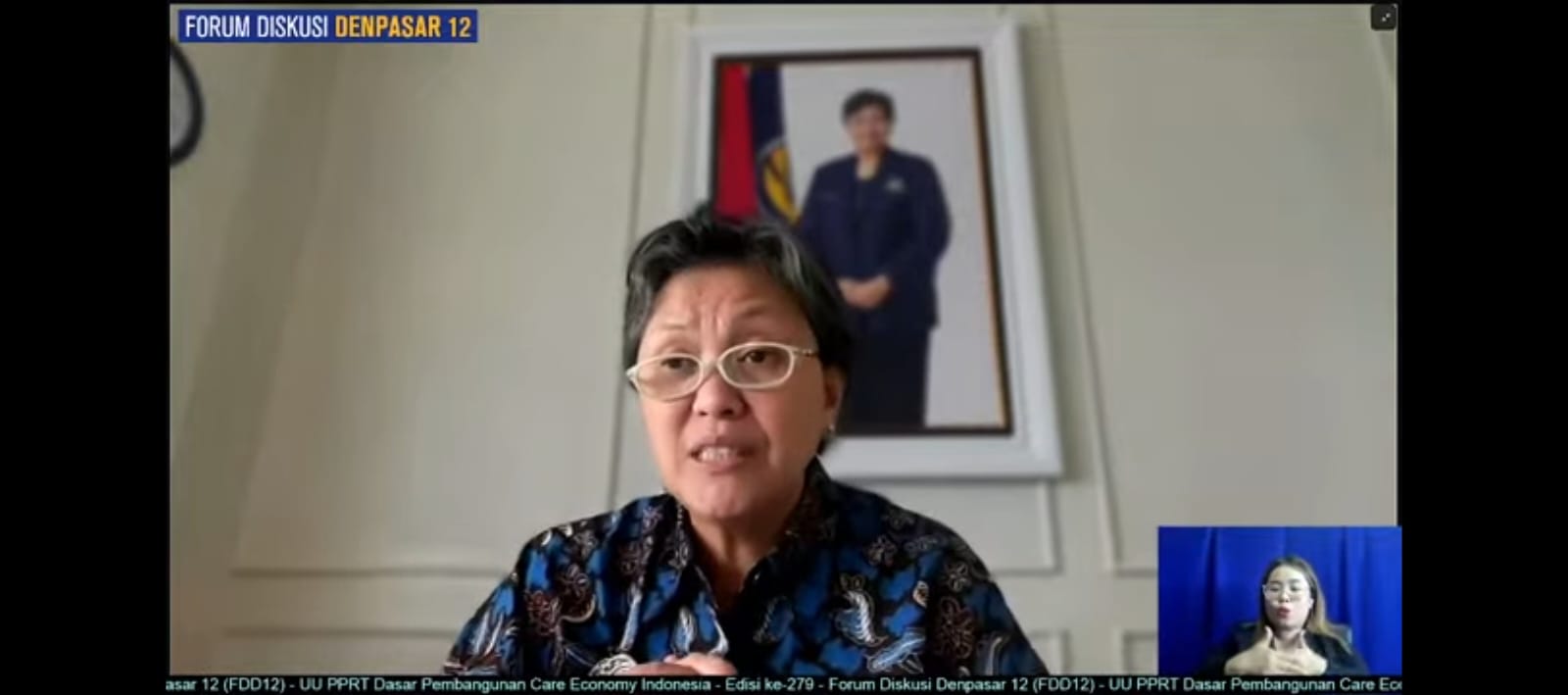
The ratification of the Domestic Worker Protection Law (UU PPRT) on 21 April 2026 and the drafting of the 2025–2045 Care Economy Roadmap mark a new chapter in Indonesia’s public policy. This strategic step is seen as a concrete effort to reinterpret national values into a more inclusive and equitable modern policy system. Deputy Speaker of the People’s Consultative Assembly (MPR), Lestari Moerdijat, stated that the UU PPRT is not merely a protective regulation but the foundation for building the care economy in the country. Speaking at an online discussion held by the Denpasar 12 Forum on Wednesday (17/6), she emphasised that the law legally transforms domestic work from an informal-private sector into a structured pillar of the national economy. Rerie, as she is familiarly known, stressed that fulfilling the rights of domestic workers is a tangible implementation of the second and fifth principles of Pancasila. “Ideologically, this is an effort to humanise workers and distribute gender and economic justice to marginalised groups,” she said. She added that strengthening the care economy structure is carried out through a four-pillar approach: recognition, redistribution, reduction, and reward. The Deputy for Human Development and Culture at the Ministry of National Development Planning/Bappenas, Pungkas Bahjuri Ali, revealed that the care economy sector is key for Indonesia to escape the middle-income trap. To achieve the 6%-7% economic growth target, optimising the care sector is essential, particularly in facing the phenomenon of an ageing population. Pungkas explained that the policy direction includes strengthening human resources, health, and the roles of women and persons with disabilities. In line with this, the Deputy for Gender Equality at the Ministry of Women’s Empowerment and Child Protection, Amurwani Dwi Lestariningsih, called the UU PPRT a historic milestone that will reduce gender gaps in workforce participation. The Head of the Worker Welfare Facilitation Team at the Ministry of Manpower, Endang Yuniastuti, stressed the repositioning of the term for domestic workers. “Domestic workers are not servants. Care work is valuable labour that drives the economy,” she asserted. The Ministry of Manpower recorded 4.2 million domestic workers in Indonesia in 2026 who require income certainty as mandated by the 1945 Constitution. Meanwhile, Member of House Commission IX, Nurhadi, reminded that derivative regulations and safe complaint mechanisms are needed for the law to be effective on the ground. Senior journalist Saur Hutabarat offered critical notes, questioning whether the work of housewives at home could be calculated as having economic value. He asked whether, if domestic workers’ jobs are formalised, a housewife’s work could be equated to a minimum wage, suggesting a figure of 70 percent of the regional minimum wage. Hutabarat also highlighted that while the UU PPRT protects domestic workers, the fate and contribution of housewives have not been considered in the regulation. He further noted that the population aged 55 and above currently stands at 51 million, and within five years they will enter the elderly phase, potentially increasing the demand for care economy services. Therefore, he urged that the role of the care economy be prepared from now to face this demographic shift. The ratification of the UU PPRT ends a struggle of more than two decades to provide legal protection for domestic workers. The Sarinah Institute has proposed a circular letter from the Ministry of Home Affairs to encourage data collection on domestic workers through neighbourhood units and village governments as an initial step.