
Dollar Surge: Yen, Rupiah, and Won Plummet, While China Outperforms US
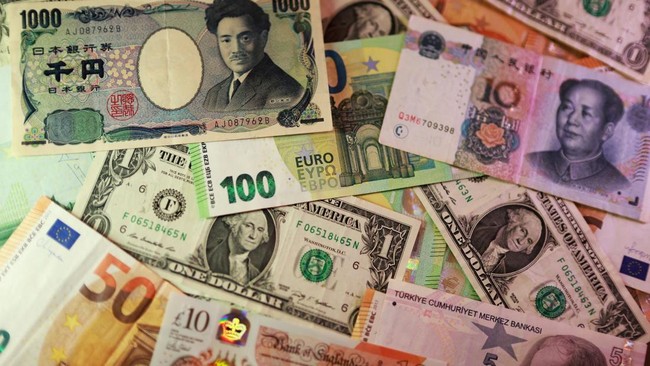
The US Dollar surged this week, causing widespread instability across Asian currencies. In the final trading session on Friday (18/09/2026), the Indonesian Rupiah managed a slight recovery, ending the day at Rp17,730/US$. Despite this marginal gain, the Rupiah recorded a weekly depreciation of 0.82%.
Most Asian currencies suffered losses this week, with the exception of the Chinese Yuan. The decline in Asian currencies followed the US Dollar Index climbing to the 100 level on Wednesday, following the US Federal Reserve’s decision to raise interest rates. The South Korean Won saw the sharpest decline, dropping 3.19%, followed by the Japanese Yen, which fell by 2.11%.
The Yen’s decline was particularly unexpected given that the Bank of Japan (BoJ) raised its policy interest rate to 1.25% on Friday, the highest level since 1995. However, the market perceived the decision as less hawkish than anticipated. Concerns that the BoJ might struggle to keep pace with the Federal Reserve’s tightening cycle also pressured the Yen, as the wide interest rate differential maintains the attractiveness of the yen carry trade.
The Federal Reserve raised its benchmark rate by 25 basis points on Wednesday (16/09/2026), marking its first increase since July 2023. The US central bank also signalled the possibility of further hikes this year due to persistent high inflation and expensive oil prices. Additionally, the Yen faced pressure as Prime Minister Sanae Takaichi’s administration adopted a cautious approach toward monetary tightening.
In contrast, the Chinese Yuan strengthened to CNY 6.69/US$ during Friday’s trading, reaching its strongest level since July 2022. This appreciation continues a trend observed since the start of the year, with the Yuan gaining approximately 4.2% against the US Dollar throughout 2026.
Wang Qing, Chief Macro Analyst at Golden Credit Rating, attributed the Yuan’s strength to two main factors: the retreat of the US Dollar Index following the Fed’s rate hike, and the deliberate direction of the Yuan’s central parity rate towards a stronger level. China’s solid export growth and relatively stable macroeconomic conditions also provided fundamental support. Wang expects the Yuan to fluctuate between 6.7 and 6.9 by the end of the year.
However, Guan Tao, Chief Economist at Huafu Securities, cautioned against overinterpreting the Yuan’s strength, noting that two-way fluctuations are normal. From a domestic fundamental perspective, China’s foreign trade remains stable, with strong export growth and steady macroeconomic development. In the long term, the onshore Yuan has appreciated by over 4.1% against the US Dollar since the beginning of the year.
Regarding the impact of the Fed’s rate hike, Wang noted that China has established a regulatory framework combining macroprudential policies and micro-supervision of cross-border capital flows. He suggested that the risks of significant volatility in capital flows due to diverging monetary policy cycles between China and the US can be effectively managed.
Lu Lei, Deputy Governor of the People’s Bank of China (PBOC), stated that China employs a managed floating exchange rate system. China allows market forces to play a decisive role in exchange rate formation while preventing herd behaviour and irrational market expectations. “China does not need, nor does it intend, to gain a competitive trade advantage through currency depreciation,” Lu remarked.
While Wang predicts the Yuan will maintain a stable to strengthening trend in the short term, he advised markets to monitor China’s export developments and the impact of major economies’ monetary policy adjustments on the US Dollar Index. Guan Tao added that while positive factors are dominant in the short term, a stronger Yuan could also lead to macroeconomic tightening, potentially affecting market sentiment.