
Dollar Rampages Again: Won, Ringgit, Yen, and Rupiah Collapse in Unison
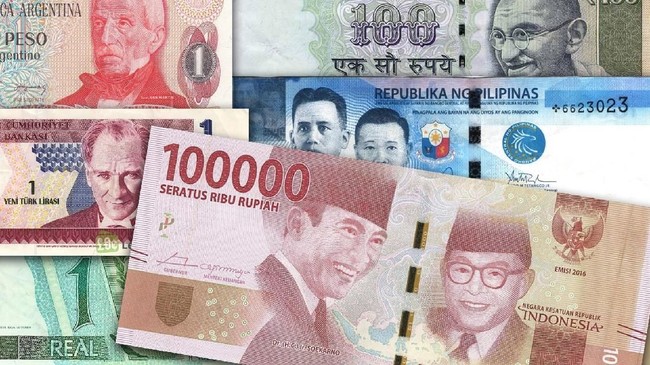
Asian currencies weakened collectively against the US Dollar in early trading on Monday (6/7/2026). The pressure occurred as the US Dollar Index began to move upwards once again.
According to Refinitiv data as of 09:20 WIB, out of the 10 Asian currencies monitored, all declined against the US Dollar. The Rupiah was dragged into the red, weakening by 0.25% to a position of Rp1.7990/US.ThispositionbringstheRupiahonceagainveryclosetothepsychologicallevelofRp18, 000/US.
The deepest pressure this morning was experienced by the South Korean Won, which weakened by 0.33% to KRW 1,534/US.TheTaiwanDollarfollowedwithacorrectionof0.29.
The Japanese Yen also corrected by 0.27% to JPY 161.79/US, whilethePhilippinePesofellby0.22, and the Thai Baht weakened by 0.18% to THB 33.19/US$.
The Malaysian Ringgit also weakened by 0.12% to MYR 4.072/US.TheChineseYuancorrectedby0.10, the Singapore Dollar fell by 0.06% to SGD 1.292/US$, while the Vietnamese Dong weakened slightly by 0.03%.
The weakness in Asian currencies occurred amidst the strengthening of the US Dollar in the global market. The US Dollar Index (DXY), which measures the strength of the greenback against six major world currencies, was observed to strengthen by 0.11% to 100.968 at the same time. This slight strengthening has exerted significant pressure on Asian currencies, particularly because the US Dollar position remains relatively high.
The US Dollar had actually faced significant pressure last week. The greenback recorded its deepest weekly decline since April after US labour data showed a sharp slowdown in job creation in June. This data led market participants to scale back expectations for interest rate hikes by the Federal Reserve (The Fed) this year. When expectations for rate hikes subside, the US Dollar typically loses some of its appeal.
However, the pressure on the US Dollar has not fully continued at the start of this week. OCBC strategists noted that the decline in the unemployment rate still indicates that the US labour market remains tight, meaning expectations for Fed policy tightening have not entirely disappeared.
“The broader outlook for the US Dollar remains constructive,” wrote an OCBC strategist, as quoted by Reuters. OCBC also maintains the view that the US Dollar has the potential to strengthen moderately by approximately 2-3% in the second half of 2026.
On the other hand, falling oil prices have helped alleviate some inflation concerns. If energy prices continue to decline, inflationary pressure may also decrease, further limiting the Fed’s room to raise interest rates.
Nevertheless, the market is still awaiting new clues from the minutes of the June Fed meeting. These minutes will be closely watched as they may provide insight into how policymakers view the direction of interest rates following the latest economic data.
A strategist from Commonwealth Bank of Australia suggested that this meeting’s minutes might be shorter or less indicative than usual. This aligns with the view of Fed Chair Kevin Warsh, who suggested the central bank had previously provided too much guidance to the market.