
Dollar Rampage: Rupiah, Yen, Ringgit, and Won Collapse in Unison
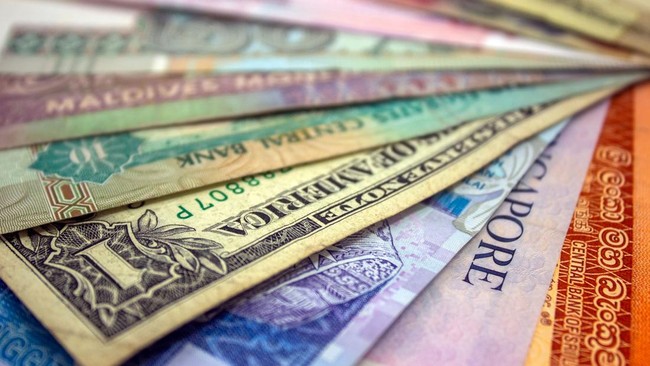
Asian currencies came under heavy pressure against the United States (US) dollar in early trading on Monday (13/7/2026), following a renewed strengthening of the greenback in global markets triggered by escalating conflict in the Middle East.
Citing Refinitiv data as of 09.15 Western Indonesia Time, nine out of ten monitored Asian currencies weakened against the US dollar, while one remained stagnant.
The rupiah was again among the currencies battered this morning. The Garuda currency weakened 0.39% to Rp18,115/US, pushingitfurtherabovethepsychologicallevelofRp18, 000/US.
The deepest pressure this morning was felt by the South Korean won, which weakened 0.38% to KRW 1,504.5/US$. The rupiah followed as the currency with the second-deepest correction in Asia.
The Thai baht was also under considerable pressure, weakening 0.30% to THB 33.35/US.TheJapaneseyencorrected0.21, while the Malaysian ringgit fell 0.20% to MYR 4.075/US$.
The Singapore dollar also weakened 0.15% to SGD 1.293/US, followedbythePhilippinepesowhichfell0.09.
Lighter pressure was seen on the Chinese yuan, which weakened 0.05% to CNY 6.78/US, andtheTaiwandollar, whichcorrected0.02.
The Vietnamese dong was the only currency that did not move this morning, holding steady at VND 26,261/US$.
The weakening of Asian currencies this morning occurred amid a strengthening of the US dollar index (DXY). The DXY was observed strengthening 0.19% to 101.141 at the same time. This DXY strengthening indicates the US dollar is being sought after again by market participants.
The US dollar strengthened against the majority of major world currencies after the conflict in the Middle East heated up again. Over the weekend, US and Iranian forces exchanged large-scale missile and drone attacks.
Tehran targeted US facilities in several Gulf countries on Sunday. Iran also stated it would once again close the Strait of Hormuz, a vital global energy trade route.
These conditions immediately lifted oil prices at the start of Asian trading. The price of Brent crude rose 3.3% to US$78.49 per barrel.
Tony Sycamore, a market analyst at IG in Sydney, said the current strengthening of the US dollar is closely linked to the rise in oil prices.
“After the escalation over the weekend that continued throughout, the dollar responded, and crude oil prices are the driver,” Sycamore said, as quoted by Reuters.
According to him, the rise in energy prices has reignited concerns that inflation could increase again. If energy prices continue to rise, the market may begin to bring forward expectations of interest rate hikes.
“This has reignited concerns that if energy prices rise from here, we could start to see rate hikes brought forward,” Sycamore said.
Market participants are now leaning towards expecting the US central bank (The Federal Reserve/The Fed) to raise interest rates twice by the end of the year. Based on the CME FedWatch, fed funds futures are pricing in a 52.1% chance of two or more rate hikes by the December meeting. This figure is up from 47.6% on Friday last week.
Westpac, in its research, assessed that inflation risks will remain the market’s focus this week. Investors’ attention is on the release of US consumer inflation data (CPI) on Tuesday, followed by producer price data (PPI) the next day, as well as testimony from Federal Reserve Chair Kevin Warsh before the US House of Representatives and Senate.