
Dollar Falters in Asia: Ringgit Leads, Rupiah and Won Also Gain
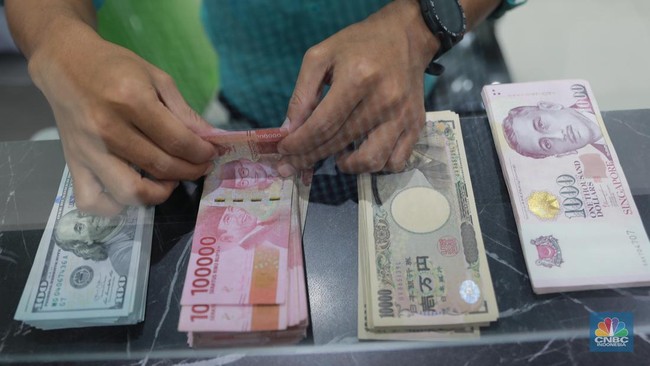
Jakarta, CNBC Indonesia – As the weekend approaches, Asian currency markets are enjoying a tailwind. Most Asian currencies strengthened against the US dollar in trading on Friday (30 October 2026), as the greenback lost considerable ground.
Refinitiv data at 9.20 am WIB showed that seven of the 10 Asian currencies monitored were up against the US dollar, while the other three remained in negative territory.
The Malaysian ringgit posted the strongest gain that morning, rising 0.27% to MYR4.046 per US dollar.
The Japanese yen followed with a 0.16% rise, while the rupiah strengthened 0.14% to Rp18,100 per US dollar.
The South Korean won and Singapore dollar each gained 0.12%. The Philippine peso rose 0.05%, while the Chinese yuan edged up 0.03%.
By contrast, the Taiwan dollar came under the heaviest pressure, falling 0.15%. The Thai baht lost 0.03%, while the Vietnamese dong edged down 0.02%.
The greenback also weakened as US government bond yields fell. The US dollar index, or DXY, was down 0.28% that morning at 101.744.
This time, the pressure on the dollar came from a somewhat different source. Concerns about artificial intelligence (AI) companies prompted a sell-off in US equities and led investors to shift into US government bonds.
Demand for those bonds pushed their prices higher and yields lower. The yield on 10-year US Treasuries stood at around 4.8958%, while the 30-year yield fell to 5.2623%. Both were at their lowest levels in more than a month.
The fall in yields, in turn, reduced the appeal of the US dollar.
“Market reaction looks different from the usual risk-averse pattern triggered by energy prices,” said Sim Moh Siong, an OCBC foreign-exchange strategist, according to Reuters.
“Rather than supporting the US dollar and pushing US yields higher, AI concerns centred in the US have instead coincided with falling Treasury yields and a weaker or more subdued US dollar,” he added.
Concerns about the AI sector intensified again after Alphabet’s earnings report prompted questions about the scale of its spending on AI development. The sentiment weighed on equity markets and increased demand for government bonds.
Despite its decline that morning, the US dollar remains on an upward trend, having gained about 0.3% over October. If it holds, this would mark a second consecutive month of gains.