
Dollar Dominates Asia: Rupiah Weakens, Yen Bleeds, Won Celebrates
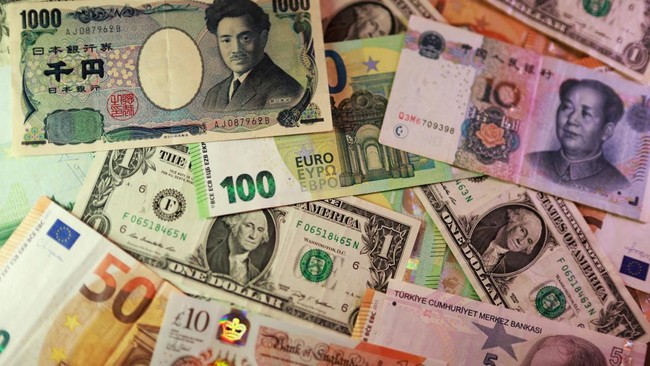
Asian currencies moved in varied directions amid a surge in the United States (US) dollar. The Indonesian rupiah exchange rate closed weaker against the US dollar in trading on Friday (24/7/2026). The Garuda currency even briefly approached the psychological level of Rp18,000/US$ before paring its losses towards the end of trading. According to Refinitiv, the rupiah closed 0.28% weaker at Rp17,935/US.Onaweeklybasis, therupiahalsoweakenedbyaround0.28.
Weakness was also experienced by a number of Asian currencies, from the yen to the rupee. The yen collapsed 0.89% this week. The depreciation was triggered by the raging US dollar. The dollar index ended at 100.468, its highest position since 24 June 2026. Conversely, the won soared, strengthening 1.89% this week. This increase was good news after the won was battered earlier this month. The yen collapsed 0.89% last week, further extending its negative trend. The Japanese yen recorded its largest weekly depreciation since May and moved closer to the psychological level of JPY165 per US dollar. This weakness triggered speculation that the Japanese government will again intervene in the foreign exchange market. Pressure on the yen was triggered by a combination of soaring oil prices due to the Middle East conflict, a strengthening US dollar, and expectations that the Federal Reserve will maintain high interest rates for longer. These conditions pushed US bond yields higher and caused investors to continue hunting for dollar-based assets. In trading this week, the dollar briefly touched JPY163.99, the weakest level for the Japanese currency since 1986. The yen is only a short distance from the 165 level, which the market views as an important threshold before the Japanese government takes more aggressive steps. Although Japanese authorities again warned they are ready to take firm action to stabilise the yen, market participants believe unilateral intervention will be difficult to reverse the weakening trend without support from a Bank of Japan (BoJ) rate hike or a change in US monetary policy direction. Analysts assess that unilateral intervention by the Japanese government will struggle to halt the yen’s depreciation as long as the strengthening US dollar and rising US bond yields remain dominant factors. Sompo Institute Plus Senior Economist Masato Koike even warned that the market needs to prepare for the possibility that the government will not intervene, so the yen could potentially weaken further.
On the other hand, the US Department of the Treasury also highlighted the yen’s weakness. In its semi-annual report, Washington assessed that excessive exchange rate volatility is undesirable and encouraged the Bank of Japan (BoJ) to continue maintaining market stability. However, market participants still believe that warnings from Tokyo and Washington will not be followed by concrete action. The yen’s depreciation also increases inflationary pressure in Japan as the cost of energy and raw material imports soars. On the other hand, this condition benefits Japanese exporters because their products become cheaper in the global market.
Meanwhile, despite the won’s sharp strengthening, the US Department of the Treasury has again placed South Korea on its currency monitoring list. Washington assessed that the won’s exchange rate remains under pressure, even though the country recorded a large current account surplus and has strong economic fundamentals. In the semi-annual report released on Thursday (local time), South Korea was again included on the list alongside China, Japan, Taiwan, Singapore, Vietnam, Germany, Ireland, Switzerland, and Thailand. The list is unchanged from the January report. South Korea met two of the three criteria for inclusion on the monitoring list, namely recording a trade surplus with the US of US$45 billion and a current account surplus reaching 6.6% of Gross Domestic Product (GDP). However, Seoul did not meet the third criterion because it did not engage in sustained one-way intervention in the foreign exchange market. Throughout the reporting period, South Korean authorities actually sold US dollars worth about 1.5% of GDP. This marks the fourth consecutive time South Korea has been placed on the monitoring list since the report covering the second half of 2024. The US Treasury noted that the surge in South Korea’s current account surplus was mainly driven by strong exports of semiconductors and technology products. However, according to Washington, the won’s depreciation is inconsistent with Korea’s solid economic fundamentals. “Despite these large external surpluses, the Korean won remained under sustained depreciation pressure,” the US Treasury wrote in its report. The report also mentioned that the heavy flow of overseas investment by households, financial institutions, and the National Pension Service (NPS) was one of the factors pressuring the won’s exchange rate over the past year. On the other hand, the US Treasury appreciated Seoul’s steps to ease foreign investor access to the domestic foreign exchange market. The policy is considered likely to improve liquidity and enhance the price discovery mechanism in South Korea’s financial market in the medium term. Daishin Securities analyst Lee Jung-hoon said the report is now more routine and no longer carries significant policy implications. “This report was once a concern at the beginning of President Donald Trump’s administration. However, because it did not produce concrete actions, its impact on the market is expected to be very limited,” he said. A similar view was expressed by NH Investment & Securities analyst Kwon A-min. According to him, the US Treasury’s currency report is increasingly formal and has lost the strong political nuance it once had.