
Dollar at Rp17,000 During the 1998 Crisis: How the Coordinating Minister in Suharto's Era Revived the Rupiah
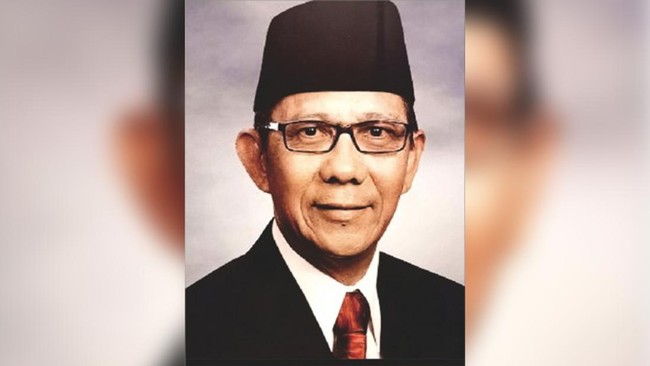
Jakarta, CNBC Indonesia - Former Coordinating Minister for the Economy, Finance, and Industry (Menko Ekuin) in President Suharto’s era, Ginandjar Kartasasmita, shared the government’s strategies at that time in stemming the rupiah’s fall during the 1998 monetary crisis.
During that period, the rupiah exchange rate once plunged to around Rp16,000-Rp17,000 per US dollar, far from its pre-crisis level of around Rp2,300-Rp2,400.
Ginandjar stressed that the core of the crisis at that time was not merely a monetary issue, but the collapse of market confidence in Indonesia’s economy.
“In every crisis, the key is to restore confidence. Both market confidence in the economy and public confidence in the government,” he said at the launch of the biography book Ginandjar Kartasasmita: Pengabdian dari Masa ke Masa: Perjalanan, Pergulatan Hidup dan Pemikiran, quoted on Friday (10/4/2026).
The pressure on the rupiah at that time was triggered by market panic that prompted economic actors to rush to hoard US dollars. This condition drained foreign exchange reserves and worsened banking liquidity in foreign currency.
“The rupiah fell freely because the market truly lost confidence,” said Ginandjar.
Facing this situation, the government targeted strengthening the rupiah back below Rp10,000 per US dollar as a psychological level more acceptable to the market. However, such efforts were not sufficient with domestic policies alone. Ginandjar emphasised the importance of international support to restore Indonesia’s economic credibility.
The government at that time collaborated with the International Monetary Fund and World Bank to obtain foreign exchange support amid dwindling reserves.
“Foreign exchange reserves at that time were very limited because they kept flowing out. We received support from the IMF and World Bank, although accompanied by various conditions,” he said.
According to him, this support was not only about additional liquidity but also an important signal to the global market that Indonesia was serious about economic reforms. The restored international confidence then helped stem the rupiah’s weakening trend while paving the way for gradual recovery.
In addition to external factors, domestic policy coordination also became a determinant. Synergy between the government, particularly the Ministry of Finance and Bank Indonesia, was deemed crucial in maintaining consistent stabilisation steps. Other measures taken included restructuring the banking sector, including closing problematic banks to restore financial system credibility.
Ginandjar also emphasised that printing money is not a solution in a confidence crisis situation. He stated that what is more important is ensuring the rupiah is once again trusted as a medium of transaction and investment by the public.
“The most important thing in facing any monetary crisis, whatever the cause, in my view, is the rupiah… But how to restore confidence so that the rupiah does not fall too much,” he said.
These strategies gradually bore fruit. Within about one and a half years, the rupiah exchange rate managed to strengthen back to around Rp7,000-Rp8,000 per US dollar. This recovery became one of the indicators that market confidence began to return after collapsing at the peak of the crisis.
This experience serves as an important lesson that economic crises are essentially crises of confidence. Therefore, policy responses must be directed not only at stabilising numbers but also at restoring public and investor confidence in the national economy’s direction. His experiences in the wheels of government are poured into his biography book.
“Originally just as a book, I hope it becomes a note for future generations. Notes on past experiences, observations of the past and present, and what we hope will be a concern for future generations,” said Ginandjar.
Source: jawawa.id (https://jawawa.id/newsitem/dollar-at-rp17-000-during-the-1998-crisis-how-the-coordinating-minister-in-suhartos-era-revived-the-rupiah-1775785848)
Originally published by CNBC Indonesia (https://www.cnbcindonesia.com/news/20260410073106-4-725513/dolar-rp17000-di-krisis-98-begini-menko-era-soeharto-pulihkan-rupiah), translated from Indonesian