
Does the 5 Per Cent Threshold Increase Aim to Block PSI from Parliament? Academic Analysis
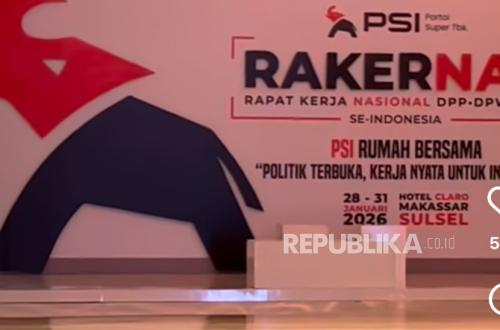
The discussion regarding increasing the parliamentary threshold to 5 per cent is viewed as a potential arena for competing political interests during the revision of the Election Law. Professor Aditya Perdana, a specialist in Political Institutionalisation at the Faculty of Social and Political Sciences, University of Indonesia (UI), stated that the PSI (Indonesian Solidarity Party) is one of the parties that needs to closely monitor these regulatory changes, as they could impact the chances of non-parliamentary parties entering the DPR.
Furthermore, Aditya responded to the Constitutional Court’s ruling, which mandates the involvement of non-parliamentary parties or election participants in the discussion of the parliamentary threshold. He assessed that the discourse regarding the threshold increase emerging from parliamentary parties should be viewed within the context of the current government’s political interests.
“All of this certainly has an objective. In the context of the current administration, the intention may be to limit the existence or survival of non-parliamentary parties,” Aditya said on Thursday (17/09/2026).
According to him, such restrictions could be related to efforts to maintain the existing power configuration. “In this way, their opportunity to strengthen the government continues uninterrupted. Thus, the status quo is maintained,” he added.
On the other hand, Aditya noted that increasing the threshold to 5 per cent could also create problems for parties whose electability hovers around that figure. He mentioned several parties that might face challenges in meeting the new threshold.
“The challenge lies with those on the borderline; there are many parties in the 5 to 7 per cent range, such as PKS, PAN, and NasDem. The question is whether they can survive at that level,” he said.
Additionally, Aditya predicted that discussions on changing the electoral system could become protracted if various issues are debated as a single package. He believes the parliamentary threshold change may overlap with the interests of parties possessing different political strengths.
“What is truly crucial and nerve-wracking is if these changes are bundled. If the discussion on the electoral system is presented as a package, I suspect there will be shifts and instability,” he remarked.
“If the tendency is to bundle issues that the ruling party, Gerindra, does not agree with, there may be further shifts. However, my suspicion is that this is intended to hinder PSI,” he added.
He emphasised that this suspicion remains an interpretation of current political dynamics rather than a confirmed conclusion. “There is a suspicion that the direction is heading there, but PSI is also working hard on its own matters,” he said.
Aditya touched upon PSI’s position, noting that the party is attempting to strengthen its political existence, even by invoking the name of Indonesia’s 7th President, Joko Widodo, in its political communications. He assessed that changes to the parliamentary threshold rules could become a significant challenge for PSI, though the outcome depends on the ongoing progress of the Election Law Bill.
“That is one of the targets. We shall see,” said Aditya.
Regarding the difficulty of the Election Law Bill discussions, Aditya noted that information suggests the process is still facing conflicting interests between parties. “It is not easy because of these matters. We shall see; there is still a long way to go,” he concluded.