
Doctor of Law Proposes Sociopreneurship Policing to Strengthen Community-Based Security
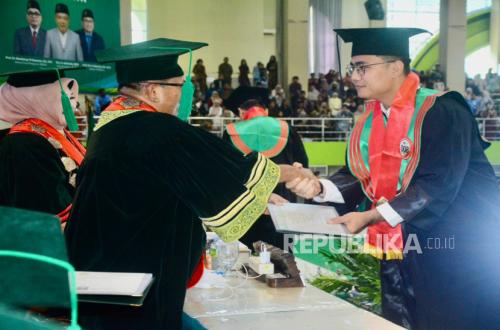
Kompol M. Fadli Amri, a member of the Indonesian National Police currently serving at the SSDM Mabes Polri, has officially earned a Doctor of Law degree from Sultan Agung Islamic University (UNISSULA) in Semarang. The alumnus of the Police Science Master’s programme at STIK-PTIK completed his education in approximately three years.
In his academic process, Fadli was guided by Promotor Jawade Hafidz and Co-Promotor Anis Mashdurohatun. Under their supervision, Fadli completed doctoral research focused on developing the concept of sociopreneurship policing, a policing approach that integrates police science, social entrepreneurship, community collaboration, and crime prevention based on community empowerment through social enterprise activities.
Sociopreneurship policing integrates police science, social entrepreneurship, community collaboration, and crime prevention, positioning the National Police as an initiator, facilitator, and catalyst for socio-economic community empowerment. Through this approach, police officers with social entrepreneurial capacity can initiate or encourage business activities that generate social impact, create jobs, strengthen community resilience, and reduce socio-economic factors that may drive criminal acts.
As a graduate of STIK-PTIK, Fadli has a particular interest in developing police science, especially in examining the relationship between the police, the community, security, social order, and crime prevention. According to him, policing should not only be understood within the framework of law enforcement, but also as an institution present in the community to build trust, strengthen social resilience, and help prevent crime from its root causes.
The sociopreneurship policing concept Fadli proposes is a policing approach that uses social entrepreneurship as an instrument to create social value, strengthen collaboration between the National Police and the community, and prevent crime influenced by socio-economic factors. This approach places the police, the community, and stakeholders in an equal, mutually reinforcing relationship oriented towards creating social order.
Within this concept, the role of the police is two-directional. First, police officers with skills, interests, and concern in social entrepreneurship can initiate or run social enterprise activities that benefit the community. Second, police officers can also act as motivators, connectors, and facilitators to encourage the community, MSMEs, local communities, the private sector, academics, and related stakeholders to build productive businesses that create jobs and strengthen the community’s economy.
Thus, sociopreneurship policing does not oblige every police officer to become an entrepreneur, but opens space for those with the ability and passion in social entrepreneurship to contribute more broadly. This role must still be carried out within the corridors of rules, professional ethics, integrity, transparency, and free from conflicts of interest. In this way, social entrepreneurship is understood not merely as a personal economic interest, but as a space for service that generates social benefits.
This idea stems from the view that some criminal acts cannot be separated from economic issues, such as poverty, unemployment, weak access to jobs, and limited empowerment opportunities. Therefore, crime prevention is not sufficiently achieved through law enforcement, surveillance, or prosecution alone, but must also address the social factors that can push someone into a cycle of criminality.
The spirit of sociopreneurship policing can also be seen in various social service practices already carried out by police officers in several regions. For example, a police officer in Cirebon developed waste processing to help the local economy. In East Java, an officer opened a humanitarian service space to care for and rehabilitate people with mental disorders. There are also examples of officers establishing free schools or Islamic boarding schools for children from underprivileged families. These practices show that the presence of police officers in the community can go beyond formal functions, helping to deliver real social solutions.
Fadli stated, ‘The National Police should not only be present when a crime has already occurred. The police also need to continuously develop approaches that are more preventive, humanistic, and empowering. Sociopreneurship policing is an effort to re-examine the role of the police in a broader social context, namely how the police’s presence can help create social value, open spaces for empowerment, and strengthen community resilience.’
Conceptually, sociopreneurship policing is built upon the foundations of police science, community policing, social entrepreneurship, entrepreneurial policing, and social crime prevention. With these foundations, the concept is not intended to replace the police’s primary function in law enforcement, but rather to complement it through a crime prevention approach that is more participatory, collaborative, and directly impactful for the community.
Fadli hopes this idea can become a contribution to strengthening police science and policing practices in Indonesia. Through a research-based approach, sociopreneurship policing is expected to enrich perspectives on the police’s role in building closer relationships with the community, while simultaneously encouraging the creation of sustainable socio-economic empowerment spaces.
Fadli’s graduation as a Doctor of Law also sends a positive message that National Police members continue to strive to enhance their intellectual capacity, professionalism, and social sensitivity.