
Do Not Ignore: Destruction and Death Continue in Gaza
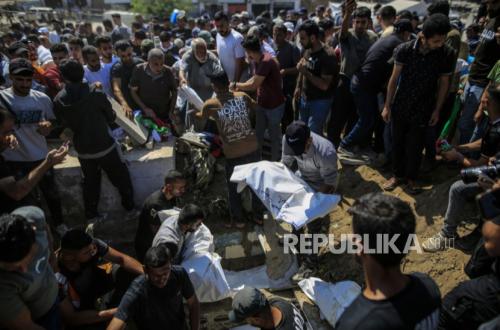
The Spokesperson for the International Committee of the Red Cross (ICRC), Pat Griffiths, stated that although the intensity of the conflict has decreased since last year’s ceasefire, death and destruction are still faced by Palestinians in the Gaza Strip every day. He warned that the crisis there continues even when the issue of Gaza is no longer a headline.
“Let us be clear: death and destruction for Palestinians in Gaza continue every day. The suffering is real, present, and here every day—even when Gaza is not making the headlines,” said Griffiths during a visit to Gaza on Friday (18/9/2026), as reported by Anadolu Agency.
He emphasised that Gazans currently still lack access to healthcare, food, education, and other basic services or necessities. “Many are still losing loved ones, not knowing whether they are detained or deceased,” he said.
Griffiths stated that, in addition to media services, the critical aid currently desperately needed by Gazans is food, clean water, and shelter.
According to Griffiths, humanitarian access remains one of the greatest challenges faced by the ICRC team working in Gaza. “To help those in need, we must be able to reach them—wherever they are, including in places of detention. That is not always possible,” he said.
He revealed that access can be restricted due to security issues or because those with the authority to grant access do not do so. In this context, Israel, as the occupying power, should open access for the delivery of humanitarian aid.
“Providing humanitarian access is an obligation for the parties involved in armed conflict and the occupying power. This is also something that is beyond our control as humanitarian workers,” said Griffiths.
However, he mentioned that the ICRC continues to strive to build dialogue with the authorities so that humanitarian access in Gaza can be improved. “People still desperately need better access to quality and nutritious food. Hospitals and primary healthcare centres still face shortages of medicines and medical supplies,” he said.
“Heavy machinery and materials that could be used to safely clear rubble, search for human remains, or repair damaged water and sanitation systems face entry restrictions,” Griffiths added.
He also reminded that most Gazans have currently lost their livelihoods. This is because Israeli aggression for over two years has destroyed various infrastructures in the region.
The effect of the loss of livelihoods is that the circulation of money is becoming increasingly scarce. This results in residents being unable to purchase their needs even when what is required is available in the market.
“All of this makes life more difficult for Palestinians in Gaza today. That is why we continue to call for unimpeded and unrestricted access to those in need for essential food, goods, medicines, and other items,” he said.
He revealed that in dialogue with the Israeli authorities, the ICRC continues to call for international humanitarian law to be upheld in Gaza. “That is why, in our dialogue with the Israeli authorities, we continue to call for international humanitarian law, which seeks to reduce the suffering of civilians during armed conflict, to be enforced,” he said.
“That is why we continue to call for the necessary political will to seek dialogue and sustainable solutions to improve the lives of Palestinians in Gaza. Too many lives are at stake for anything less,” Griffiths added.