
DKI Jakarta Allocates Rp90 Billion to Construct Integrated Utility Networks on Strategic Roads
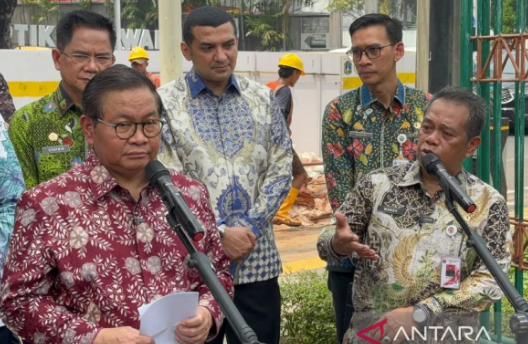
The Jakarta Provincial Government has allocated a budget of Rp90 billion for the construction of Integrated Utility Networks (SJUT) spanning 16.9 kilometres during this year.
The Head of the Jakarta Public Works Agency, Heru Suwondo, explained that the integrated utility network project will be spread across several points and strategic road segments in Jakarta. “Our budget for building this SJUT is Rp90 billion,” Heru stated in South Jakarta on Thursday.
Heru detailed that the works include the MT Haryono, Gatot Subroto, Dr. Supomo, KH Abdullah Syafei, Saharjo, Pemuda, Otista, Tebet Barat Dalam Raya, Matraman, and Jatinegara areas. “The length is 16.9 kilometres, and the locations are MT Haryono, Gatot Subroto, Supomo, Abdullah Syafei, Saharjo, Pemuda, Otista, Tebet Barat Dalam Raya, Matraman, and Jatinegara. Those are the locations,” he continued.
Jakarta Governor Pramono Anung is optimistic that the long-term target of improving the capital’s appearance can be achieved within five years. The Jakarta Provincial Government will open opportunities for open and professional cooperation for the private sector interested in investing.
“So, for 90 billion, 16.9 kilometres. You just have to multiply it to see how long it will eventually be. But the point is, the Jakarta Government, in order to provide, handle, and make Jakarta much more beautiful, comfortable, and organised, has launched this programme for the long term,” said Pramono.
Meanwhile, the Jakarta Central Bureau of Statistics (BPS) recorded that Jakarta experienced a monthly inflation rate of 0.15 per cent in August 2026. It was noted that the arrangement of population distribution and mobility is necessary to ensure population growth aligns with the region’s carrying capacity and capacity.
Vital sectors such as health, education, social protection, and transportation are ensured to continue functioning to reduce social inequality in the capital. The uneven coverage of public transport services remains one of the challenges in increasing the use of public transport in the Jabodetabek area.