
DJKI Tests GI Tourism Route in Dieng Region
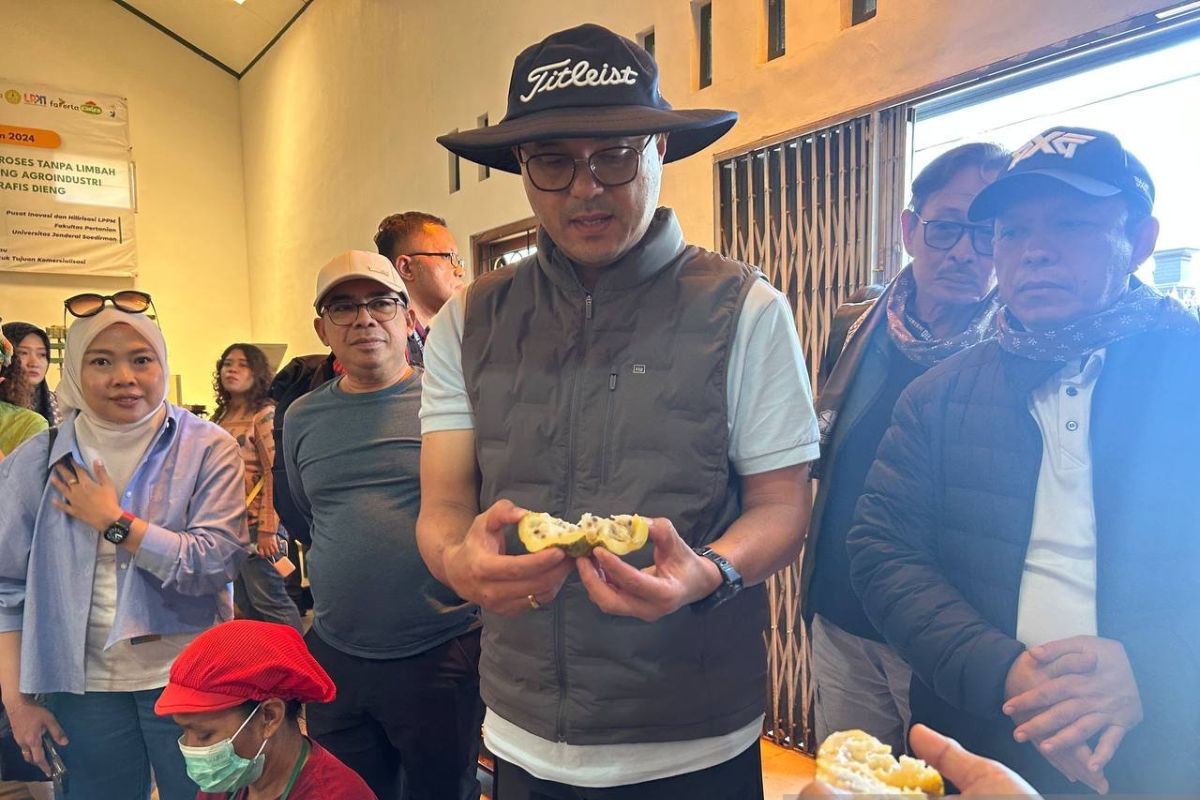
The Directorate General of Intellectual Property (DJKI) of the Ministry of Law held a trial run for Geographical Indication (GI) Tourism in the Dieng region, covering Banjarnegara and Wonosobo, Central Java, on Monday.
In this trial, the DJKI invited various stakeholders, including the media, content creators, travel and hotel associations, representatives from the Creative Economy, local governments from Banjarnegara and Wonosobo, and the GI Protection Community (MPGI).
This trial run serves as a preparatory stage leading up to the soft launch of GI Tourism for the Dieng region, scheduled for October 202.
Officials explained that while tourists have long recognised Dieng’s agricultural products as souvenirs, they often remain unaware of the history and origins of these goods. Through GI Tourism, the authenticity of geographically indicated products is protected, ensuring that local communities reap the benefits.
GI Tourism encompasses culinary experiences, local entrepreneurs, and ecotourism, spanning from upstream production to downstream consumption, all of which can be utilised by local residents.
“Through GI Tourism, visitors can learn; there is education and socialisation involved. The difference is that this tourism includes an educational element,” stated Fajar, a representative from the DJKI.
According to Fajar, Dieng is an attractive destination widely known to international tourists for its beautiful nature, which also houses various geographically indicated products.
“This is why Dieng was chosen as the pilot project for GI Tourism,” Fajar explained.
He noted that there are currently three products in Dieng with geographical indications: Carica Dieng, Purwaceng, and Dieng Mountain Arabica Coffee.
“These three products are what we are developing and utilising as concrete evidence that geographical indications can benefit the local community,” said Fajar.
The visit began in Kampung Gagot, Banjarnegara Regency, which offered a traditional local breakfast.
Participants sampled various types of rice, including nasi tiwul, nasi jagum, and ketupat cooked with rice husks, alongside ayam petis, buntil, and urap.
Following this, participants visited the Carica Dieng processing centre at UD Podang Mas, a business established in 1980.
At this location, participants learned about the origins of Carica Dieng, which was brought by the Dutch to be planted in the Dieng region.
“Carica is part of the papaya family. If planted above 1,900 metres above sea level, it becomes Carica; below that, it grows as papaya,” explained Rumi Wikaningtyas, the second-generation owner of UD Podang Mas.
After visiting the production house, the trial participants were taken to a Carica plantation on the slopes of Mount Pakuwaja in Parigesit Village, Wonosobo.
In the plantation, participants met the owner, Subiyati (47), who introduced her intercropping farming system. Alongside the Carica trees, jakon tubers and spring onions are planted.
“This jakon tuber is similar to jicama; it can be eaten raw. Although we call it a tuber, it is a fruit that can be consumed directly,” she said.
The visit continued to the Tuk Bimo Lukar cultural heritage site, a bathing place built near the Dieng temple complex in the 8th century, which also serves as the headwaters of the Serayu River.
“The Tuk Bimo Lukar site is evidence that the Dieng community has practised water resource conservation since ancient times,” said the guide.
The trial run proceeded to the Purwaceng plantation on Bukit Sekunir, at an altitude of 2,500 metres above sea level, managed by Uswatun Hasanah (45).
Purwaceng, scientifically known as Pimpinella pruatjan, is a herbal plant with a long history of use in traditional herbal drinks.
Visitors were invited to taste a warm cup of Purwaceng infusion, known for its health benefits in maintaining physical fitness.
DJKI has designated Dieng as a pilot project for GI Tourism to enhance the protection of intellectual property.
A Geographical Indication (GI) is a sign used to indicate the origin of a good and/or product, where the quality, reputation, or other characteristics are essentially attributable to its geographical origin, including natural and human factors.
Geographical Indications provide a specific reputation, quality, and characteristics to the products produced. The marks used for GI can take the form of labels or symbols attached to the products, which may include place names, images, letters, or a combination of these elements.