
Dividends and Hajj Season Drive US Dollar to Rp17,630
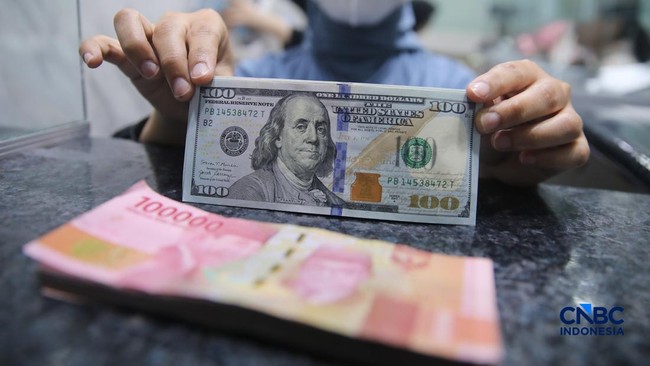
The rupiah exchange rate has weakened again against the US dollar. According to Refinitiv data, the Indonesian currency opened in the red during Monday’s trading (18/05/2026), depreciating sharply by 0.97% to the level of Rp17,630/US$.
Mayrdal Gunarto, Chief Economist at Maybank Indonesia, assessed that the strengthening dollar is driven by expectations regarding the monetary policy direction of the US central bank, the Federal Reserve. Market participants see a diminishing probability of US interest rate cuts this year. “In fact, there is a possibility that the Fed’s interest rates will rise this year after observing US inflation developments from the Consumer Price Index side, which rose to 3.8% year-on-year in April 2026,” Gunarto told CNBC Indonesia.
In addition to external factors, domestic pressure is also believed to be exacerbating the rupiah’s decline. Demand for foreign exchange has increased alongside the need for corporate dividend payments and the Hajj season. On the other hand, the domestic supply of foreign exchange is considered sub-optimal because exporters have not yet fully converted export proceeds (DHE) into rupiah. “The foreign exchange they hold from export activities has not been 100% converted, so our domestic foreign exchange supply appears unable to accommodate the high domestic demand. Those are the causes,” he added.
Gunarto also highlighted the heavy outflow of foreign funds, or ‘hot money’, from the stock and government bond (SUN) markets, which is further pressuring the rupiah. While Indonesia’s widening trade surplus is a positive sign, this surplus is also influenced by weakening imports due to the more expensive exchange rate for importers.
Yusuf Rendy Manilet, an economist at the Centre for Reform on Economics (CORE) Indonesia, noted that the current rupiah weakness stems from a combination of simultaneous global and domestic pressures. However, he pointed out that the deeper depreciation compared to regional currencies indicates domestic risk factors. “If it were purely a global factor, the rupiah’s movement should be relatively in line with the ringgit, baht, or peso. In reality, the rupiah’s weakness has been deeper in recent periods, indicating an additional country risk premium demanded by investors to hold Indonesian assets,” Manilet told CNBC Indonesia.
Regarding the possibility of the rupiah hitting the Rp18,000/US$ mark, Yusuf advised that the market should not get trapped by specific psychological figures. Instead, it is better to monitor determining indicators such as the DXY movement, 10-year US Treasury yields, capital flows in the SBN market, foreign exchange reserve positions, and Indonesia’s CDS as an indicator of country risk perception. “As long as Bank Indonesia continues to perform triple interventions, foreign exchange reserves remain adequate, and there are no additional shocks from the fiscal or political sides, there is still a buffer to keep the market orderly. However, it must be admitted that the policy maneuverability is narrower than in previous years,” he said.
Yusuf added that if the pressure on the rupiah continues deeper, the impact will be felt through several channels, most notably via imported inflation. “Prices of goods that depend on imports, such as non-subsidised fuel, medicines, wheat, animal feed, and electronics, will begin to rise gradually.”
Previously, Finance Minister Purbaya Yudhi Sadewa ensured that the pressure on the rupiah exchange rate against the US dollar, which breached the Rp17,500/US$ level, has not affected the State Budget (APBN), including the debt burden. He stated that when preparing the 2026 APBN last year, the government had included an exchange rate assumption of up to Rp17,500/US.Althoughtheofficialmacroassumptioninthe2026APBNLawisRp16, 500/US—well below the current condition—the pressure was anticipated. “When we calculated it, our assumption was already above the APBN assumption, not far from the current situation. Therefore, the APBN remains relatively safe,” Purbaya said at his office in Jakarta on Tuesday (12/05/2026).
Nevertheless, Purbaya ensured that at the current level, the government will actively assist Bank Indonesia in managing the ongoing pressure of the US dollar against the rupiah. He claimed that government cash reserves are currently very abundant to assist BI in intervening against dollar pressure in the bond market. However, the government has not yet disclosed further strategies for the rupiah rescue mission.