
Diverging Fortunes for Asian Currencies: Rupiah Weakest, Won and Yen Soar
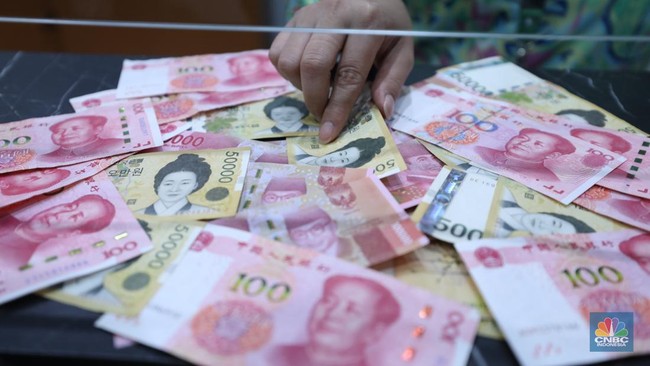
Asian currencies moved mixed against the United States (US) dollar this morning, following the announcement of US inflation data that eased market concerns about an imminent interest rate hike by the US central bank (The Federal Reserve/The Fed).
Citing Refinitiv data in trading on Thursday (13/8/2026) at 09.12 WIB, out of 10 Asian currencies, four currencies strengthened against the US dollar. Meanwhile, three currencies weakened and three others were stagnant.
The South Korean won became the currency with the sharpest strengthening in Asia this morning. The won strengthened 0.22% to KRW 1,415/US$.
The Taiwan dollar followed with a 0.17% increase to TWD 32.162/US.TheVietnamesedongalsostrengthened0.06, while the Japanese yen rose slightly by 0.02% to JPY 159.39/US$.
On the other hand, the rupiah became the currency with the deepest pressure in Asia this morning. The Garuda currency weakened 0.08% to Rp17,880/US$. This depreciation occurred after the rupiah closed 0.20% weaker in the previous trading session, marking a two-day losing streak.
The Malaysian ringgit also corrected 0.02% to MYR 4.084/US$, while the Singapore dollar edged down 0.01%.
Meanwhile, the Chinese yuan, Thai baht, and Philippine peso were observed to be stagnant. The yuan was at CNY 6.743/US, thebahtatTHB33.09/US, and the peso at PHP 61.210/US$.
The movement of Asian currencies this morning occurred amid a US dollar that still tended to move in a limited range. The US dollar index (DXY) at the same time was observed to have edged up 0.04% to 99.974.
Although the DXY strengthened slightly this morning, pressure on the US dollar had emerged after US consumer inflation data for the July period came in line with economists’ expectations. The data eased concerns that hot inflation could revive expectations of a Fed rate hike in the near term.
In the 12 months to July, the US consumer price index or CPI rose 3.4%, lower than June’s 3.5% increase. Meanwhile, core CPI rose 2.5% year-on-year, slowing from 2.6% in June.
The more controlled inflation data caused the market to again trim expectations of a Fed rate hike in September. Fed funds futures now price in a 40% chance of a rate hike at the 15-16 September meeting, down from 44% before the CPI data was released and 55% the previous week.
Marc Chandler, chief market strategist at Bannockburn Global Forex, assessed that the US dollar began to weaken after the CPI release because the market slightly lowered the probability of a Fed rate hike. “We got a little dollar weakness after the CPI. It seems the market slightly lowered the odds of a rate hike in September,” Chandler said.
Previously, pressure on rate hike expectations also came from US labour data. The jobs report showed a weakening labour market, causing market participants to begin doubting the chances of the Fed raising interest rates in the near term.
On the other hand, oil prices remain a concern. Oil prices rose in volatile trading after attacks on two vessels again heightened fears of supply disruptions from the Middle East. Talks to end the Iran war were also reported to remain at an impasse.
The rise in oil prices means inflation risks have not completely disappeared. Therefore, although the CPI data eased market concerns, the direction of the US dollar and Asian currencies will still depend heavily on inflation developments, energy prices, and future Fed policy expectations.