
Diverging Fortunes for Asian Currencies: Rupiah Most Miserable, Yuan and Yen Smile
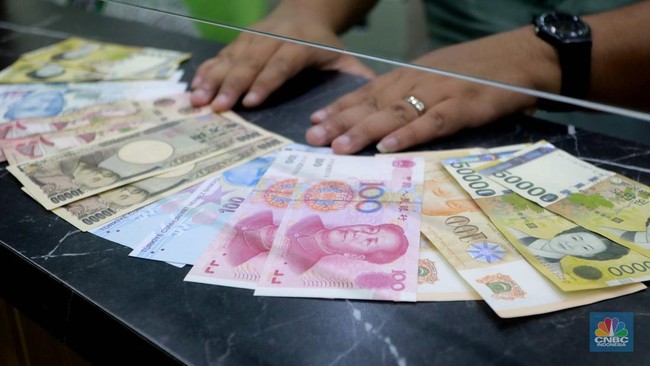
Asian currencies moved in mixed directions against the United States dollar in trading on Thursday. The rupiah was the currency under the deepest pressure, once again breaching the psychological level of Rp18,000/US$.
Referring to Refinitiv data as of 09.15 Western Indonesia Time, six out of ten Asian currencies were under pressure from the US dollar, three currencies strengthened, and one currency was stagnant.
The rupiah was the most pressured in early trading this morning. The Garuda currency weakened 0.47% to a position of Rp18,075/US.ThispositionputstherupiahbackabovethepsychologicallevelofRp18, 000/US.
Pressure was also seen on the Thai baht, which weakened 0.12% to THB 33.48/US, followedbythePhilippinepeso, whichfell0.08. The Taiwan dollar also corrected 0.07% to TWD 32.057/US.Meanwhile, theSouthKoreanwonandtheMalaysianringgitbothedgeddown0.02 and MYR 4.075/US$, respectively.
On the other hand, the Chinese yuan and the Singapore dollar were the currencies with the largest gains in Asia this morning. Both rose 0.09% against the US dollar. The yuan was at CNY 6.796/US, whiletheSingaporedollarwasatSGD1.292/US. The Japanese yen also managed to strengthen 0.08% to JPY 162.46/US.TheVietnamesedongmovedstagnantlyatVND26, 294/US.
Meanwhile, the US dollar index, which measures the greenback’s strength against six major world currencies, was observed weakening slightly by 0.01% to 100.977. Despite the slight decline, the DXY position remained in a high area, near the 101 level.
The movement of Asian currencies this morning was influenced by the minutes from the Federal Open Market Committee meeting. The minutes showed that US central bank officials remain divided on the future direction of interest rates. Some Fed officials assessed that inflation has the potential to ease, allowing interest rates to be cut. However, others predicted that price pressures will persist, meaning interest rates might actually need to be raised.
The FOMC meeting on 16-17 June 2026 was the first meeting under the leadership of Fed Chair Kevin Warsh. At that meeting, the Fed agreed to maintain the benchmark interest rate in the range of 3.50%-3.75%. The FOMC minutes noted that many meeting participants expected the appropriate interest rate at the end of the year to be around the current level or slightly lower. However, many other participants actually assessed that interest rates should be above the current level.
The Fed also stressed that its next decision will be highly dependent on incoming economic data, especially inflation developments. Fed officials expect inflation to remain high in the short term. This pressure comes from the impact of President Donald Trump’s import tariffs, the war with Iran, and rising energy prices. However, inflationary pressures are expected to ease gradually if the impact of tariffs begins to fade, energy prices return to normal, and supply chains recover after disruptions in the Strait of Hormuz. Even so, the majority of meeting participants still assess that inflation risks are tilted to the upside. This condition means the market is not yet fully convinced that the Fed will soon loosen its monetary policy.
Source: jawawa.id (https://jawawa.id/newsitem/diverging-fortunes-for-asian-currencies-rupiah-most-miserable-yuan-and-yen-smile-1783569062)
Originally published by CNBC Indonesia (https://www.cnbcindonesia.com/research/20260709091906-128-749360/beda-nasib-mata-uang-asia-rupiah-paling-sengsara-yuan--yen-tertawa), translated from Indonesian