
Diverging Fates for Asian Currencies: Rupiah and Ringgit Tumble, Yen Strengthens
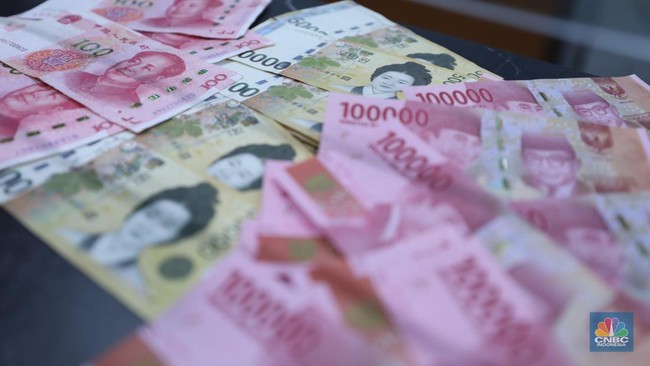
Most Asian currencies weakened against the US Dollar in Thursday trading. Pressure continues to shadow the regional foreign exchange market, even though the US Dollar Index moved slightly lower this morning.
According to Refinitiv as of 09:15 WIB, six Asian currencies were observed to weaken against the greenback, while four currencies managed to strengthen. The Rupiah was among the pressured currencies, declining 0.11% to a position of Rp17,970/US.ThispositionbringstheRupiahclosertothepsychologicallevelofRp18, 000/US, despite having opened at Rp17,925/US$, an increase of 0.14%.
The deepest pressure this morning was experienced by the South Korean Won, which weakened 0.34% to KRW 1,527.47/US.TheVietnameseDongfollowedwithacorrectiontoVND2′26, 314/US, depreciating by 0.19%. The Taiwan Dollar also weakened 0.14% to TWD 31.711/US, whiletheMalaysianRinggitcorrectedslightlyby0.05. Meanwhile, the Chinese Yuan weakened slightly by 0.03% against the US Dollar.
On the other hand, the Thai Baht was the sharpest improver in Asia, rising 0.15% to THB 32.90/US.TheSingaporeDollarandPhilippinePesobothstrengthenedby0.04 and PHP 61.30/US$ respectively. The Japanese Yen also rose slightly to JPY 160.46/US$, an increase of 0.03%.
The US Dollar Index (DXY), which measures the strength of the greenback against six major world currencies, was observed to be weakening slightly by 0.04% to 99.912. Despite this decline, the US Dollar remains near the 100 level, meaning pressure on Asian currencies has not yet fully subsided.
US Dollar movements continue to be influenced by two major sentiments: geopolitical tensions in the Middle East and the direction of US central bank (The Federal Reserve) interest rate policy. The US Dollar experienced volatility after new US attacks in the Middle East weighed on market sentiment. The foreign exchange market tends to move within limited ranges this week as investors weigh the fragility of the Middle East ceasefire amidst renewed clashes between the US and Iran.
The US military stated that the United States began a new round of attacks on Iran on Wednesday night local time. US President Donald Trump also promised to carry out more attacks if a peace agreement is not reached.
Furthermore, US inflation data has become a primary focus for the market. The US Consumer Price Index (CPI) rose 4.2% annually in May, marking the largest increase since April 2023. This rise in inflation has caused investors to become more cautious regarding the direction of Fed policy. However, core inflation pressure remains relatively more controlled, with Core CPI recorded at a monthly increase of 0.2%, lower than the 0.4% increase in April.
James Knightley, head of international economics at ING, assessed that cooling wage pressures could help alleviate core inflation. “This should help keep inflation expectations under control. So, while we no longer expect the Fed to cut interest rates this year because economic momentum is improving, we also do not expect an interest rate hike,” Knightley said, as quoted from Reuters.
Nevertheless, market participants have now fully priced in the possibility of a 25 basis point interest rate hike in December. This represents a sharp change from previous expectations, when the market still anticipated two rate cuts this year before the Iran war broke out in late February.
For Asian currencies, the combination of geopolitical uncertainty, high US inflation, and expectations regarding Fed interest rates leaves limited room for appreciation. This is evident from the fact that the majority of regional currencies were still moving weaker against the US Dollar this morning.