
Ditjenpas Prepares 968 Locations for Social Work Penalties
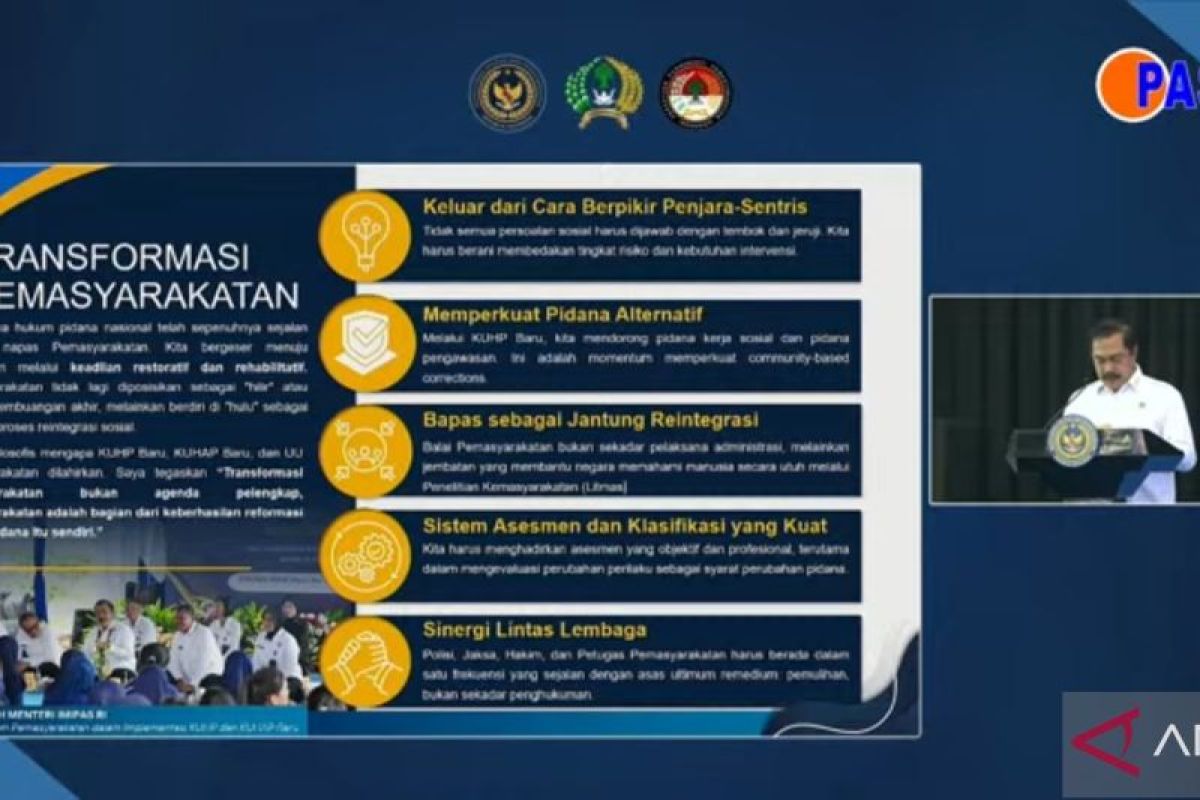
Jakarta (ANTARA) - The Directorate General of Corrections (Ditjenpas) has prepared 968 locations for the implementation of social work penalties as a follow-up to the enactment of the new Criminal Code (KUHP) and Criminal Procedure Code (KUHAP). Minister of Immigration and Corrections Agus Andrianto stated that the preparation of these locations for social work penalties represents a strategic step by Ditjenpas in welcoming the new paradigm of national criminal law. “Ditjenpas has prepared 968 locations for the implementation of social work penalties, supported by 1,808 partners through 719 cooperation agreements across Indonesia,” Agus said in his opening remarks at the National Corrections Seminar titled “Transformation of the Corrections System in the Implementation of the New KUHP and KUHAP,” held in a hybrid format at the Auditorium of the Indonesian Immigration and Corrections Polytechnic in Tangerang, attended online from Jakarta on Wednesday. Based on Article 85 of Law Number 1 of 2023 on the KUHP, social penalties may be imposed on defendants facing imprisonment of less than five years. The three-star police general explained that the changes to the national criminal law (New KUHP-KUHAP) are not merely regulatory adjustments on paper but a paradigm revolution. He also stated that the implementation of the New KUHP and KUHAP aligns with the transformation of corrections, shifting towards recovery through restorative and rehabilitative justice. Corrections, he said, is no longer positioned as the downstream or final disposal site but stands upstream as the cornerstone of the social reintegration process. The former Deputy Chief of Police emphasised that the transformation of corrections is not a supplementary agenda but an integral part of the success of criminal law reform itself. He added that the corrections transformation is carried out with a primary focus on moving away from prison-centric thinking. “Not all problems must be answered with walls and bars; we must dare to differentiate levels of risk and intervention needs,” Agus said.