
Dissenting Opinion Argues Nadiem Makarim Should Be Acquitted in Chromebook Graft Case
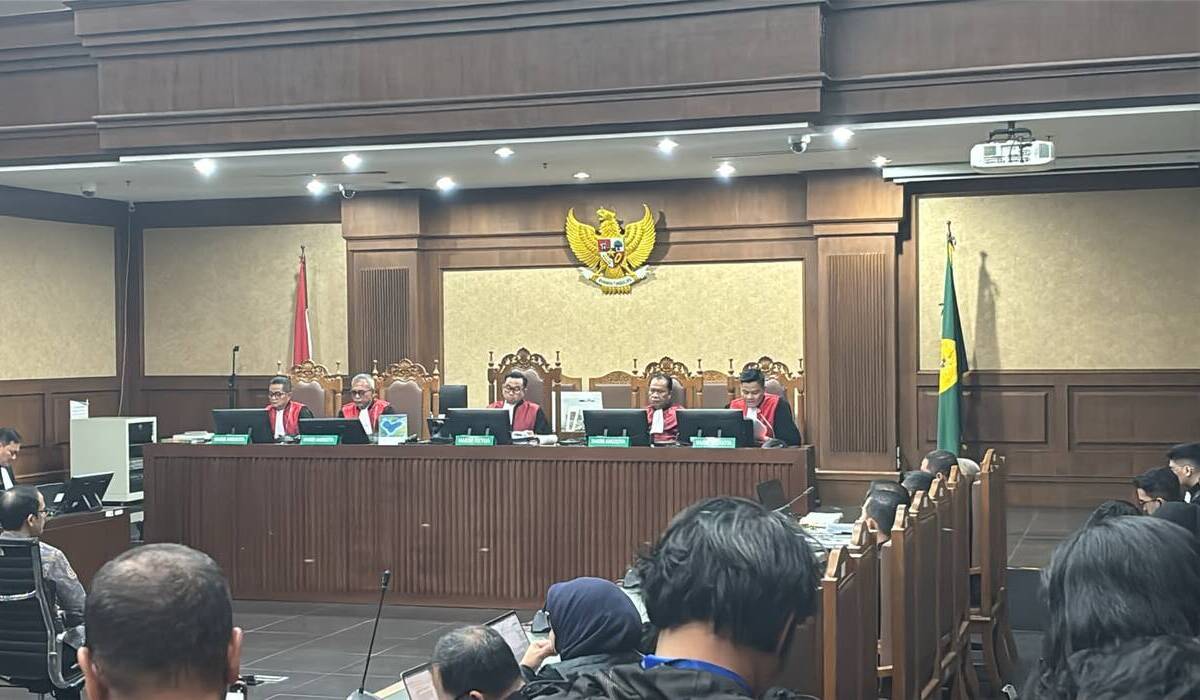
One of the five members of the Jakarta Central Corruption Court panel hearing the Chromebook corruption case against former Education, Culture, Research, and Technology Minister Nadiem Makarim delivered a dissenting opinion. Judge Andi Saputra argued that Nadiem should be acquitted because there was insufficient evidence to prove criminal intent (mens rea) or an unlawful act (actus reus) as charged by prosecutors. ‘From the series of facts compiled based on the evidence presented in court, a perfect causal conclusion cannot be drawn that there was criminal intent on the part of the defendant as a minister to commit an unlawful act,’ Andi said during the verdict hearing in Jakarta on Tuesday (30/6/2026).
According to Andi, Nadiem’s act of signing Minister of Education Regulation Number 5 of 2021, which formed part of the indictment, could not yet be categorised as an unlawful act. He assessed that the regulation did not lock in the use of a specific brand for the technology procurement but merely regulated the operating system. ‘The act of signing the ministerial regulation is not yet strong and conclusive as a criminal act. The regulation does not lock in a specific brand, but rather locks in the operating system,’ he stated.
Furthermore, Andi noted that the trial found no evidence of a criminal conspiracy between Nadiem and the other defendants, namely Ibrahim Arief, Sri Wahyuningsih, and Mulyatsyah. ‘Until the end of the trial, no conclusive evidence was found of a criminal conspiracy between the defendant Nadiem and the other defendants,’ he said. Judge Andi also assessed that there was no proof Nadiem ordered his subordinates to commit corruption or intervened in the procurement process. ‘The defendant Nadiem never explicitly or implicitly instructed Ibrahim, Mulyatsyah, and Sri to commit corruption. Moreover, the defendant was not proven to have intervened directly or indirectly with the procurement committee,’ he added.
The dissenting judge also highlighted conversations in a WhatsApp group created before Nadiem was inaugurated as minister. He considered that the content of these conversations could not be used as evidence of a criminal conspiracy. He argued that the discussions were merely about policy plans if Nadiem were indeed appointed as minister, and thus could not be qualified as a ‘meeting of minds’ or preparatory acts for a crime. Andi also rejected the notion of a causal link between the Chromebook procurement policy, state losses, and Google’s capital injection into PT GoTo. ‘These three events do not have a strong causal relationship indicating criminal conduct, a conflict of interest, or influence peddling by the defendant,’ he said. Based on all these considerations, Andi stated that Nadiem should be acquitted of all charges. ‘Because the defendant has not been legally and convincingly proven guilty of committing the acts as charged, the defendant Nadiem Anwar Makarim must be acquitted of all charges by the public prosecutor,’ he said.
However, this opinion was a dissenting opinion. The majority of the panel of judges found Nadiem proven guilty of jointly committing corruption in the procurement of Chromebooks and Chrome Device Management (CDM). In its ruling, the panel sentenced Nadiem to 10 years in prison, a fine of Rp1 billion, subsidiary to 190 days of confinement, and ordered him to pay restitution of Rp809 billion. If the restitution is not paid, it will be replaced with an additional five years in prison. Previously, prosecutors had sought a prison sentence of 18 years, a fine of Rp1 billion, subsidiary to 190 days of confinement, and restitution of approximately Rp5.68 trillion.