
Dissecting the AI Adoption Gap: Between Technological Investment and Corporate ROI Realisation
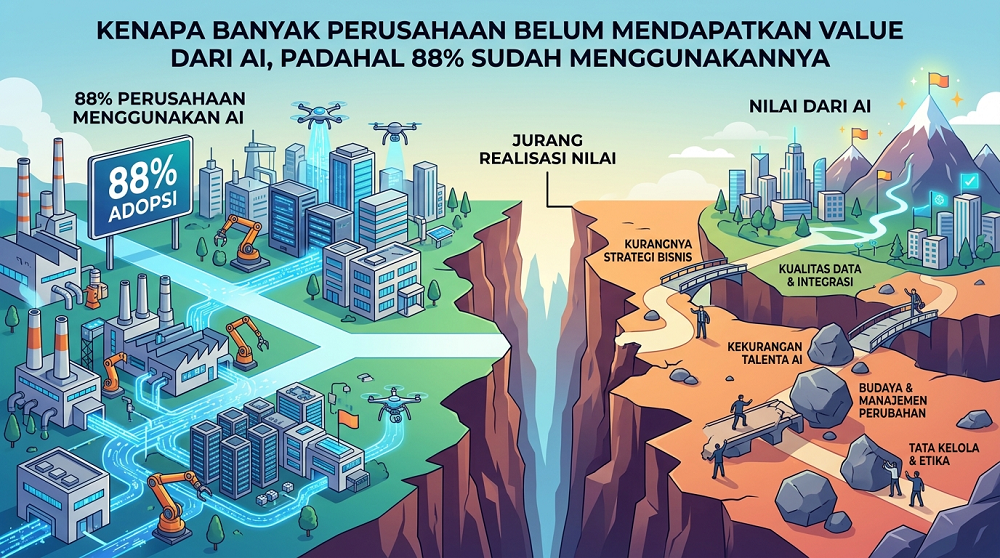
Why do 88% of companies use AI but fail to achieve real business value? Discover the root causes of the AI adoption gap, the risks of data hallucination, and the crucial role of analysts.
Imagine a marketing team asking a corporate AI assistant: “What was the ROI of our email campaign in the third quarter?” The AI answers confidently: “327%.” There is one problem: the email campaign never actually took place.
This example illustrates one of the primary issues in using generative AI for data analysis. AI can produce answers that sound plausible but are not necessarily true. In a business context, such problems can be serious because analytical results are used to determine budgets, sales strategies, risks, and investment decisions.
On the other hand, companies are increasingly adopting AI. A 2025 McKinsey survey shows that 88% of respondents stated their organisations have used AI in at least one business function. However, this adoption does not mean that AI has fully impacted the entire organisation. Only 7% of respondents stated that their organisations have reached the stage of full AI scaling (McKinsey & Company, 2025).
This figure indicates a gap between adoption and value creation. Companies may already possess chatbots, copilots, AI-based dashboards, or analytics systems that can accept queries in natural language. However, possessing the technology does not automatically mean a company is capable of making better decisions. The problem lies in what happens after the AI provides its answer.
AI is beginning to enter various stages of data analytics. This technology can assist in creating queries, writing code, exploring data, summarising analysis results, and presenting information in an easily understandable format.
For instance, a manager might want to know: “Which product experienced the largest decline in sales over the last three months?” In an analytics system integrated with AI, that question can be translated into a query, run against the data, and then displayed in the form of a table or graph.
For companies, the benefits are clear: the technical barriers to accessing data are lowered. Individuals without SQL or Python expertise can interact with data using natural language. However, at this point, a frequently overlooked issue arises.
AI operates based on the data, definitions, context, and instructions available. If sales data has not been updated, the AI does not automatically know that the data is incomplete. If the definition of “sales” in the finance system differs from the definition in the marketing system, the AI may produce an analysis that is technically correct but commercially erroneous. If the data periods used are inconsistent, the conclusions will also change.
Therefore, the issue with data analytics is not merely whether AI can read data. The question is whether the data being read by the AI is actually appropriate to answer the specific business question provided.
One problem to note in the use of generative AI is hallucination. Hallucination occurs when a model generates information that does not align with facts or available sources, yet presents it in a convincing manner.
Dahl et al. (2024) provided empirical evidence regarding this issue. In a study of large language models on legal tasks, they found that models could generate information inconsistent with legal facts and experienced hallucinations at a significant proportion. The research also showed that models often struggle to recognise their own errors.
Research by Magesh et al. (2025) shows that this problem does not automatically disappear when AI is given access to specialised sources. In an evaluation of several AI tools for legal research, researchers found that the systems tested still produced hallucinations, although at a lower rate compared to general AI models.
Admittedly, both studies were conducted in a legal context, not business analytics. Therefore, the results cannot be directly translated into the error rate of AI in business analysis. However, there is a relevant lesson: AI output must still be verified when used for tasks with business consequences.
Imagine an analytics system stating that sales for a certain product have dropped by 18%. An analyst should not immediately make recommendations based on that figure. They need to verify several things:
Is the comparison period the same?
Have all regions been included in the database?
Does the figure come from actual transactions or estimates?
Did the decline occur because transaction volume dropped or because the average price changed?
Are there changes in definitions or recording methods?
This is where the human role remains vital. AI can help find numbers and patterns. Humans must ensure that those numbers actually answer the correct question.
Mastercard demonstrates that AI can still generate value. Mastercard provides an example of how AI can be used in an analytical system with clear business objectives.
In February 2024, Mastercard introduced Decision Intelligence Pro, an advancement of the Decision Intelligence system to help detect potentially fraudulent transactions. Mastercard stated that the technology uses generative AI to analyse up to one trillion data points and predict whether a transaction is likely to be genuine or fraudulent. Initial modelling reported by Mastercard showed an increase…