
Discussion on PP TUNAS at UI Highlights Importance of Child Protection in Digital Spaces
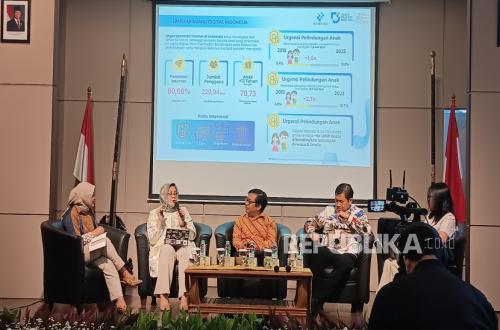
REPUBLIKA.CO.ID, DEPOK — Age restrictions on social media in the Government Regulation on the Governance of Electronic Systems in Child Protection, or PP TUNAS, were a key topic in a discussion at the University of Indonesia’s Faculty of Social and Political Sciences on Thursday (7/5).
The forum, titled “Assessing the Edge of PP TUNAS”, brought together officials from the Ministry of Communication and Digital Affairs, academics, cyber activists, and students to discuss child protection in the digital realm, from age restrictions and platform algorithms to social media oversight.
Dean of the Faculty of Social and Political Sciences UI, Prof. Evi Fitriani, stated that the development of digital technology brings great benefits but also presents new challenges for children.
“Technology provides democratisation of information. But it also brings forth much harm,” said Evi.
According to her, campuses need to become open spaces to discuss the social impacts of internet development and to strengthen public awareness regarding child protection in the digital space.
Legal Staff Expert from the Ministry of Communication and Digital Affairs, Cahyaning Nuratih Widowati, said that the internet has now become part of children’s daily lives, so the state must be present to ensure that the digital space remains safe for them.
She mentioned that based on a survey by the Indonesian Internet Service Providers Association for 2024–2025, the number of internet users in Indonesia reaches more than 221 million people, with around 88 million of them being children.
“Without strong legal fences, children play without supervision. The state must be present to protect children,” said Cahyaning.
According to her, PP TUNAS was drafted as an effort to strengthen child protection from various digital risks such as pornography, data exploitation, cyber grooming, and social media addiction.
In the regulation, children under 13 years of age are restricted from having general social media accounts, while those aged 13 to 15 are directed to low-risk digital services. Users aged 16 to 17 still receive supervision when accessing high-risk platforms.