
Discussing Regional ASN Salaries, Here Are the Results of the Meeting Between Purbaya, PANRB, and the Home Affairs Minister
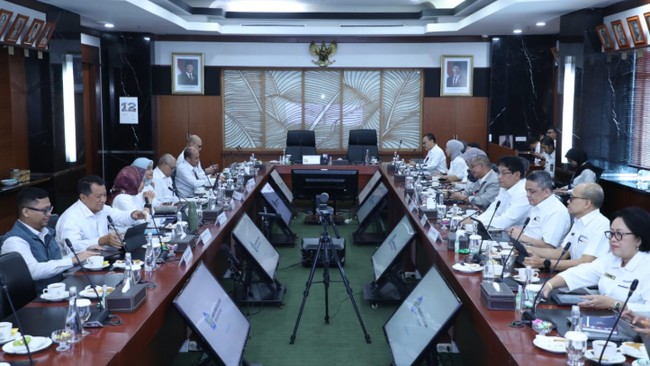
Minister for State Apparatus Utilisation and Bureaucratic Reform (PANRB) Rini Widyantini held a special meeting with Finance Minister Purbaya Yudhi Sadewa and Home Affairs Minister Tito Karnavian regarding the regulatory certainty of salaries for regional ASN in the Government Employee with Work Agreement (PPPK) category.
This meeting follows up on the recommendations of Commission II of the DPR RI from the Working Meeting on 31 March 2026, related to the implementation of Article 146 of Law No. 1 of 2022 on Financial Relations between the Central Government and Regional Governments (HKPD), which mandates regions to allocate a maximum of 30% of the APBD for employee expenditure, with a five-year transition period since its enactment on 5 January 2022.
From the results of the Ministerial Level Meeting (RTM) on Regional Personnel and Financial Management held at the Ministry of PANRB Office on Thursday (7/5/2026), it was decided that the provisions of Article 146 of the HKPD Law will also be regulated through the State Budget (APBN) Law.
Minister PANRB Rini Widyantini explained that this decision is based on the government’s efforts to ensure that the management of human resources for the apparatus continues to run well without disrupting regional fiscal sustainability and the quality of public services.
“Today, we, together with the Home Affairs Minister and the Finance Minister, are following up on the HKPD Law, especially regarding the 30% maximum employee expenditure provision from the APBD. The government assures there will be no mass layoffs of PPPK,” said Rini in a press release, quoted on Friday (8/5/2026).
Meanwhile, Home Affairs Minister Muhammad Tito Karnavian stated that the meeting produced concrete solutions to quell concerns in the regions and among PPPK circles.
“I know that many regions are currently worried about the possibility of violating Article 146 of the HKPD Law, and some regions are even planning to stop PPPK. With this meeting, we have found the solution. The transition period for implementing the 30% provision will be extended and regulated through the APBN Law,” he emphasised.
He explained that regulation through the APBN Law has legal force equivalent to the HKPD Law. “We apply the principle of lex posterior derogat legi priori, meaning the newer law overrides the previous one. That means regional heads no longer need to worry,” he said.
Tito added that the main message to be conveyed to regional heads is reassurance. “That means regional heads no longer need to worry. If there are regions where employee expenditure exceeds 30% of the APBD, it will refer to the APBN Law which will be coordinated by the Finance Minister,” said Tito.
Furthermore, Tito explained that the central government will also provide development programme support for regions with high employee spending ratios to ensure public services continue optimally.
“For regions with high employee expenditure, we, together with the Finance Minister, will design programmes for the benefit of the community in those regions to be implemented by central government ministries and agencies. That means, even if employee spending is high, development activities and programmes for the community will continue, backed by the central government. This will reassure the public,” he elaborated.
Finance Minister Purbaya Yudhi Sadewa expressed full support for the framework of the solution that has been formulated together.
“I fully support what was stated by the Home Affairs Minister and the PANRB Minister. The Ministry of Finance will ensure that the APBN Law instrument can provide legal certainty for the regions and job certainty for PPPK, while maintaining national fiscal balance,” he said.
As a follow-up, the three ministries will issue a joint circular to regional governments in the near future as technical guidance. In addition, a policy framework for future civil servant recruitment will be prepared that is more calibrated with regional fiscal capacity and organisational needs of the government.