
Disaster Strikes in China: Many Young Graduates with 'Rotten Tails'
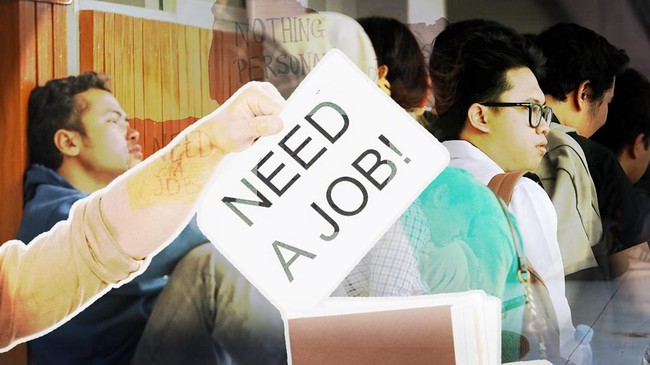
A distressing situation is currently unfolding among China’s younger generation. Increasing numbers of them are struggling to secure employment aligned with their field of study.
This was revealed in a CNA report from 2025 titled “Why Are So Many Young Graduates Unemployed in China”.
Many job seekers interviewed by CNA at the Lishuiqiao job fair in Beijing admitted to difficulties in finding roles relevant to the expertise they acquired at university.
“I see the prospects as quite bleak; the job market is quiet, so I’ve given up pursuing certain positions,” said Hu Die, a 22-year-old job seeker and design graduate from Harbin University of Science and Technology, to CNA, as quoted on Sunday (10/5/2026).
Li Mengqi, a 26-year-old chemical engineering graduate from Shanghai Institute of Technology, has been unemployed for eight months since graduating.
The reason is the same: she couldn’t find work matching her major from university.
Chen Yuyan, 26, a 2022 graduate of Guangdong Food and Drug Vocational College, has even ended up working as a package sorter at a courier agency branch.
She said that despite her vocational education, it’s difficult for her to obtain jobs with sufficient salary standards. This is because many vacancies list challenging requirements.
“Many companies seek candidates with experience—people who can start working immediately. As fresh graduates, we don’t have enough experience. They often say they lack resources to train new employees, and the offered salaries are very low,” Chen stated.
China’s Labour Market Crisis
Zak Dychtwald, founder of the Shanghai-based think tank Young China Group, said what is happening to Li, Hu, and Chen illustrates the labour market crisis in China for its youth, who hope to pursue careers in their field of expertise.
“One of the biggest problems right now is the mismatch between the hard work they put in during university and the jobs awaiting them after graduation,” Zak Dychtwald said.
Zhou Yun, assistant professor of Sociology at the University of Michigan, observed that while graduates from elite schools and automation or AI majors are in demand, scholars still struggle to secure jobs matching their skills due to rising competition in the job market.
“Industries that have traditionally been major absorbers of university graduates, such as internet startups and education, have also shrunk in recent years. So, there are deep structural reasons behind it,” he said.
The deteriorating job market in China has given rise to the term “rotten tail kids” to describe young graduates forced to work low-wage jobs and rely on their parents because they can’t get employment matching their education. This term is borrowed from “rotten tail buildings,” stalled housing projects that have become an economic burden in China since 2021.
Eli Friedman, professor of Global Labour and Work at Cornell University, highlighted a cultural shift affecting young people’s attitudes towards work.
Threat to Economic Stability
Unlike their parents’ generation, today’s young graduates are more reluctant to accept low-quality or unstable jobs, even amid economic pressures. They are also unwilling to start small businesses to develop their ventures.
“If you’re 22 or 23 years old and just graduated from university in China right now, I don’t think you’d want to sell small items on the street, save up, and use that to start a small business. Culturally, I think that’s no longer the path chosen by most people,” Friedman said.
This shift in attitude has given birth to the term “lying flat” or tangping in Mandarin, when young people choose to withdraw from hyper-competitive work environments. Some youth are reluctant to “take any available job” due to growing disillusionment with the traditional career development model, according to Friedman.
Zhou from the University of Michigan highlighted the profound psychological impact of prolonged unemployment, especially among graduates who were previously promised stable futures.
“The inability to get a job not only creates economic uncertainty but also strips away dignity and life purpose. For graduates, this shatters the narrative they’ve long believed—that education would provide a better life,” he said.
This year, the number of university graduates in China will reach a record 12.22 million, up from 9 million in 2021. The Chinese government has acknowledged that solutions to the employment challenges in the country are urgently needed.
“The mismatch between the supply and demand of human resources is becoming more pronounced,” said China’s Minister of Human Resources and Social Security, Wang Xiaoping, at a press conference on 9 March during the annual Two Sessions meetings.
The 2025 China Government Work Report details plans to address youth unemployment, emphasising the expansion of job opportunities, more targeted financial assistance, and new support for entrepreneurship.
Specific measures proposed include refunding unemployment insurance premiums, tax and fee reductions, job subsidies, and direct support for labour-intensive industries.
China has set a target to create more than 12 million new urban jobs this year, as outlined in the Government Work Report at the Two Sessions.
Despite the record number of graduates entering the job market this year, China still faces a shortage of skilled labour, particularly in the manufacturing sector.
According to a China Daily report on Ju