
Disaster Rehabilitation Task Force Accelerates Social and Economic Recovery for Affected Communities
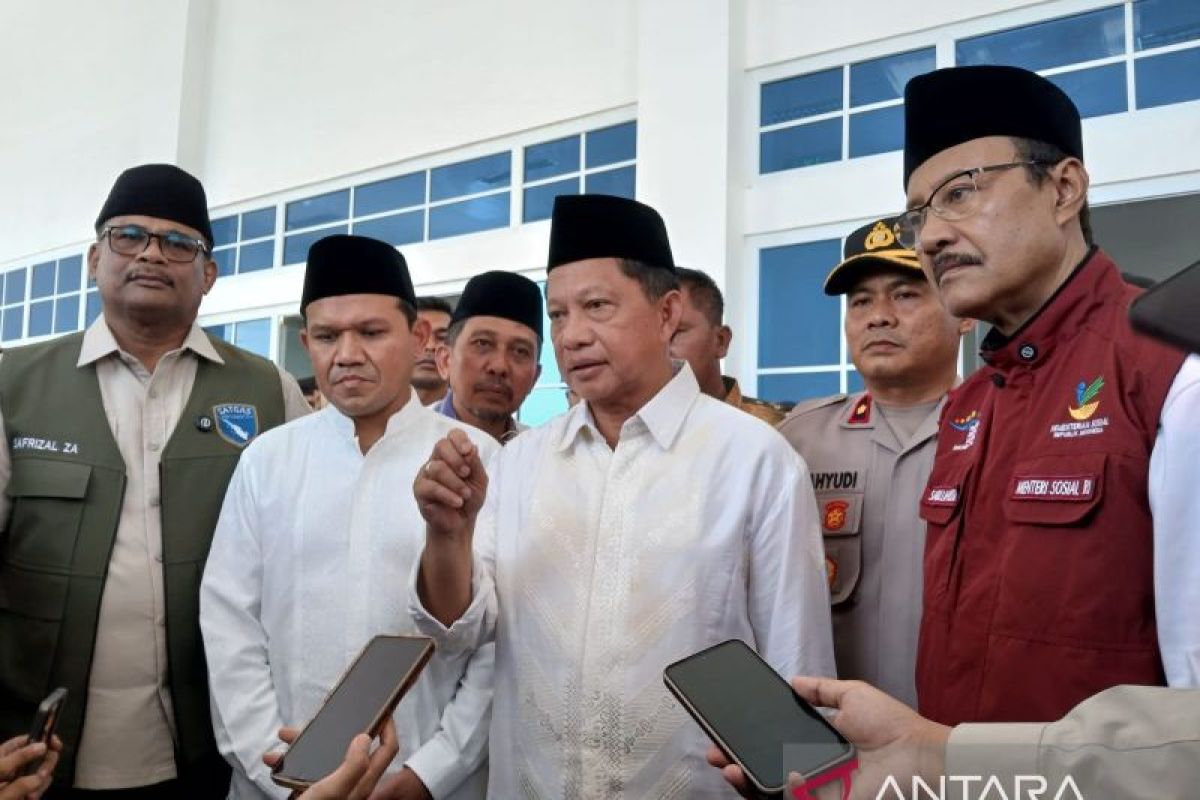
Jakarta — Indonesia’s Acceleration of Rehabilitation and Reconstruction Task Force (Satgas PRR) has stated that post-disaster response efforts in Aceh, North Sumatera (Sumut), and West Sumatera (Sumbar) are also focused on accelerating social and economic recovery for affected communities.
Social Minister Saifullah Yusuf, speaking in Jakarta on Monday, stated that the government has prepared various assistance schemes for disaster-affected communities, ranging from temporary shelter provision to family economic recovery assistance.
Following the emergency phase, the government then prepares housing for evacuees, either in the form of temporary shelter (huntara) or permanent housing (huntap).
“Following that, we prepare temporary shelter for those in evacuation centres or move directly to permanent housing,” said Saifullah.
He noted that given the considerable scale of the disaster and its coverage across multiple provinces, response efforts are not undertaken by a single institution alone.
“Typically, the National Disaster Management Agency (BNPB) handles such matters. However, because the scale is wide and significant, the President, through the Interior Minister as Task Force Chair, has assigned many agencies to be involved,” he said.
Several ministries and agencies, including state-owned enterprises and the Ministry of Public Works, are also involved in assisting the construction of temporary and permanent housing for affected communities.
He stated that in its implementation, there may be differences in facility standards as the government seeks to provide decent housing as quickly as possible to evacuees.
“Rather than keeping communities in evacuation tents for too long, it is better to move them quickly to temporary shelter. If there are shortcomings in temporary housing, these can be corrected or adjusted later,” he said.
In addition to shelter provision, the government is also preparing assistance for families occupying temporary and permanent housing. This assistance takes the form of household goods valued at Rp3 million for each family, assuming that most of the disaster victims’ household equipment has been lost or damaged.
The government is also providing economic stimulus assistance of Rp5 million per family to help communities restart their lives after the disaster.
Additionally, during their stay in temporary shelter, the government provides living allowance assistance for purchasing side dishes amounting to Rp15,000 per person per day for three months.
“So each person receives Rp450,000 per month for food needs, provided for three months,” he said.
He stressed that one of the most important factors in disaster response is the accuracy of data on affected victims. For this reason, local governments have been asked to conduct detailed data collection in cooperation with the National Disaster Management Agency (BNPB).
“Those who best understand community conditions down to the village level are regents and mayors, so data collection must be carried out by local governments,” he stated.