
Disaster Looms as Himalayan Mountain City Begins to Sink
Every summer, millions of Indian residents flock to the Himalayan mountains. When temperatures in the plains reach extreme levels in May, hill stations such as Shimla become mass escape destinations. Cool air, pine forests, snow-capped peaks, and old colonial landscapes act as magnets for India’s growing domestic tourism year on year.
Unfortunately, Shimla now faces a far more serious problem than tourism congestion.
According to The Economist, the city, which once served as the summer capital of British colonial government, is slowly experiencing physical pressure due to uncontrolled construction that has occurred for decades. Narrow roads originally built for horse-drawn carriages are now packed with approximately 26,000 vehicles per day. Steep slopes are filled with homestays and small hotels built tightly together, standing flush against cliff sides.
During the British colonial era, Shimla’s population was only around 25,000 people. Today, the city receives approximately 2.7 million tourists annually. This growth has far outpaced the city’s capacity to support its population and vehicles.
Drainage systems, waste management, and road infrastructure are said to have exceeded capacity. Residents have begun observing alarming signs, such as tree roots emerging to the surface, cracks in house walls, and certain areas slowly subsiding due to ground movement.
Many other mountain cities in India’s Himalayan region face similar pressures. States such as Himachal Pradesh, Uttarakhand, and Sikkim have experienced major construction booms in recent years.
India’s central government is promoting large-scale infrastructure projects ranging from new highways to hydroelectric power plants. Construction activity is proceeding aggressively in areas that are geologically fragile.
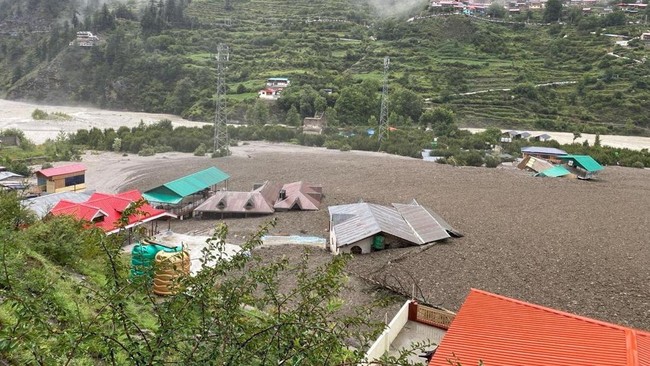
The problem coincides with changing weather patterns in the Himalayan region. Winters have become drier, summers increasingly hot, whilst rainfall patterns have become increasingly unpredictable. When extreme rain occurs, the impact becomes far more destructive because mountain slopes have already lost stability due to development and hillside cutting. Landslides, flash floods, and forest fires have increased over the past decade.
The Himachal Pradesh government has recorded more than 10,500 deaths from disasters such as landslides, flash floods, and forest fires over the past ten years. India’s Supreme Court even warned that the continued practice of development that “slices” through mountains could cause the region to “disappear into thin air”.
Economic pressure puts local governments in a difficult position. Tourism is a primary source of income for many Himalayan regions in India. The Himachal Pradesh government even has a target to triple the number of tourists every year.
The main road into Shimla continues to be widened to accommodate surging vehicle numbers. At the same time, construction regulations that previously limited development in certain areas are being relaxed through the Shimla Development Plan 2041, the city’s first comprehensive development plan in four decades.
Some conservation and disaster mitigation experts are calling for a different approach. They advocate for limiting tourist numbers, implementing tourist taxes, halting new hotel permits, and enforcing stricter building regulations.
The greatest concern stems from the simple fact that the Himalayan region was not designed to support massive urbanisation. When mountain slopes are forced to bear the weight of hotels, highways, vehicles, and millions of tourists simultaneously, the risk of collapse becomes increasingly real.