
Disabled Persons in Brebes Receive Vocational Training
Opportunities for independent living and securing decent employment remain a significant challenge for many people with disabilities in Indonesia, despite their potential to contribute to society. Data from the Central Bureau of Statistics (Barga Pusat Statistik - BPS) indicates that the labour participation rate for people with disabilities remains relatively low. Furthermore, the Ministry of Manpower (Kemnaker) noted that only 702 people with disabilities were placed in jobs through Disability Service Units (ULD) in 2023.
A primary cause is that ULDs are currently only available in 28 provinces, or 73.7% of the total 38 provinces. At the regency/city level, only 179 ULDs exist, representing just 34.82% of the 514 regencies/cities. Consequently, many individuals with disabilities possess skills but face limited access to training and formal employment opportunities, which hinders their economic independence.
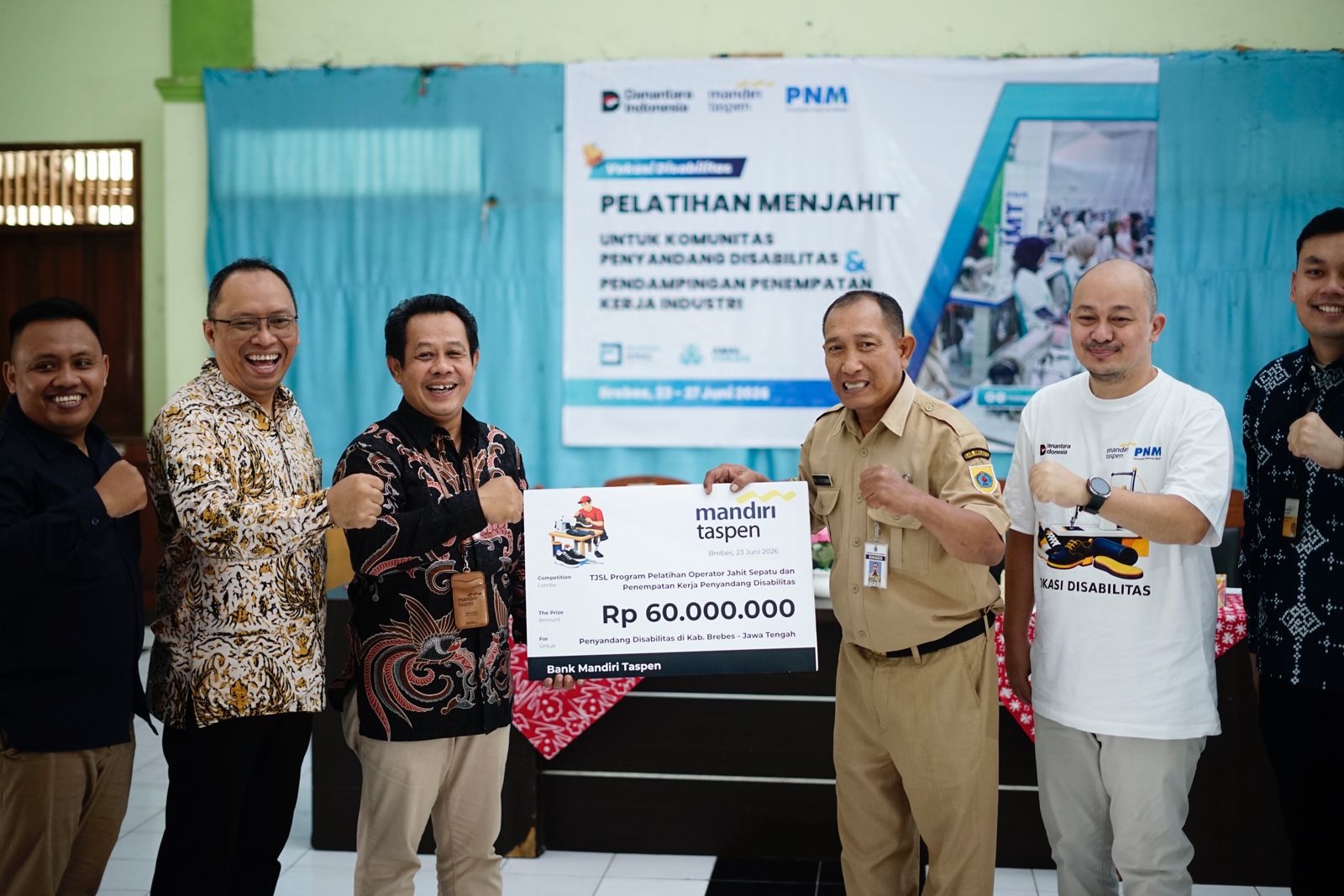
To address these challenges, PT Bank Mandiri Taspen and PT Permodalan Nasional Madani (PNM) Tegal Branch are conducting empowerment efforts to create more equitable access. This spirit serves as the foundation for the Disability Vocational Programme held at the Islamic Centre Building in Brebes over the coming week. This programme is part of a joint effort by both state-owned enterprises to expand opportunities for vulnerable groups to achieve economic independence through relevant skill training.
One goal of this vocational training is to ensure that people with disabilities do not merely remain recipients of aid but can generate their own income through formal employment or entrepreneurship. Additionally, the programme acts as a bridge between labour supply and demand, with Bank Mandandi Taspen and PNM acting as intermediaries. On the supply side, the programme trains participants until they are competent and certified; on the demand side, it connects them to garment or footwear companies in need of operators.
This initiative aligns with the ‘job intermediation’ mission of the Ministry of Manpower’s ULD and supports an inclusive education ecosystem. For Bank Mandiri Taspen and PNM, the programme is a concrete effort to prepare a job-ready workforce, similar to their existing collaboration with Gadjah Mada University (UGM). Thirty participants from the disability community in Brebes and surrounding areas are participating in sewing skills training under a Footwear Operator scheme, facilitated by Ruang Amal Indonesia. Over the course of a week, participants receive technical training tailored to industrial needs.
Agus Suyana, Head of the Bank Mandiri Taspend Pekalongan Branch, stated that this specific training scheme was chosen because the footwear industry in Indonesia, particularly in West Java and Banten, urgently requires skilled labour that can be trained quickly. “Sewing shoes is a specific technical skill with low risk and limited physical movement requirements, making it suitable for people with physical or motor disabilities. We hope that once skilled, they can be immediately absorbed by MSMEs and industries,” Agus said in Brebes, Central Java.
Sutanto, Leader of the PNM Tegal Branch, added that sustainable empowerment must reach all layers of society, including people with disabilities who face barriers to entering the workforce. “Every person has the potential to grow if given the right opportunity and access. Through this programme, we hope participants gain not only skills but also a greater chance to be independent, productive, and improve their quality of life,” Sutanto remarked.
Upon completing the training, participants will undergo a job placement process with footwear companies operating in the Brebes region. This programme aligns with PNM’s long-standing commitment to empowering underprivileged communities. While PNM is widely known for empowering women and micro-entrepreneurs, this initiative expands its scope to provide capacity building for people with disabilities.
For Bank Mandiri Taspen, this effort also serves to reduce social risks within its operational areas, including Brebes. For the participants, the training represents a new hope for a better future. “We often feel that job opportunities are limited. Through this training, we gain new knowledge and the confidence that we are capable of working and contributing. We hope that after this training, we can secure jobs and support our families,” said one participant.
Through this collaboration, Bank Mandandi Taspen and PNM aim to deliver empowerment that leaves no one behind. This vocational programme is expected to be a small step towards significant change, helping participants move towards more independent, productive, and empowered lives.